← On a small screen, scroll the diagram horizontally. →
01 /
Aim and equipment
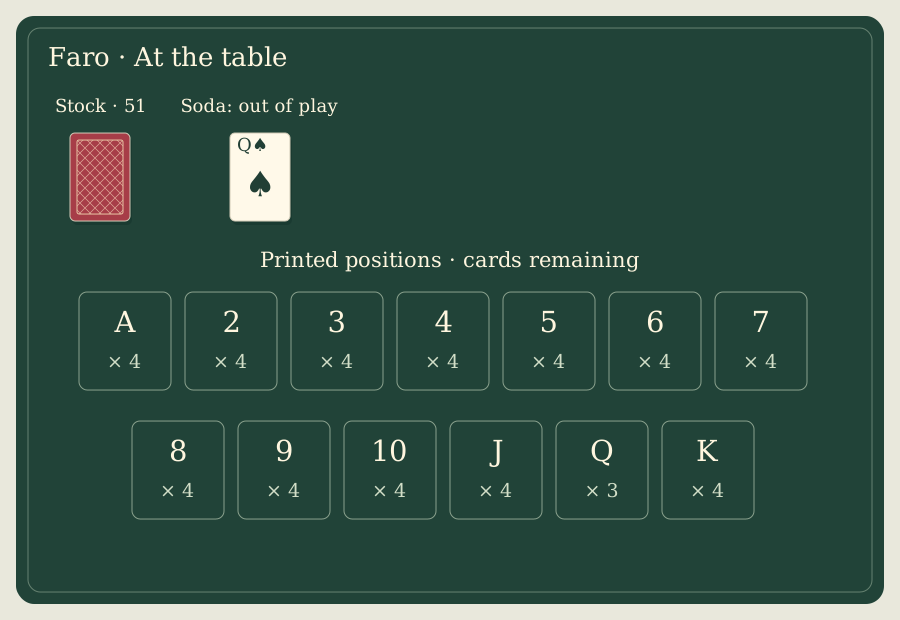
This is the historical banking game in an accounting-points teaching mode, with no cash transactions. From 2 to 10 participants include a banker and other players. Use one 52-card pack without jokers and a reference of 13 ranks A–K; print or draw those labels rather than removing playing cards. Suits do not affect ordinary predictions. This selects single-rank, copper and final calling-the-turn play without additional multi-rank zones.
02 /
Setup and deal
Choose the first banker randomly. Shuffle and cut, reveal the first card as soda and set it aside: it neither wins nor loses. Preserve the order of the other 51. A historical dealing box exposes cards differently, but a tabletop reconstruction may reveal consecutive pairs from a concealed stack in the same order. Everyone starts with balance 0 and negative entries are allowed. There are no player hands or community cards to choose from.
03 /
Legal actions
Before a turn record a rank, a positive even prediction weight and direction: ordinary means win, copper means lose. Even weights permit exact halves without fractions. Multiple predictions are allowed; change or remove them only between turns. The banker’s signal locks entries until the pair finishes. Reveal the first card as loser, then the second as winner. Never compare their ranks: dealing position determines the result.
04 /
Scoring
With different ranks, an ordinary prediction on the first loses its whole weight and one on the second gains the same amount as profit: 1:1. Copper reverses those outcomes. Other ranks remain unresolved with no balance change. Identical ranks form a doublet or split: that rank loses half its weight regardless of copper; others are unchanged. Record net changes only, never add a retained weight again. Banker balance changes opposite to the players’ combined result.
05 /
Counting exposed cards
Keep a public case count: each rank begins with 4 copies; subtract soda and every exposed card. Remove predictions on exhausted ranks without result; our teaching version does not confiscate them. Never recycle cards. After 24 pairs there are 3 left: next loses, next wins, final hock has no ordinary effect. Settle ordinary predictions on the last loser and winner as before; remaining unresolved entries end without change.
06 /
Calling the last three
Before the final three, separately name the exact rank order: loser, winner, hock. Three distinct ranks pay profit 4:1 for a correct call; an incorrect one loses its weight. With a same-rank pair, cat-hop, correct order pays 2:1. If all three share a rank, Foster’s historical profile permits calling their colour order: two share a colour and one differs; correct colour order pays 2:1. Settle these separately from ordinary predictions. Hock is neither a fourth card nor a card removed beforehand.
07 /
Ending the game
After hock all 52 cards are accounted for: soda, 25 losers, 25 winners and hock. Check every remaining case count is zero. For a teaching session everyone banks once; rotate left between packs and reshuffle completely. Highest final balance wins, tied leaders share the result. Accounting weights, no confiscation and session duration are explicit teaching agreements; historical card resolution is preserved.
08 /
Context and variants
Faro is known from historical banking-game accounts. Foster’s checked Complete Hoyle, revised in 1914, details the box, case keeper, splits and final turn. It documents a particular historical code, not a precise invention date. Later implementations handle identical final ranks differently; here we retain Foster’s colour call. Counting exposed cards identifies the remaining composition but cannot guarantee a successful prediction.
09 /
Worked example
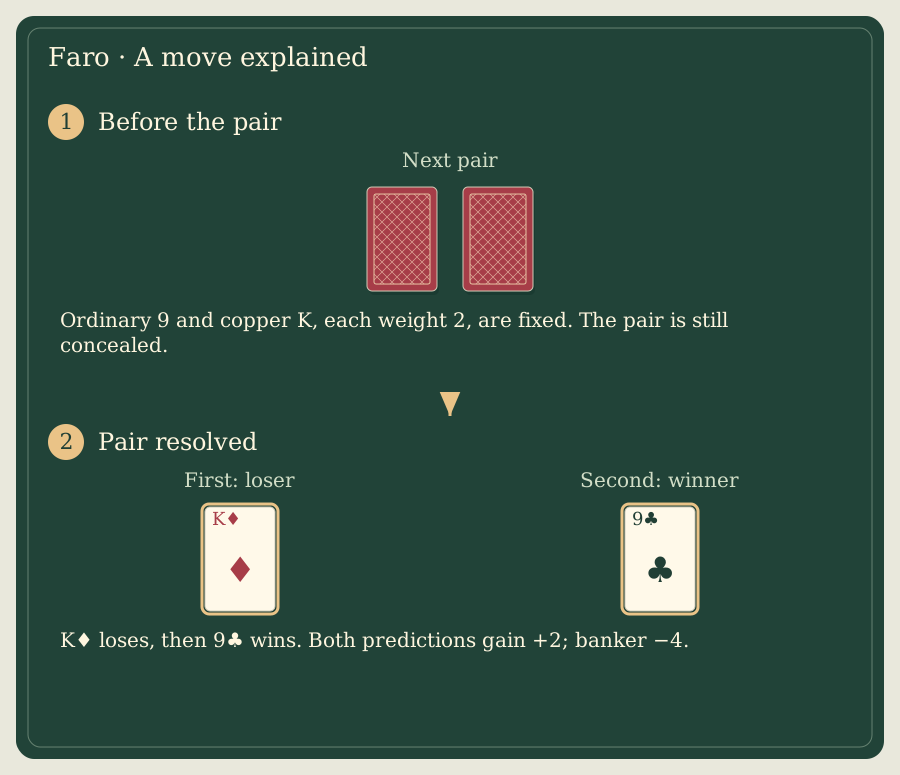
An ordinary prediction on 9 has weight 2, as does copper on K with weight 2. K♦ appears as loser, 9♣ as winner. Both gain +2 and the banker records −4. With pair 9♣–9♥ instead, the ordinary 9 would lose 1, regardless of copper, while K remains unresolved. Final order 7–J–3 matches the call “7 loses, J wins”; weight 2 earns profit 8 for that correct call.
← On a small screen, scroll the diagram horizontally. →
Common questions
Does the higher card win?+
No: first loses and second wins regardless of rank.
Does copper avoid a split?+
No: an identical-rank pair loses half the weight.
Do soda and hock resolve ordinary predictions?+
No: both still count in pack accounting and the case count.