← On a small screen, scroll the diagram horizontally. →
01 /
Pack and deal
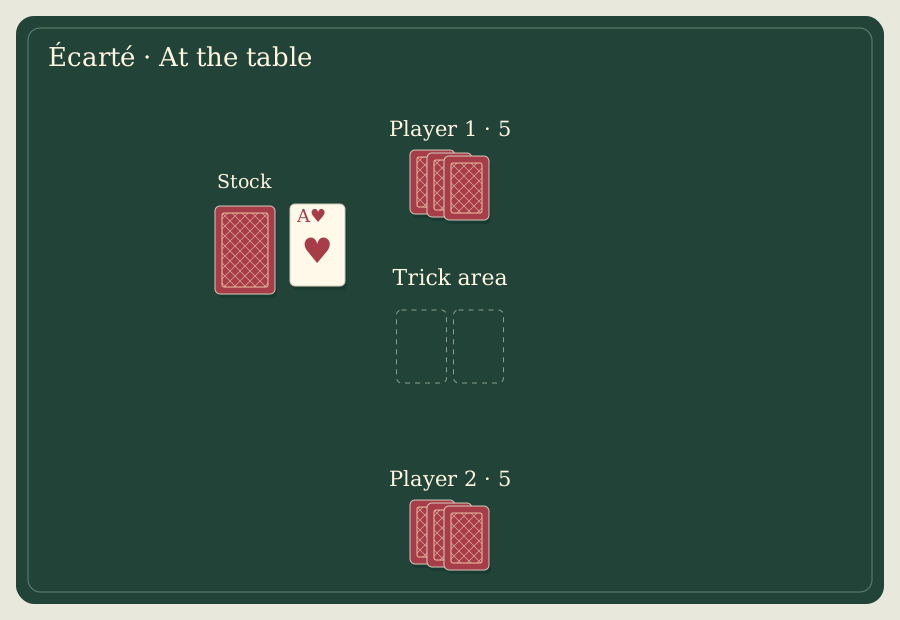
Use 32 cards, 7 through ace, for 2 players. In every suit rank K, Q, J, A, 10, 9, 8, 7. Cut for the first dealer using that order; equal ranks cut again. Shuffle and let the opponent cut. Deal 5 each, opponent first, in packets of 3 then 2; keep that dealing pattern throughout the game. Expose the next card as trump; it remains outside both hands. The remaining 21 cards form the stock. Alternate dealers between deals.
A turned trump king scores 1 immediately for the dealer. Otherwise a player holding the trump king may declare it before playing their first card and score 1. Our explicit timing convention claims a held king after the exchange decision, before play. First to 5 wins immediately, including by the king point.
02 /
Propose or play
The non-dealer may play the current hand or propose an exchange. If the dealer refuses, play starts immediately. If accepted, the non-dealer discards between 1 and 5 cards face down and receives as many from the stock; then the dealer may replace any number up to 5, including none. Discard before receiving; discards stay out of play and may not be inspected. After an accepted exchange, non-dealer may propose again and the dealer again accepts or refuses. Continue until non-dealer elects to play, dealer refuses or the stock is exhausted. Neither player takes the exposed trump.
Non-dealer has priority when the stock runs short. If the request exceeds the available stock, take only the remaining cards and recover the excess from the most recent discard before looking at replacements. The dealer then exchanges only as many cards as the remaining stock can supply, keeping the rest of the hand; if none remain, keeps the whole hand. Do not discard cards the stock cannot replace. This explicit procedure follows the historical priority and recovery principle while avoiding an incomplete hand.
If non-dealer plays without proposing and loses the majority, dealer scores 2 instead of 1 for tricks. If dealer refuses the initial proposal and loses the majority, non-dealer likewise scores 2. Once an exchange has been accepted, later refusals carry no refusal penalty.
03 /
Play and score
The non-dealer leads any card. The other player must follow suit and beat the lead if able. Without that suit, trump if possible; without suit or trump, discard freely. Highest trump, otherwise highest of the led suit, wins. The winner leads next. Continue until all 5 tricks have been played.
Winning 3 or 4 tricks scores 1; winning all 5, the vole, scores 2. A refusal penalty also makes the trick award 2, not 3 even if the winner sweeps. The king point is additional. Only the trick winner receives the trick award, so a tied deal is impossible. Continue alternating dealers until someone reaches 5; there is no simultaneous final-score tie because points are claimed in order.
04 /
An ace is not the highest
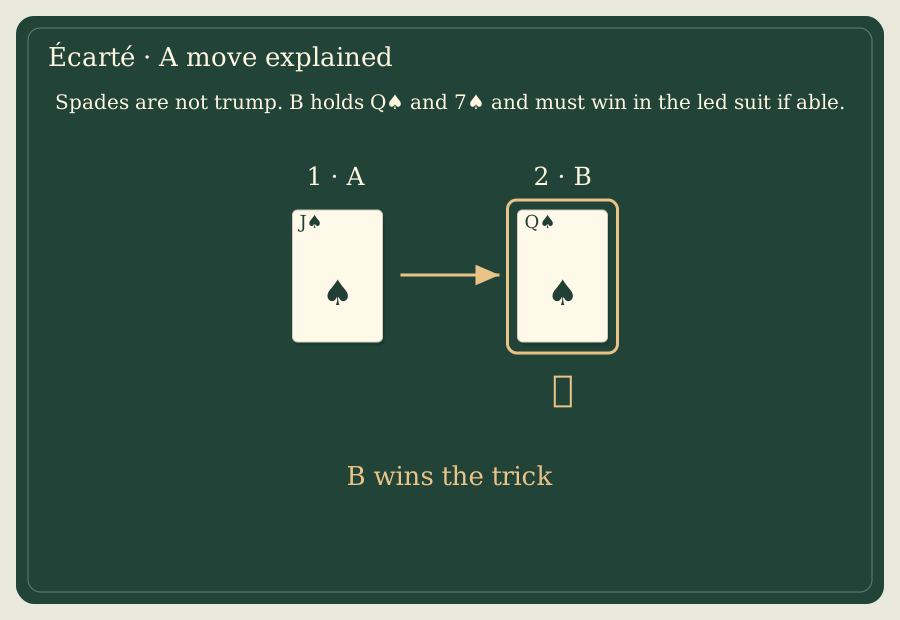
Spades are not trump. The opponent leads J♠, and your spades are Q♠ and 7♠. You must play Q♠ and take the trick. If you instead had A♠ and 7♠, neither could beat the jack: following suit is still required, but either is legal. Suppose you then win 3 tricks after the dealer refused your proposal: you score 2, independently of any earlier king point.
← On a small screen, scroll the diagram horizontally. →
05 /
Historical setting and variants
Écarté is documented in nineteenth-century manuals. The consulted French cultural-centre sheet places its popularity in the Restoration period. Historical manuals describe proposals, repeated exchanges and non-dealer priority when the stock runs short. They support a period and tradition without securely identifying an inventor. A single-exchange game is a shorter agreed variant, not the main profile taught here.
Common questions
May I keep the original hand if the dealer refuses?+
Yes. No exchange takes place for either player.
Does a sweep plus refusal score three?+
Not in this profile: the trick award is capped at two, with a separate king point possible.
Can a king point finish the match before play?+
Yes. Stop as soon as the claimed point reaches the target.