← On a small screen, scroll the diagram horizontally. →
01 /
Diloti: declarations on the table
Diloti is a Greek table-capture game combining Kontsina and Xeri ideas with declarations related to Casino builds. Its name derives from the Greek verb meaning declare. We choose the Greek contributors’ main two-player Pagat profile to 61. This is not simplified Scopa: numeral captures may be declined, courts cannot be summed, and a declarer’s obligations restrict later turns.
02 /
Two hands of six
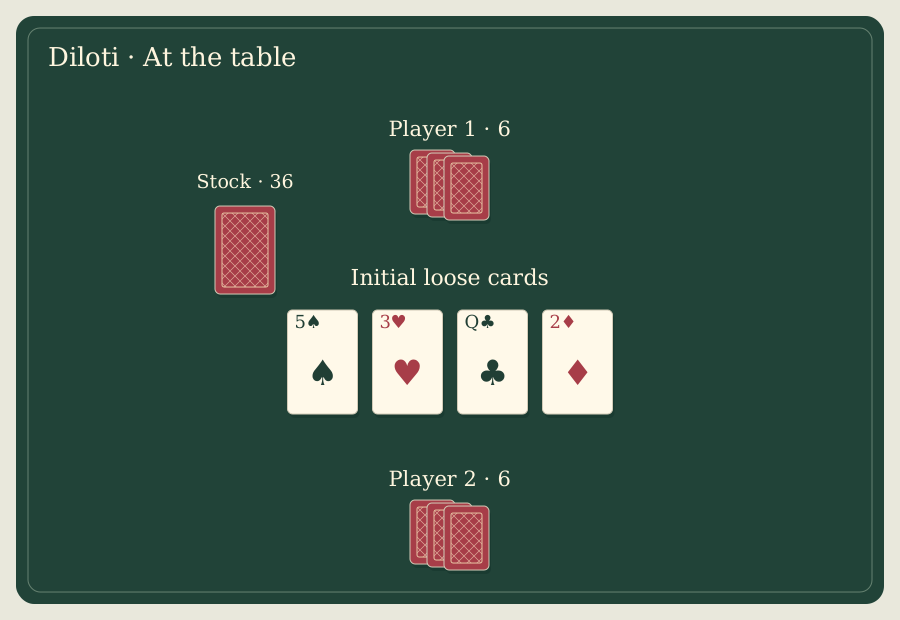
Exactly 2 play with one 52-card pack without jokers. A=1, 2–10 face value; J,Q,K have no numerical value and capture only matching courts. Choose dealer by lot, shuffle and let opponent cut. Deal first 6 to dealer’s opponent, next 6 to dealer, then 4 separately face up on the table. Remaining 36 are concealed. If the four include three or four equal courts, shuffle those table cards into the remainder and expose another 4. Dealer’s opponent starts, then alternate.
03 /
Matches and disjoint sums
Play one card per turn. A numeral takes equal loose numerals and/or disjoint groups summing to its value. Several such groups may be captured together: 6 takes both a loose 6 and 2+4. Count each table card once only; unselected cards remain. You may decline a numeral capture and trail separately unless bound by a declaration. A court facing a matching court must capture exactly one: J neither takes every J nor captures 5+6. The played card joins the captured cards; do not inspect winnings before scoring.
04 /
Plain declaration
Play a numeral, combine it with loose numerals and declare a total no higher than 10. Retain a card of that total for later capture. The pile stays on the table and its cards cannot be captured separately. For example, 3 on 5 declares 8 while keeping an 8. Anyone may capture it with an 8, together with qualifying loose 8 cards or sums.
Only the opponent may raise a plain declaration with a hand card, retaining a card of the new total; you cannot raise your own. After an opponent raises yours, you may raise theirs. In this main profile a plain pile is not a numerical component of a different total; joining a family of exactly the same value is separately permitted below.
05 /
Family declaration and obligations
A family has at least two components of equal value: single numerals or groups with that sum. Your played card may combine loose cards and, where appropriate, an existing plain declaration of exactly that value. Retain another matching card. Two 6 cards, for example, mean a family of sixes, not a sum of 12; clarify this. A family cannot be raised and only its exact value captures it whole. A 10 cannot take a family of 9 plus A. Further equal-value components may be added.
The responsible declarer cannot trail or start another build until this pile is captured or changed by another player. They may capture other cards, their pile, or extend it into a family. Never spend the sole retained capturing card elsewhere. Courts cannot enter declarations.
06 /
Xeri and further hands
Clearing the table by a legal capture earns xeri, worth 10. Exception: the very first card played in the deal never earns xeri, even when clearing the initial layout. Building does not clear the table because its cards remain there. When both hands empty, deal another 6 each without adding table cards; dealer’s opponent starts again. There are 3 such refills. After final play, leftovers go to the last capturer without automatic xeri; dealer’s last card can still earn xeri by genuinely capturing the entire table.
07 /
Eleven points and xeri
Most cards earns 4, with neither awarded at 26:26. Each A earns 1, 10♦ earns 2 and 2♣ earns 1: total 11 basic points plus 10 per xeri. Add scores after each complete deal from 0, target 61. If both reach target, higher wins; equality requires another deal. Dealer alternates. For example, 28 cards, two A, 10♦, no 2♣ and one xeri yield 4+2+2+0+10=18.
08 /
An opponent’s raise changes ownership
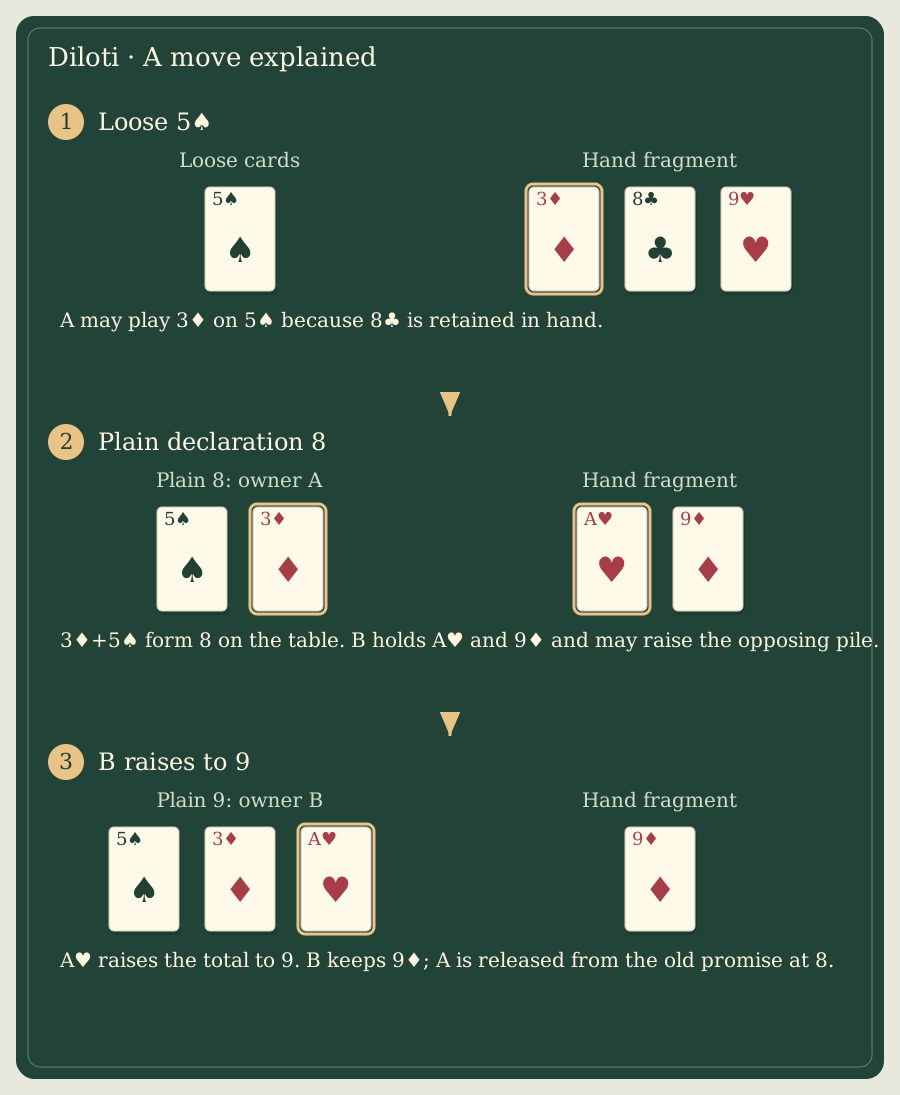
Mid-deal table has 5♠. A plays 3♦ and declares 8, retaining 8♣ and also holding 9♥. B plays A♥ to raise the pile to 9, retaining 9♦. A’s obligation at 8 is released; B now owns the obligation at 9. A may next play 9♥ and take 5♠,3♦,A♥ together with that 9♥: 4 captured cards and xeri 10 if no other table cards remain.
← On a small screen, scroll the diagram horizontally. →
Common questions
Can a court capture a sum?+
No. J,Q,K take only one matching court.
May I raise my own plain?+
No. An opponent retaining the new total may raise it.
Does building earn xeri?+
No. Declared cards still remain on the table.