← On a small screen, scroll the diagram horizontally. →
01 /
Players and cards
Exactly 3 players compete individually. Remove 2♣ from an ordinary 52-card pack, leaving 51 cards without jokers. Spades are always trump; every suit descends A, K, Q, J, 10, 9, 8, 7, 6, 5, 4, 3, 2. There are no partners. This profile includes individual bids, nil and accumulated bags, with a target of 200 after a complete deal.
02 /
Deal and opening
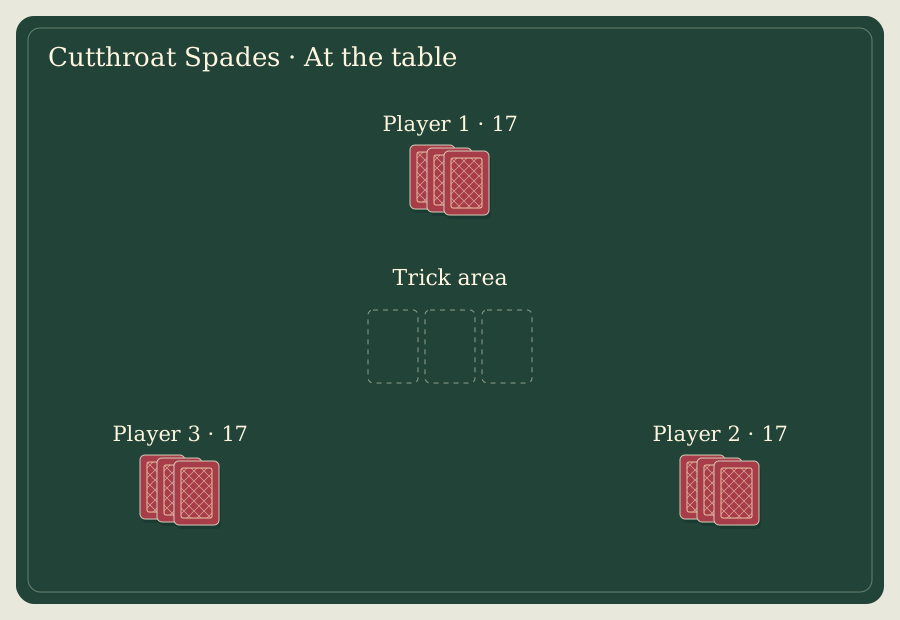
Choose the first dealer by lot, then rotate left. Shuffle and deal every card singly clockwise from the left: 17 each. There is no stock, exchange or hidden leftover card. Starting left, each publicly bids once from 0–17 expected tricks. No pass or bid change is allowed. The bid total is unrestricted, including 17. Zero is nil, a promise to take no trick, not a risk-free pass.
03 /
Playing a turn
The dealer’s left neighbour leads any nonspade, unless holding only spades. Follow clockwise, following suit when able. When void, play a trump or anything else; neither overtaking nor trumping is compulsory. Highest spade wins, otherwise highest led suit. The winner collects and leads next. Do not lead a spade until one has been played on another suit, unless only spades remain. Spades are then “broken”. Play all 17 tricks.
04 /
Scoring
A made positive bid scores 10 per promised trick plus 1 per overtrick. Falling short loses 10 per promised trick, with no credit for tricks taken. Overtricks are bags: keep an individual cumulative count. Every 10 bags cost 100 points; retain any excess for the next cycle. Do not cancel the overtrick points; subtract the penalty separately. Negative totals are allowed.
05 /
Scoring nil
Nil with no tricks scores +100; any trick makes it −100. Under this expressly selected accounting agreement, failed-nil tricks earn no extra trick points, but each counts as a bag and may trigger the normal penalty. All results belong to the bidder alone; another player cannot cover the bid. Blind nil, blind bids, special jacks and final-trick bonuses are excluded.
06 /
Ending the game
After a complete deal apply all scores and bag penalties. If anyone reaches 200, the highest total wins. Exact leaders remain tied until another complete three-player deal produces one leader. Never stop mid-play or remove the third player from a deciding deal. Correct an illegal response by checking the remaining hand; this is a teaching correction agreement, not another way to earn points.
07 /
History and selected variant
Cutthroat means competing without partners. It is a branch of American Spades, not Call Break: overtaking and trumping when void are optional here. Three-player versions vary in the omitted card, opening lead and penalties; this selects removal of 2♣ and ordinary accumulated bags. An exact origin date for this particular profile and an individual author are not established.
08 /
Worked example
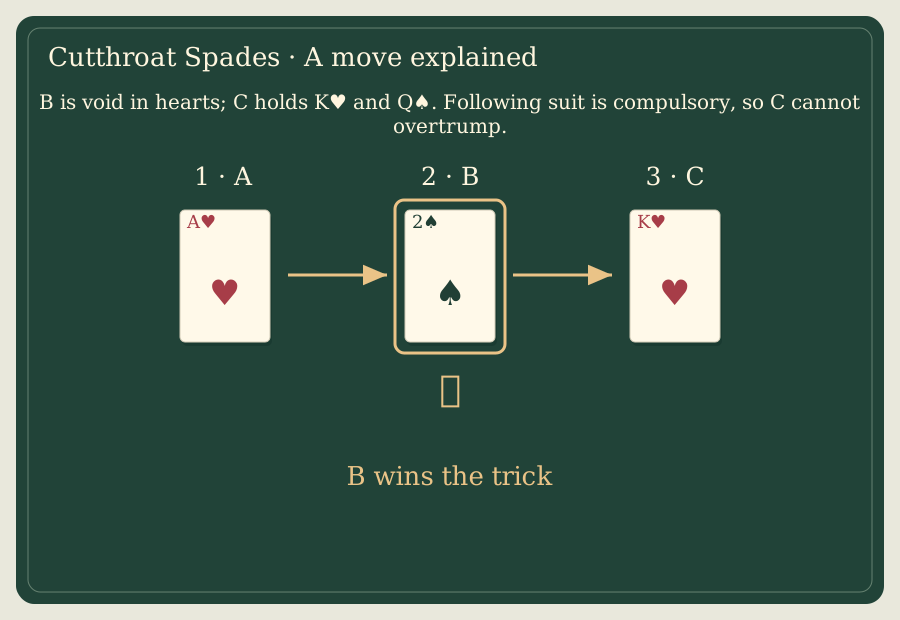
A leads A♥. B, void in hearts, plays 2♠; C, holding K♥ and Q♠, must follow with K♥. B wins with trump and breaks spades for later leads. In a separate count bids 5, 6, 4 and results 7, 6, 4 score 52, 60, 40; tricks total 17. If A had 9 bags, the new 2 make 11: subtract 100 and retain 1 bag. A’s score changes by −48.
← On a small screen, scroll the diagram horizontally. →
Common questions
May I decline to trump when void?+
Yes, you may discard another suit.
Do all bags disappear after a penalty?+
No, remove only a full group of ten and retain the remainder.
Is zero a safe pass?+
No, it is nil with a separate award or penalty.