← On a small screen, scroll the diagram horizontally. →
01 /
Players and cards
Four players form fixed partnerships, partners opposite, playing clockwise. From an ordinary 52-card pack without jokers remove every 8, 9 and 10, leaving 40. Sequence order is A–2–3–4–5–6–7–J–Q–K; suits are ignored. For addition A=1, cards 2–7 have face value, and J/Q/K have no numerical value. This selects Pagat’s detailed profile, one game to 40 points, without a multi-game match.
02 /
Deal and opening
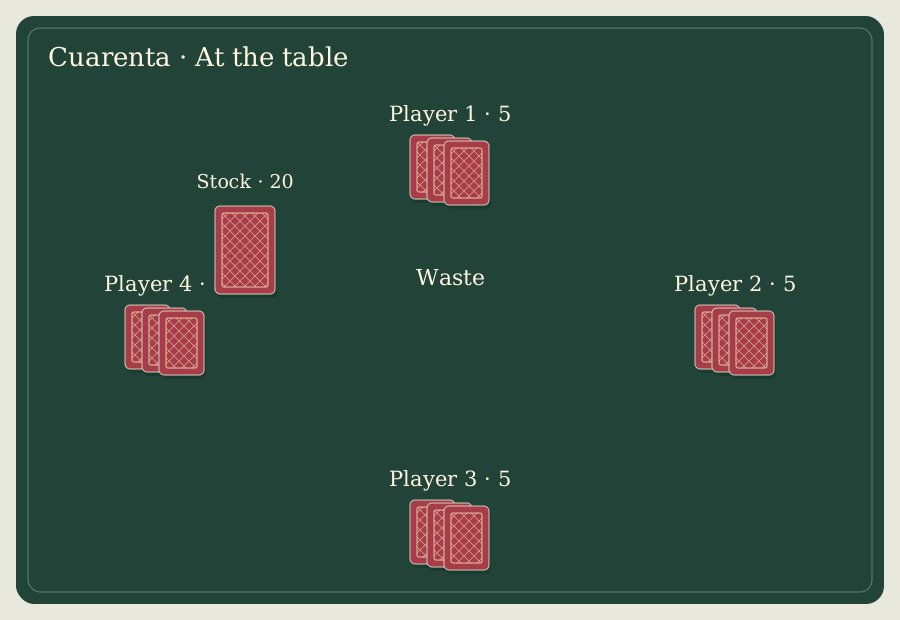
To choose dealer, deal face-up cards around: the first recipient of a diamond deals. Gather and shuffle. Give each player 5 hidden cards as one packet, starting left; the table is empty and the other 20 form stock for the next packet. The left neighbour starts. When all hands are played, deal another 5 each: keep table cards, adding none directly to the table. After the whole pack is used, dealer moves left. In the selected source a misdeal immediately loses the game for the dealer’s partnership, rather than charging a small penalty.
03 /
Announcements after dealing
After each packet and before play, announce ronda, 3 cards of one rank, for 4 partnership points without naming the rank. Show 4 equal cards to win the game immediately. For a definite home-table order, check announcements clockwise from the dealer’s left. At a score of 30 or more ronda no longer scores. Do not claim a late ronda after play begins.
04 /
Playing a turn
On a turn play 1 card. Capture one equal table card or one group of numerical cards adding to the played value. Choose one capture basis: never combine a match with another sum, two separate sums or multiple equal cards. Pictures can be captured only by matching or a subsequent sequence. Put the played card and captures face down in the partnership pile; pass the turn. Without a capture the played card stays on the table.
After matching or addition, take an unbroken ascending sequence from the table, beginning immediately above the played rank, taking one card of each rank. J follows 7. A sequence alone cannot capture without an initial match or sum. If you begin capturing but omit an available continuation, opponents may take the missed sequence cards. Missing an entire capture has no such forfeiture: the cards remain on the table.
05 /
Caída, limpia and special award
Caída means the next player immediately matches and captures the previous player’s just-played card: 2 points. Taking it by addition or sequence does not qualify. The first play after a new packet cannot score caída on the last card of the previous packet. Limpia is an actual capture clearing the whole table: 2. Both together score 4. At exactly 38 limpia does not score, but from 36 the combined action scores 4 and wins: check the restriction against the pre-action score.
If a caída took a card from an opposing ronda, remember its rank and claim at the end of the complete hand before the next deal. Award the confirmed event a special 10; our explicitly selected accounting adds it to the ordinary caída already scored. With a current score of 30 or more this special award is unavailable. Opponents below the threshold may claim even on an unannounced ronda suppressed by the threshold, if recognised.
06 /
Scoring
After all 40 cards are played, remaining table cards belong to nobody and do not count as captures. A partnership with 20 cards scores 6. Add 1 for each above 20 and round the resulting score upward to even: 21–22 give 8, 23–24 give 10. If both have 20, only the nondealing side scores 6. If both have fewer than 20, the larger collection scores 2; tied lower collections give those 2 to the nondealers. Never round the card count first or award both majorities.
07 /
Ending the game
The first partnership to reach 40 or more by a legal award wins immediately; do not play extra turns. At 38, caída and final card-count points remain available, not limpia or ronda. If nobody has reached the target, gather and shuffle, change dealer and retain scores. Claim action points immediately and the special ronda-caída award in the stated window after the complete hand. Awards are not simultaneous: a finishing result on a partnership’s turn has priority, while opening announcements follow the selected order.
08 /
History and selected variant
Cuarenta is associated with Ecuador, especially Quito and Cuenca. Its name means forty, both the pack size and the target score. Pagat’s detailed account is based on Paul Welty’s contribution. Local clubs and tournaments differ on direction, ronda values, special caída and misdeal penalties; this profile is not presented as the only official code. An exact inventor and origin date are not securely established.
09 /
Worked example
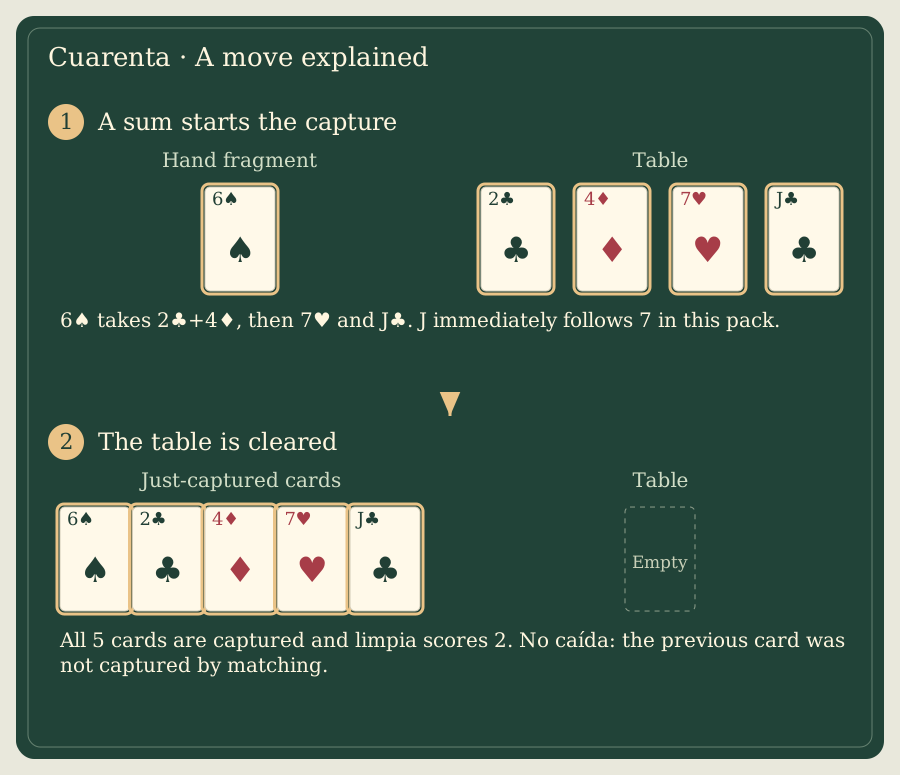
The table holds 2♣, 4♦, 7♥, J♣. Play 6♠: sum 2+4 supplies the capture basis, followed by 7 and J as an unbroken continuation above 6. Take all 5 cards including the played one: the table is empty and limpia scores 2. There is no caída: the six matched no previous card. A partnership on 36 moves to 38, where another limpia cannot win. Without the initial sum, a lone 6 could not simply capture 7 and J.
← On a small screen, scroll the diagram horizontally. →
Common questions
Does the last capture take residue?+
No, table cards remaining after the pack belong to nobody.
Why does jack follow seven?+
All eights, nines and tens were removed from the playing pack.
Can a limpia win from 38?+
No, at that score use caída or the final card count.