← On a small screen, scroll the diagram horizontally. →
01 /
Aim and equipment
This profile is for exactly 4 individual players. Combine two 52-card packs and 3 jokers, making 107 cards. Only jokers substitute; deuces are natural. Dispose of cards, but the complete current contract must open your right to meld. The session goal is the smallest penalty total after 7 rounds, not points for exposed combinations.
02 /
Setup and deal
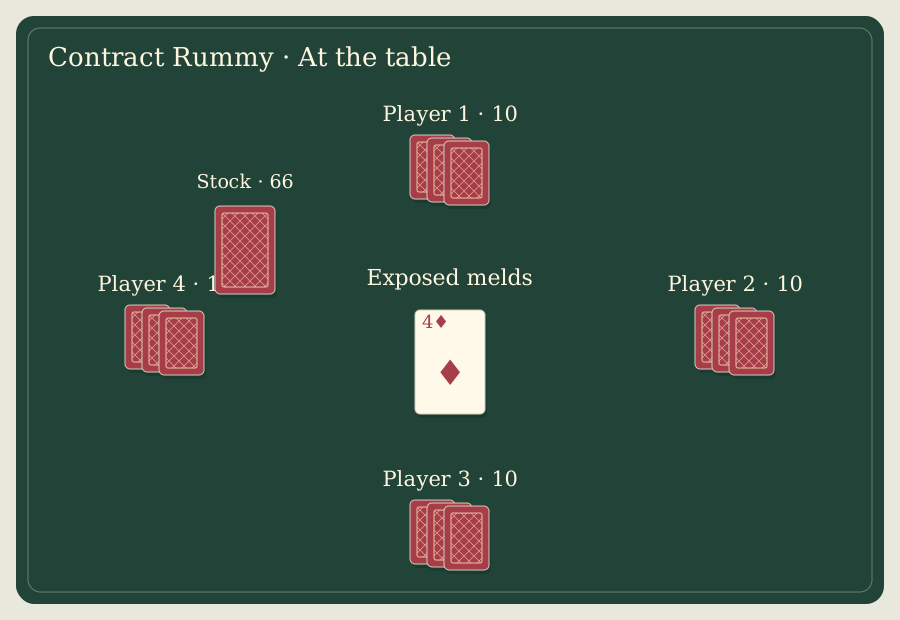
Choose first dealer randomly, then rotate left. Deal concealed cards singly: 10 each in rounds 1, 2, 3; 12 each in rounds 4, 5, 6, 7. The next upcard starts discard; the rest form concealed stock. Dealer’s left starts and turns run clockwise. Reshuffle everything before each round. With 4 players, the first round starts with stock of 66 and discard of 1 card.
03 /
Declarations
A contract group has 3 equal ranks, including duplicate suits from different packs. A contract run has 4 consecutive ranks in one suit. Ace may be low or high: A–2–3–4 and J–Q–K–A fit, K–A–2–3 does not. Later runs may extend at both ends up to 14 with two physical aces at the ends, never through an ace. Groups extend with equal ranks. One physical card cannot count twice. Assign each joker a declared position; this profile has no separate joker-count cap per meld.
04 /
Bidding and contracts
Contracts in order: 1, two groups; 2, a group and a run; 3, two runs; 4, three groups; 5, two groups and a run; 6, a group and two runs; 7, three runs with immediate exit and no discard. Everyone attempts the same contract in a round. Multiple opening runs of one suit cannot be contiguous: 3–4–5–6 and 7–8–9–10 do not qualify as a pair. Leave a rank gap or overlap ranks using different physical cards. Later additions may close a gap.
05 /
Legal actions
A normal turn draws the stock top or discard top, optionally melds, then discards a card. Your initial exposure must be the complete contract with exactly its minimum lengths. Never open it piecemeal, add extra cards or expose additional combinations. After opening you create no new melds. Only from your next own turn may you lay off any number of cards on existing melds, yours or others’. Before the final round retain a card for the compulsory finishing discard.
06 /
Out-of-turn buying
Out-of-turn buying is possible when the active player chooses stock over the discard. Any other player may request discard top; competing requests favour the earliest upcoming turn. The buyer also takes stock top as a penalty card, neither melds nor discards and gains no normal turn. Another player may then request the new discard top with the same penalty; one person cannot make two consecutive purchases. After all requests the original active player draws their own stock card and finishes their turn. There is no round purchase limit. If the active player wants discard, they take it without penalty and nobody may buy.
07 /
Jokers and final round
During laying off, a player who opened on an earlier turn may replace a run joker with the exact natural card. The released joker must be laid off into an exposed meld in that same turn, never kept for a later one. Jokers in groups cannot be reclaimed. The final round has no ordinary laying-off phase: opening must immediately use your entire hand, including purchase additions, in exactly three runs of at least 4. Thus after a normal draw one must exceed minimum length; no finishing discard or retained hand card is allowed.
08 /
Scoring
As soon as a player legally empties their hand, others record penalties for every remaining card: K Q J are 10, A and joker are 15, numerals their face value. Exposed cards incur no penalty; the player out scores 0, with no bonus or credit for meld values. For example, remaining K♣, A♥, 5♦ and a joker score 10+15+5+15=45. Add all rounds without resetting when a new contract is completed.
09 /
Ending the game
When a stock draw is required from empty stock, shuffle discards except their exposed top into new stock. This also applies to purchase penalty cards. If a required draw is still impossible, the round ends without a winner and everyone counts hand penalties. Advance to the next contract; after the final one the lowest cumulative penalty wins. Tied leaders share victory, our explicit tie agreement. An uncompleted contract neither carries forward nor excuses penalties.
10 /
Context and variants
Contract Rummy names a related family rather than one universal code. Pagat separately describes Contract, Liverpool, May I? and Shanghai, with differences in jokers and buying. This selects Pagat’s main Contract rules for a fixed foursome, not a neighbouring variant. CRP also describes a contract cycle but its pack and penalties may differ. No established inventor or precise date is claimed for this particular rule profile.
11 /
Worked example
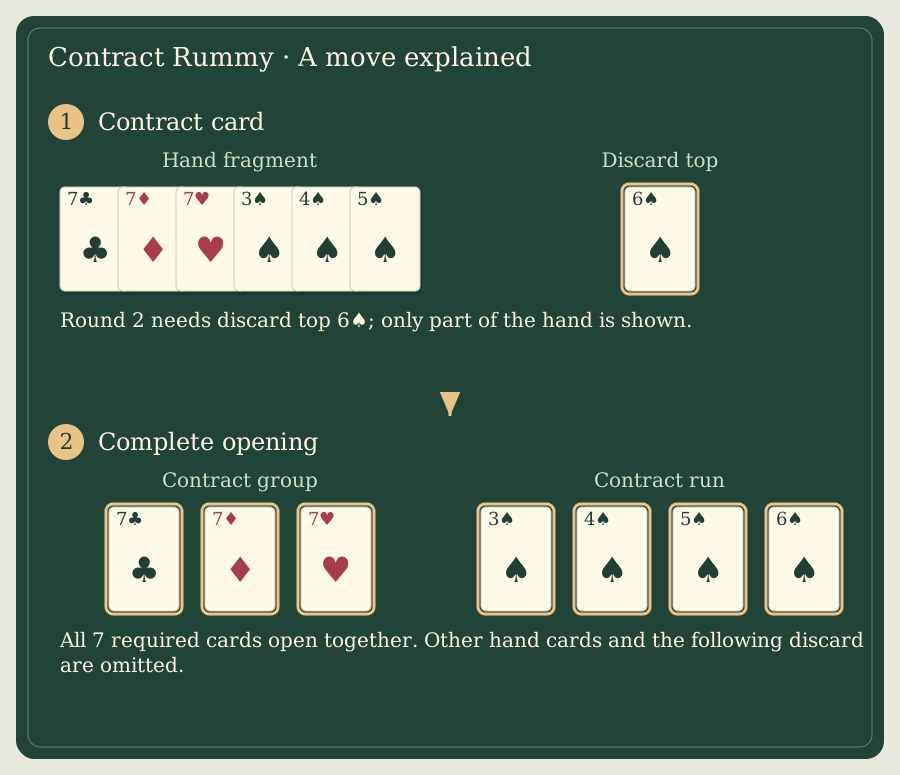
In round 2 your hand includes 7♣–7♦–7♥ and 3♠–4♠–5♠ among other cards. Take discard top 6♠ and expose the group and full run together: all 7 contract cards. Even if holding 8♥ for an opponent’s meld, you cannot lay it off now: wait for your next own turn. Discard an unwanted card after opening. Other hand cards are omitted here; this is not an exit or scoring event.
← On a small screen, scroll the diagram horizontally. →
Common questions
May I lay off on my opening turn?+
No: only from your next own turn.
May I keep a reclaimed joker?+
No: lay it off into an exposed meld in the same turn.
Does the final round need a discard?+
No: the whole hand goes into exactly three runs together.