← On a small screen, scroll the diagram horizontally. →
01 /
Aim and equipment
For 2 to 6 players use one 52-card pack without jokers. This profile matches rank alone, regardless of suit or colour: 7♠ matches 7♥. Each pair earns 1 point. Collect more pairs than your opponents by remembering both your own reveals and everyone else’s.
02 /
Setup and deal
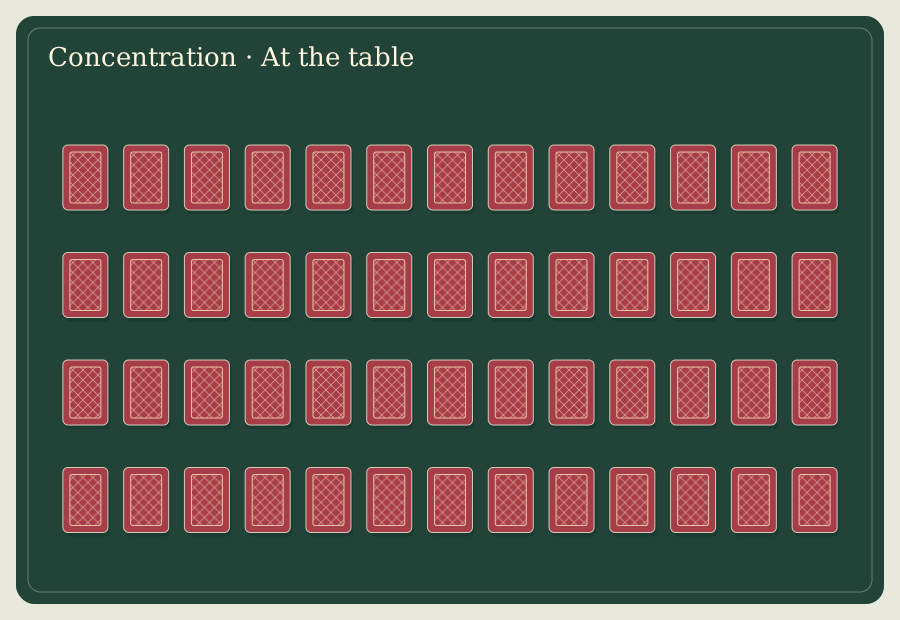
Shuffle and lay all 52 cards face down in 4 rows of 13. Do not overlap cards; each needs a fixed position. Deal no hands and keep no stock. Choose the first player randomly and rotate turns clockwise. Nobody may inspect faces before the game begins.
03 /
Legal actions
On your turn reveal a chosen card so everyone can see it. Leave it visible while revealing another remaining concealed card. Compare those cards only: do not change your first choice after the second reveal, turn over a third or use a previously captured card. Take a matching pair into your own collection and immediately play again; a successful streak has no limit.
04 /
Scoring
When ranks differ, leave both faces visible for at least 5 seconds, then conceal them in their original positions and pass the turn. Keep gaps left by captured pairs: never shift remaining cards or reshuffle the layout. Only captured pairs score; an unsuccessful reveal does not remove points already earned.
05 /
Ending the game
When the layout is empty, count pairs. There are 26 altogether, so scores must total 26. The largest collection wins; tied leaders share the victory. Start a separate game by thoroughly reshuffling. For this teaching profile, do not write down positions: that is an explicit agreement to test memory.
06 /
Context and variants
Concentration, Memory and Pelmanism are established names for pair-memory play. Bicycle and Pagat match rank alone, while CRP selects rank and colour. This guide uses the former. Matching picture packs support related play but are not required equipment; no uniquely established inventor is claimed here.
07 /
Worked example
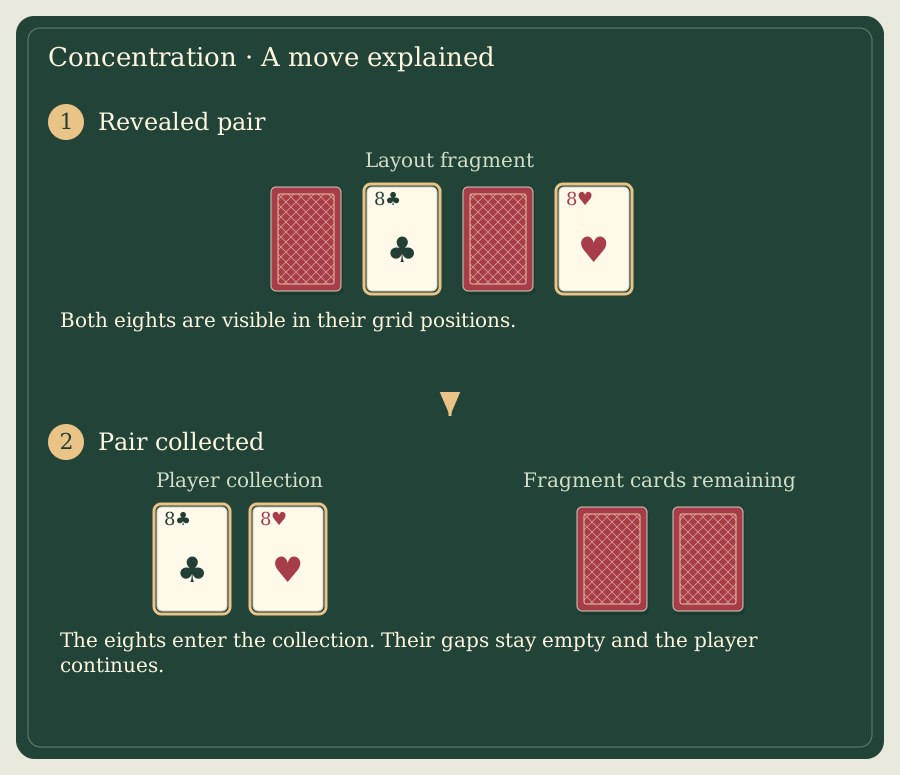
You reveal 8♣ and 8♥. Despite their different colours, they match: take them, score 1 point and continue. Your next attempt reveals Q♠ and 4♦. After showing them, conceal them in place: an opponent may use that memory but does not automatically receive those cards.
← On a small screen, scroll the diagram horizontally. →
Common questions
Must suits match?+
No: this profile requires the same rank only.
Does a pair pass the turn?+
No: its capturer plays again.
May I close the gaps?+
No: remaining positions stay fixed.