← On a small screen, scroll the diagram horizontally. →
01 /
Aim and equipment
For 3 to 12 players use 52 cards without jokers. This selects Foster’s no-widow game: the dealer trades stock tops for accounting points, while neighbours may exchange blind. Everyone always holds 3 cards. For non-cash play start a ledger at zero and allow negative balances; nobody is eliminated.
02 /
Setup and deal
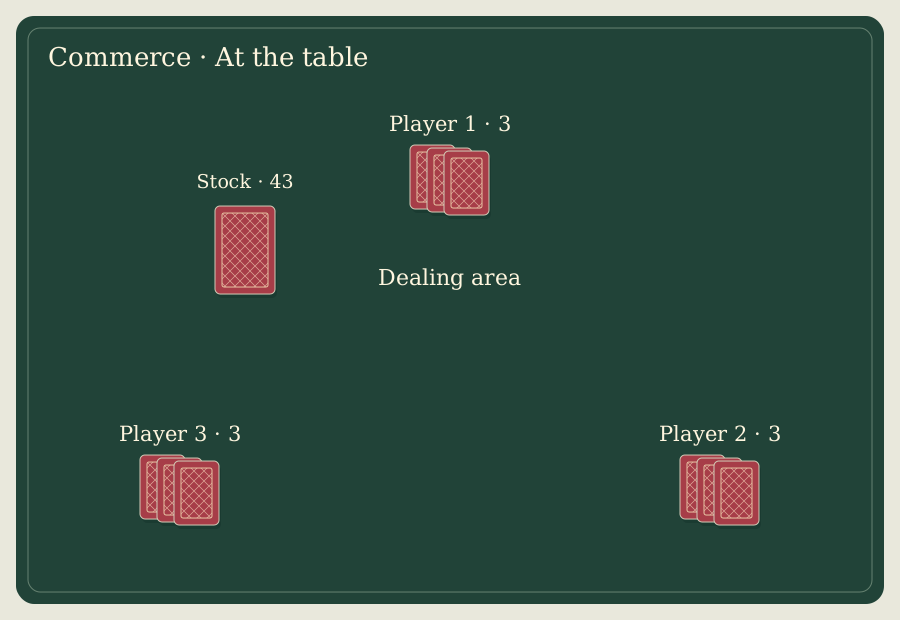
Choose the first dealer randomly. Everyone contributes 1 point to a common pool, deducting it from their balance. Shuffle, cut, deal 3 concealed cards each singly, and keep the rest as concealed stock. There is no exposed widow. The left neighbour starts; turns and subsequent deals move clockwise. Each deal creates a fresh pool.
03 /
Legal actions
On your turn trade, barter or knock. To trade, give the dealer an unwanted card and 1 point; receive the concealed stock top. Put the rejected card into separate concealed waste, never back into stock. A dealer trading on their own turn pays nothing to themselves, an explicit clarification of the dealer’s advantage. To barter, offer a card face down to the left neighbour. They either return their chosen card before inspecting yours or refuse by knocking. Accepting barter does not replace that neighbour’s upcoming normal turn.
04 /
Declarations
Rank hands from highest: equal-rank triplet; same-suit sequence; point, the best total of 2 or 3 cards of one suit. Compare triplets by rank, A above K. Compare sequences by top rank; Q–K–A is highest, A–2–3 lowest, and K–A–2 invalid. For point, ace is 11, K Q J are 10, others their numbers; a singleton suit scores 0. Equal point totals favour 3 cards over 2. Resolve remaining ties by dealer, then nearest left: an explicit extension of positional priority to every category. Pairs and ordinary flushes have no separate ranking.
05 /
Scoring
A knock stops exchanges immediately, with no final circuit. Reveal all hands and award the pool to the best. A losing dealer pays the winner another 1 point. If the dealer’s losing hand is in the same category as the winning hand, instead pay 1 to every other player. Compare the whole hand’s category: point against point qualifies even in different suits. Trade payments belong to the dealer, not the pool.
06 /
Ending the game
Play one deal per participant; highest final ledger balance wins and tied leaders share victory. If stock runs out, our teaching agreement reveals and settles immediately as after a knock; do not recycle waste. If nobody has a combination or point, all hands tie and positional priority applies. These are stated edge-case agreements for the old account, not newly claimed historical laws.
07 /
Context and variants
Foster describes Commerce with and without a widow in Complete Hoyle, whose checked edition was revised in 1914. This documents a historical version, not an invention date. CRP offers another arrangement with a shared row and lives; it is not imported here. Historical cash payments become an accounting ledger while retaining actions and the dealer’s advantage.
08 /
Worked example
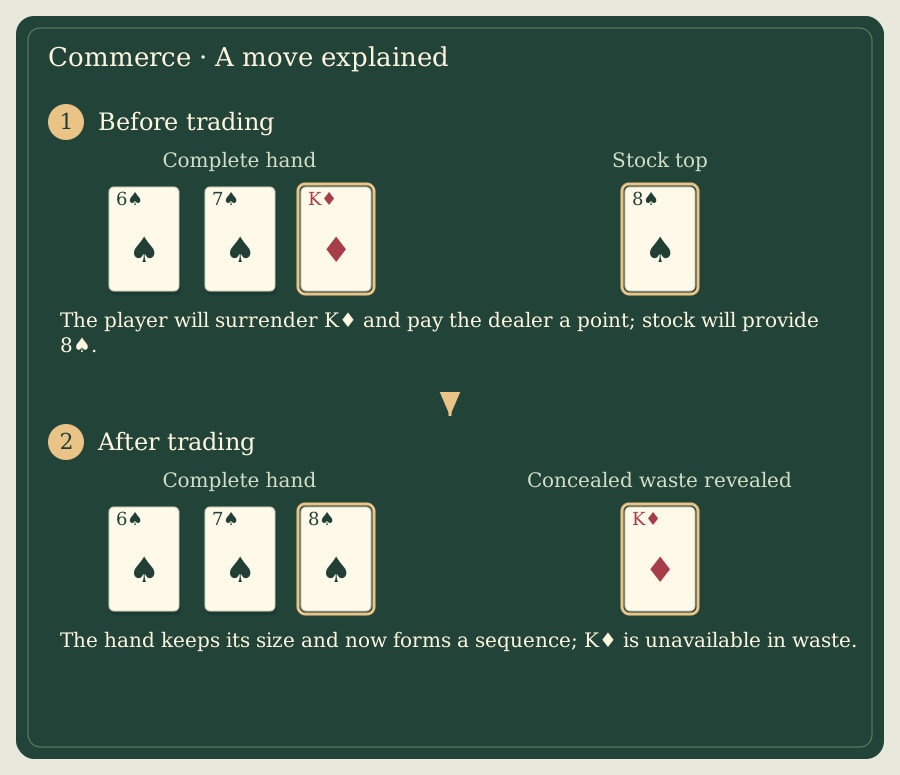
A holds 6♠–7♠–K♦. They surrender K♦ and pay the dealer 1 point, receiving 8♠ from stock. That makes a same-suit sequence. On the next turn A may knock: it beats point A♥–K♥–4♣ despite that point totalling 21. If the dealer holds 3♣–4♣–5♣, they lose in the same category and pay every opponent.
← On a small screen, scroll the diagram horizontally. →
Common questions
Does everyone trade after a knock?+
No: showdown is immediate.
Does a pair beat point?+
There is no pair category; evaluate the available point.
May I inspect a barter offer first?+
No: choose the return card first or knock to end the deal.