← On a small screen, scroll the diagram horizontally. →
01 /
Aim and equipment
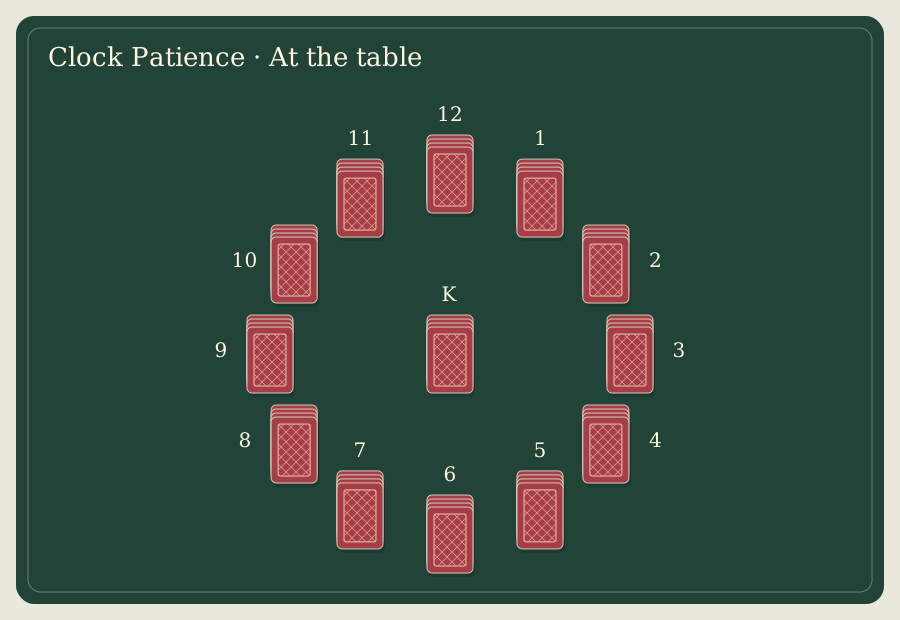
Use 52 cards without jokers and leave room for a clock face. This is for 1 player; suits and colours do not affect the procedure. Sort every card to its rank position: A belongs at one o’clock, J at eleven, Q at twelve, and K in the centre. There is no choice of playable card: the rank just revealed determines the next action.
02 /
Setup and deal
Shuffle without inspecting the order. Make 12 concealed piles at the hour positions and another in the centre. Deal around all positions including the centre until each of the 13 piles holds 4 cards. There is no separate stock or hand. All 52 cards must be face down before starting.
03 /
Legal actions
Turn over the top concealed centre card. Slide it face up beneath the pile matching its rank, keeping sorted cards below concealed ones. Reveal the top concealed card of that destination pile and repeat. After a 6, for example, continue at six o’clock rather than the next hour. A K sends you back to the centre. Never reveal an already sorted card again or choose another pile to keep the game going.
04 /
Scoring
The ordinary result is a win or loss. To compare attempts you may record the number of sorted cards, including the final king, up to 52. That is only an optional progress record; ranks have no point value and speed earns no bonus. A partly completed clock is not a win.
05 /
Ending the game
Stop after placing the fourth K: the centre has no concealed card left to continue from. You win if all 52 cards are now revealed and sorted. Any concealed cards elsewhere mean a loss. Do not replace a king with a random card or redeal one pile; a new attempt begins with a complete shuffle.
06 /
Context and variants
Clock Patience and Clock Solitaire name the same mechanical patience. The checked BVS rules describe it without a redeal. These sources do not establish a reliable inventor or first appearance. This profile gives no extra chance after the final king; such a rescue changes the stopping condition.
07 /
Worked example
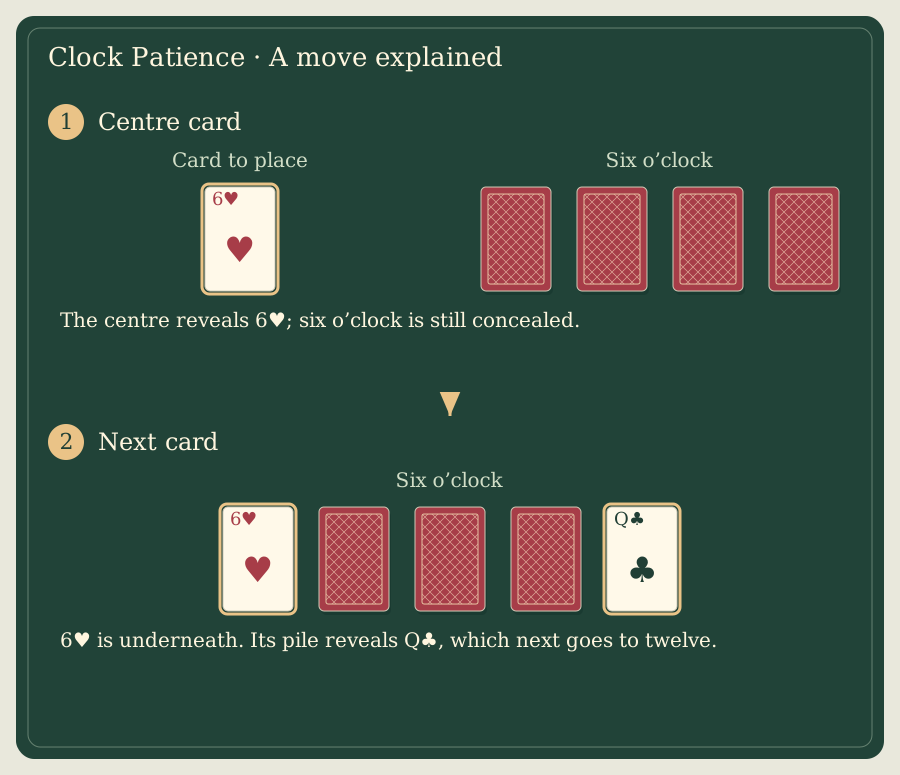
The first centre card is 6♥. Put it beneath six o’clock; that pile has Q♣ on top. Q♣ now goes beneath twelve o’clock, whose concealed top is revealed next. The suits make no difference. You cannot ignore Q♣ and turn a convenient centre card instead.
← On a small screen, scroll the diagram horizontally. →
Common questions
May I choose another pile?+
No: continue from the revealed rank’s pile.
Do aces go in the centre?+
No: ace goes at one o’clock; the centre is for kings.
Is there a redeal?+
No: the fourth king ends the attempt.