← On a small screen, scroll the diagram horizontally. →
01 /
The bank passes between players
Chemin de Fer is French baccarat banked by a participant. Jean Quinola’s late-nineteenth-century account still linked the name to a rotating choice of banking game; baccarat became the usual choice. Here one bank hand faces one shared punter hand, not Baccarat Banque’s two tableaux. Real decisions and bank rotation distinguish it from Punto Banco. We select a home profile without commission or side bets; commercial tables set their own conditions.
02 /
Cards and notional capital
Our home session has 3–12 participants, including the active banker. Shuffle 6 packs of 52 without jokers: 312 cards. A=1, 2–9 face value, 10/J/Q/K=0; use only the sum’s last digit, maximum 9. For example, 7+8=15 counts 5.
Each starts with 100 notional chips. Choose first banker by lot; banker may manage the deal. Minimum new bank is 2, punter bet at least 1 within their remaining balance. Borrowing is forbidden. Session lasts 12 coups; shuffle before the session, discard after each coup, with no burns.
03 /
Covering the bank
Banker offers available capital B. Any other player may call banco to cover all of it; competing claims favour the first anticlockwise from banker. A losing banco caller requesting banco suivi next coup has priority over the others. Without banco, each in turn from banker’s right anticlockwise stakes no more than the uncovered remainder; once covered, later players do not participate. Our profile has no spectators.
Total stakes S cannot exceed B. Set B−S aside as banker’s personal reserve. Largest bettor acts as active punter; equal largest bets favour the earlier player by explicit agreement. This person decides for all bettors. Punters bet only on the shared hand, not on bank or ties.
04 /
Two concealed hands and naturals
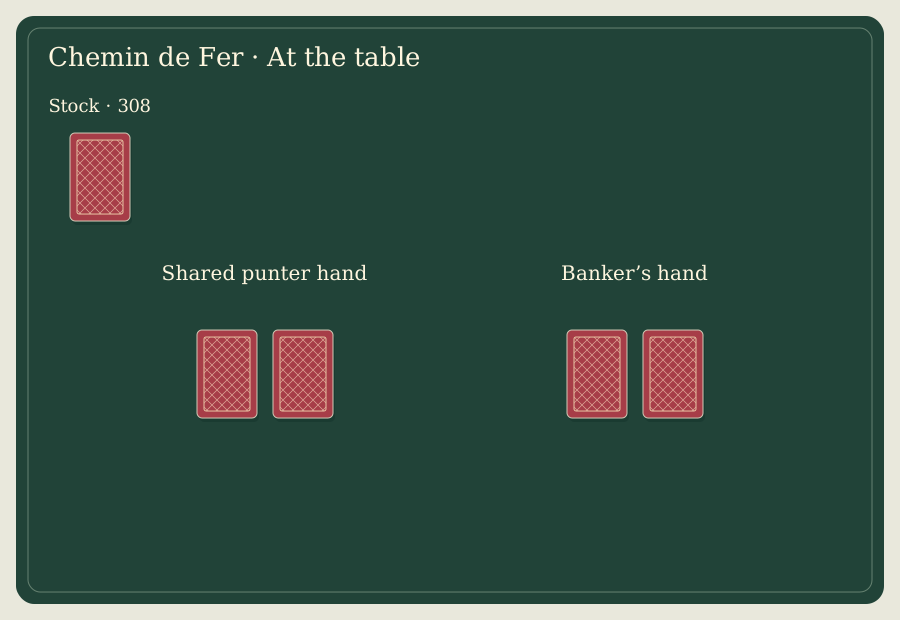
Banker deals singly: punter, banker, punter, banker, all concealed. Active punter examines their 2. With 8 or 9, expose immediately; bank exposes too, higher total wins, equal totals push and no third cards are dealt. Without a natural, punter first requests a card or stands. Banker then examines their 2: banker 8 or 9 wins immediately, without supplying the requested third card. Only without naturals does drawing continue; punter’s initial cards remain hidden from banker until the final decision.
05 /
Punter’s decision
When only one punter bet, they must draw on 0 but may choose freely on 1–7. When several bet, draw on 0–4, stand on 6–7 and choose on 5. A requested third card is dealt face up after bank’s natural check. It is punter’s only additional card. Other bettors must not discuss hidden cards or signal advice.
06 /
Complete banker decision table
If punter stood, bank draws on 0–5 and stands on 6–7. If punter drew, bank 0–2 always draws and 7 always stands. For other totals consider only punter’s exposed third card, with 10/J/Q/K counting 0:
Bank 3 draws against 0–7, stands against 8 and chooses freely against 9. Bank 4 draws against 2–7, otherwise stands. Bank 5 draws against 5–7, chooses against 4, otherwise stands. Bank 6 draws against 6–7, otherwise stands.
Bank receives at most one additional card. These two free-choice cases differ from the compulsory Punto Banco table. Expose all cards after the decision and compare final values.
07 /
Payment and required next bank
A punter win pays each 1:1, profit equal to stake; banker loses S and the bank, retaining reserve. A bank win earns S without home commission. To continue, next bank must be at least the previous covered S plus winnings S: minimum 2S. It may be increased, not reduced without retiring. On a tie return wagers and let banker continue with at least the previous covered S. Personal reserve remains owned and is not automatically part of the required next bank.
08 /
Bank transfer and session end
After a loss, the next player right receives the new-bank option; skip decliners. A winner or tied banker may retire. Offer succession anticlockwise, starting at the retiring banker’s right, at no less than the required continuation amount. If the immediate neighbour accepts, it uses their ordinary turn; a later successor preserves that neighbour’s ordinary turn when the successor loses. If nobody accepts that amount, the immediate neighbour may open a fresh bank from the minimum.
After 12 coups return reserves and committed capital to owners and compare personal balances: highest wins, ties share position. End earlier if nobody can open a bank or everyone declines betting against it; this is an explicit home agreement, not forfeiture of unmatched stakes.
09 /
Bank freedom at 3 against 9
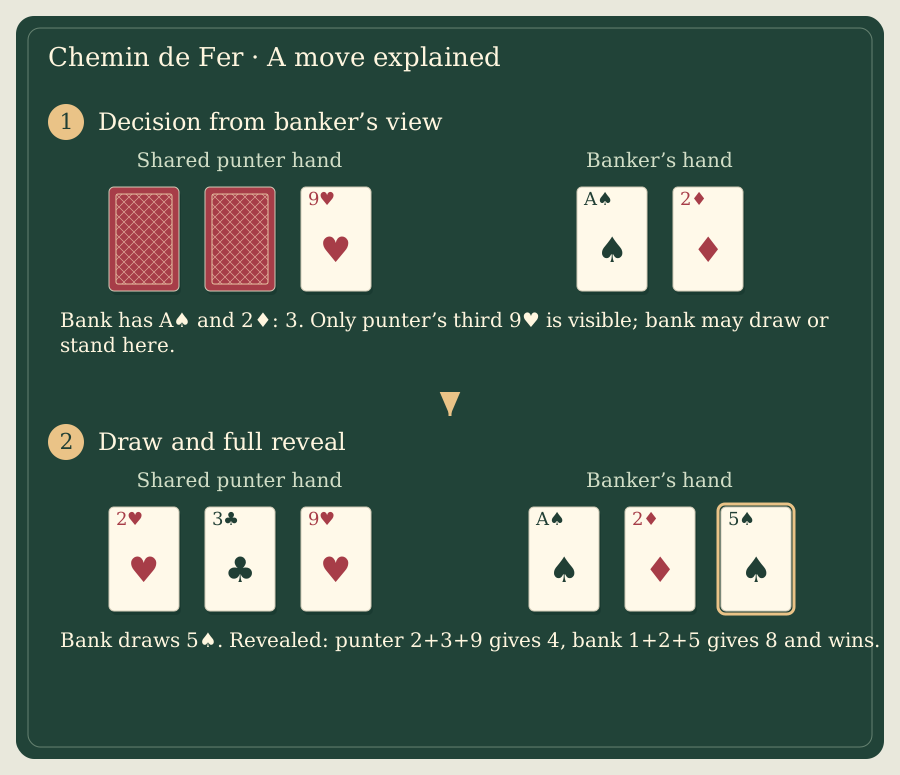
Punter has 2♥,3♣, total 5, chooses to draw and receives exposed 9♥. Punter finishes at 4. Bank A♠,2♦ totals 3 and sees only exposed 9♥, so may choose freely. It draws 5♠, reaches 8 and wins.
If bank offered 20 and punters together covered 12, reserve 8 is separate. Winning earns profit 12; continuation requires a bank of at least 24, not the previous 20. Reserve 8 remains personal and may be added voluntarily.
← On a small screen, scroll the diagram horizontally. →
Common questions
Does each punter have a separate hand?+
No. All punter bets concern one shared hand.
Is the bank always automatic?+
No. Bank 3 against third-card 9 and bank 5 against third-card 4 allow choice.
Does a tie transfer the bank?+
No. Wagers return and banker may continue.