← On a small screen, scroll the diagram horizontally. →
01 /
English ascending-rank profile
Cheat belongs to an international family of false-declaration games. We select the English ascending-rank profile published by cardmaker Bicycle as I Doubt It. The required rank changes after every play, including a challenged one. Russian Veryu Ne Veryu often keeps a rank until a challenge; that is a different profile. This traditional game has no securely established single invention date.
02 /
Setup
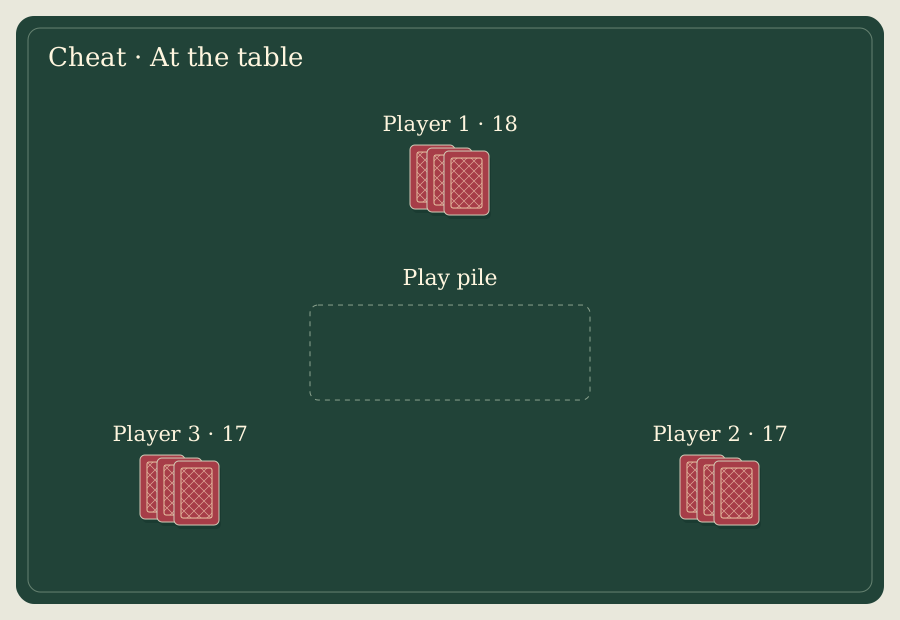
Our table supports 3–6 people with one 52-card pack, no jokers. Suits have no significance and cards have no point values. Choose dealer by lot, shuffle and deal every card clockwise from the left; unequal hands differing by a card are acceptable. Centre starts empty, with no stock. Dealer’s left begins with A. Required announcements run A,2,3,4,5,6,7,8,9,10,J,Q,K, then A again.
03 /
Claiming and bluffing
On your turn put 1–4 cards face down onto the common pile and announce their exact number with the required rank, such as “two 7 cards”. Their identity may be false, but do not conceal the physical count. Passing is forbidden: without that rank you must bluff. Turns move clockwise. Next player claims the next rank, irrespective of how many cards were played. Nobody inspects older pile cards.
04 /
Challenging the last play
Any opponent may say “Cheat!” after the claim and before the next player puts cards down. Inspect only the latest group, not the whole pile. If any card has a different rank, the claimant takes the entire pile, including inspected cards. If all are correct, the challenger takes it. Next is claimant’s left neighbour with the next rank; a challenge never resets to A. For simultaneous calls our agreement gives priority to the first challenger clockwise from the claimant.
05 /
Last card and winning
After emptying your hand, allow the challenge window. Others either challenge or explicitly accept the final play. A verified truthful play or an accepted unchallenged one wins; a caught bluff restores the pile to your hand and play continues. There are no card scores or drawn results here. First to empty successfully wins the game; a fresh game has the next dealer left.
06 /
A correct challenge
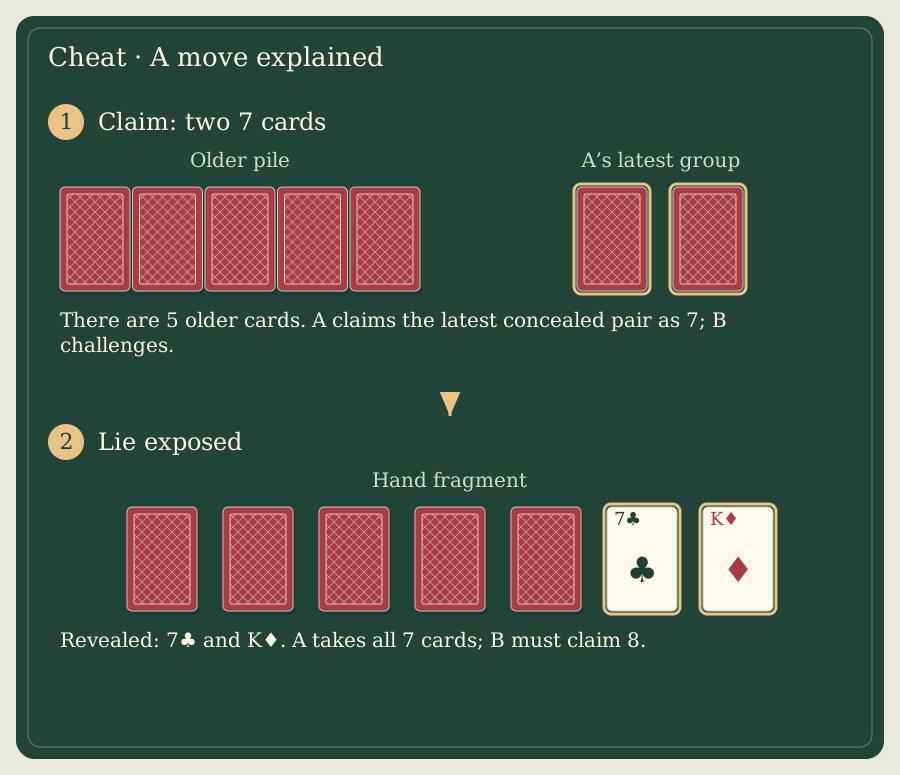
Rank 7 is required and the pile already contains 5 cards. A puts down 7♣ and K♦, claiming “two 7 cards”; B challenges. K♦ proves the lie: A takes 5+2=7 cards. B plays next and must claim 8, despite being the challenger. Without a challenge both cards would have remained in the pile.
← On a small screen, scroll the diagram horizontally. →
Common questions
May I pass?+
No. Play a permitted group, bluffing if necessary.
Does a challenge restart at A?+
No. Next player announces the next rank.
Can a final bluff win?+
Yes, if opponents accept it without challenge.