← On a small screen, scroll the diagram horizontally. →
01 /
Players and cards
One human player faces the bank’s dealer. Mix 6 identical 52-card packs: 312 cards without jokers. Use notional counters and a separate cutting marker that never participates in comparisons. Ranks from high to low are A, K, Q, J, 10, 9, 8, 7, 6, 5, 4, 3, 2; suits are equal. This selects the Massachusetts Gaming Commission base settlement, including 2:1 on a repeated tie, without Tie wagers or progressive bonuses.
02 /
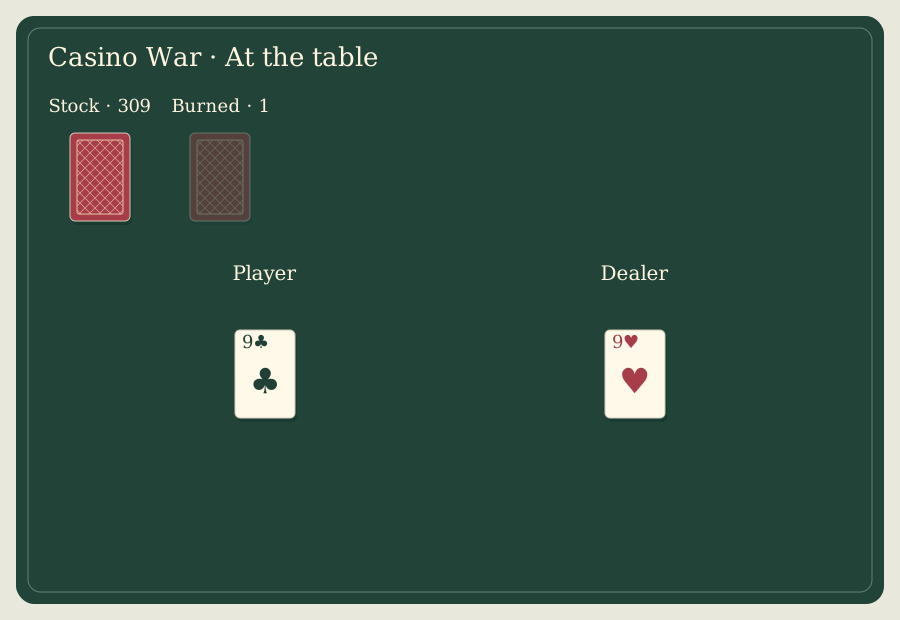
Deal and opening
For a home ledger session agree on 20 rounds and shuffle the complete set before each. After cutting, burn 1 card face down without looking at it. The player places an initial 2 units. Deal 1 face-up card to the player, then the dealer. If the player’s card is higher, the stake wins 1:1: return 2 and add 2, net +2. If lower, the stake loses: net −2.
03 /
Playing a turn
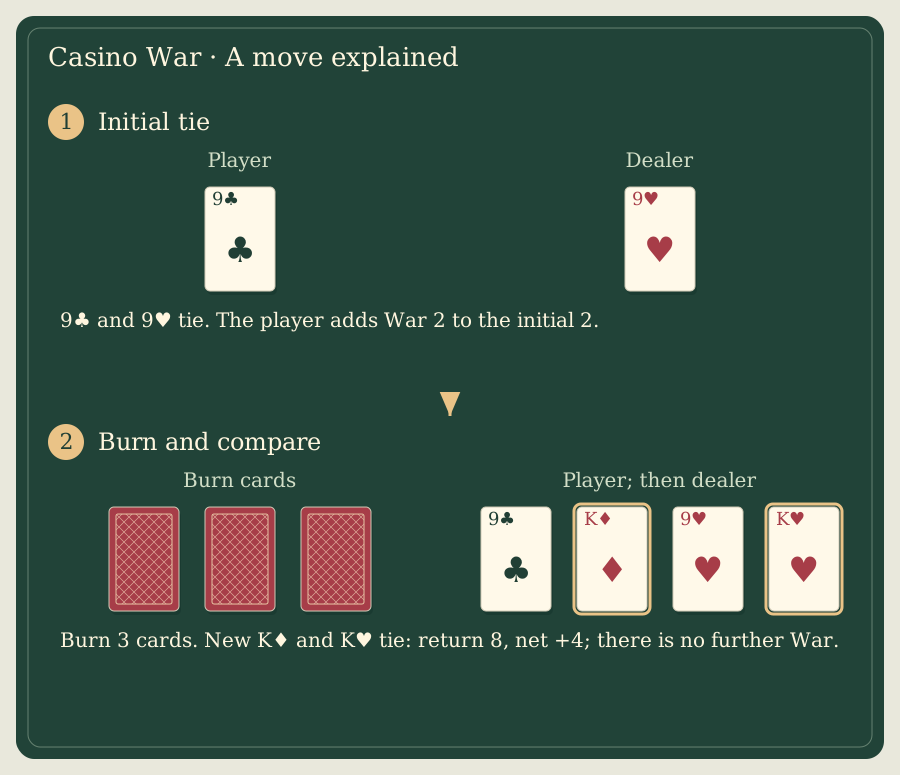
When ranks tie, choose surrender or War. Surrender returns 1 and loses 1, net −1. For War add another 2, equal to the initial wager; the total committed is 4. Leave the original cards face up. The dealer burns exactly the next 3 cards together face down, then deals a new face-up card to the player and a new one to the dealer. Do not burn extra cards between these new cards. Compare only the new cards.
04 /
Scoring
After War: a lower player card loses both stakes, net −4. A higher player card returns the initial stake and wins War 1:1: return 6 in total, net +2. Equal new cards return the initial stake and win War 2:1: return 8 in total, net +4. There is no further War. Ratios describe profit; return of the winning stake is additional. The repeated-tie payment is a base settlement, not a jackpot.
05 /
Ending the game
Settlement ends the round; cards never enter a player’s personal deck. Record net profit and collect the complete set for the next shuffle. After the agreed rounds a positive sum wins for the player, a negative sum for the bank, and 0 is a draw. If the set is incomplete or a card is unavailable after burning, the home agreement is to void the entire round, refund all stakes, restore the set and replay without counting it. Never compare a missing card.
06 /
History and selected variant
Casino War uses the simple rank comparison familiar from children’s War, but replaces collecting the pack with settlement against a bank. The regulator permits different pack counts; this guide chooses one profile instead of mixing operators’ rules. The regulatory source does not establish an inventor or origin date. The home session of 20 rounds and reshuffling before each are declared session arrangements, not casino requirements.
07 /
Worked example
The initial 9♣ and 9♥ tie. The player adds War 2 to the initial 2. After 3 burn cards, the player receives K♦ and the dealer K♥: another tie. The initial 2 is returned, and War earns 4 plus its returned stake of 2. Total returned is 8 from 4 committed, net profit +4. No further cards are dealt.
← On a small screen, scroll the diagram horizontally. →
Common questions
Does an ace beat a king?+
Yes: A ranks above K; low cards have no special exception.
Does a repeated tie start another War?+
No. This profile immediately pays War 2:1 and returns the initial stake.
Burn before every new card?+
No. For War burn one shared packet of 3 cards, then deal both new cards.