← On a small screen, scroll the diagram horizontally. →
01 /
Players and cards
One human player faces the bank’s dealer. Use 52 cards without jokers and notional units. This guide selects Vivo’s base profile: an enhanced Ante paytable and Call 1:1 when beating a qualified dealer. AA, jackpots and other bonus wagers are excluded. This is not player-versus-player Hold’em: you cannot choose your own raise size or bluff the dealer into folding.
02 /
Deal and opening
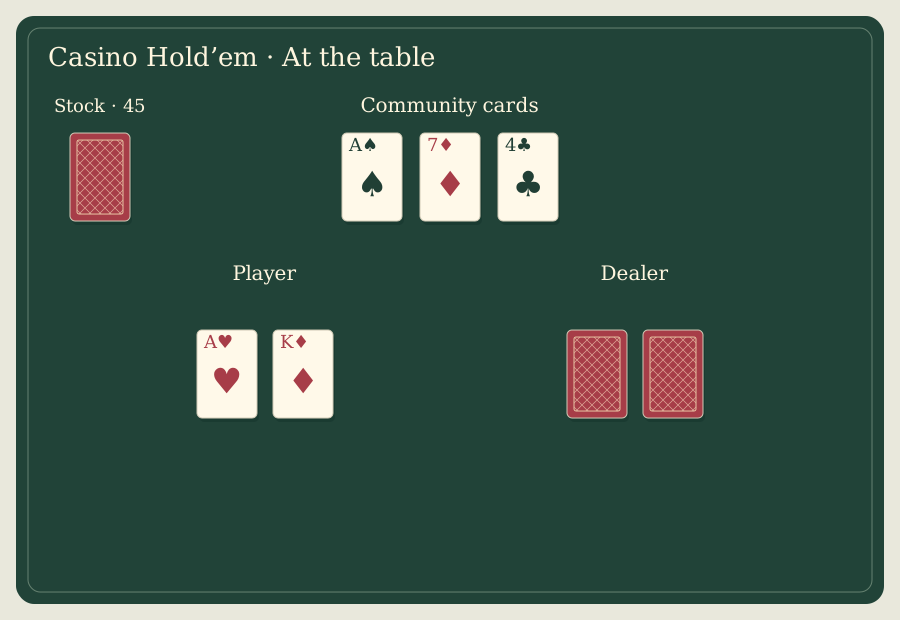
Place Ante 1. Deal the player 2 face-up private cards, the dealer 2 hidden cards, and a flop of 3 face-up community cards. The player now chooses Fold, losing Ante, or Call, adding 2, twice Ante. After Call reveal 2 further community cards, then the dealer’s cards. There are no other wagers or decisions. Both hands share the community cards.
03 /
Best hand from seven
Each side selects its best 5 cards from its 2 private cards and the 5 community cards. It may use 0, 1 or 2 private cards. Compare only the chosen 5: the sixth and seventh cards never break a tie. If the board alone is best for both, the hands tie. There is no shared pot to split: settle each wager as described below.
04 /
Hand rankings
From strongest to weakest: straight flush, four of a kind, full house, flush, straight, three of a kind, two pair, one pair, high card. A royal flush is the highest straight flush, A–K–Q–J–10. A straight needs 5 consecutive ranks; A may be high or low in A–2–3–4–5, but K–A–2 cannot wrap. A flush has 5 cards of one suit; a full house has a triple and a pair.
Within a category compare the straight’s top card; four of a kind then its kicker; the full house’s triple then pair; a triple or pair followed by the other cards in descending order. With two pair compare the higher pair, lower pair, then kicker. Compare flushes and high-card hands card by card in descending order until different. Suits are equal; identical ranks in the best 5 cards produce a tie.
05 /
Qualification and settlement
The dealer qualifies with a pair of 4 or better. Without qualification, Ante pays by its table regardless of the hands’ relative strength, while Call is returned. If a qualified dealer is stronger, the player loses Ante and Call; an exact tie returns both. When the player beats a qualified dealer, Ante pays by its table and Call pays 1:1. Fold gives −1; losing after Call gives −3.
06 /
Scoring
Net Ante payouts: royal flush 100:1; other straight flush 20:1; four of a kind 10:1; full house 3:1; flush 2:1; straight, three of a kind, two pair, pair or high card 1:1. This is the Ante table, not the Call table. Return a winning stake in addition to net profit; a push only returns the stake. Dealer nonqualification does not cancel the enhanced Ante award for a strong player hand.
07 /
Ending the game
Use notional units and record net results; there is no shared pot between players. Agree on 20 rounds. Gather all 52 cards and shuffle after each. Void an incomplete or incorrect deal, return all stakes and replay it without counting the void round. A positive total is a player win, a negative total a bank win, and 0 a draw. If counters run short, continue on a ledger without changing the stakes.
08 /
History and selected variant
Casino Hold’em adapts Hold’em’s shared-card idea to a house-banked game. Vivo’s published rules do not provide a complete origin history, so this guide does not assign a sole inventor. Distinguish its fixed Call/Fold decision from Texas Hold’em’s multiple betting rounds. Commercial bonus products can have separate tables unrelated to the base game.
09 /
Worked example
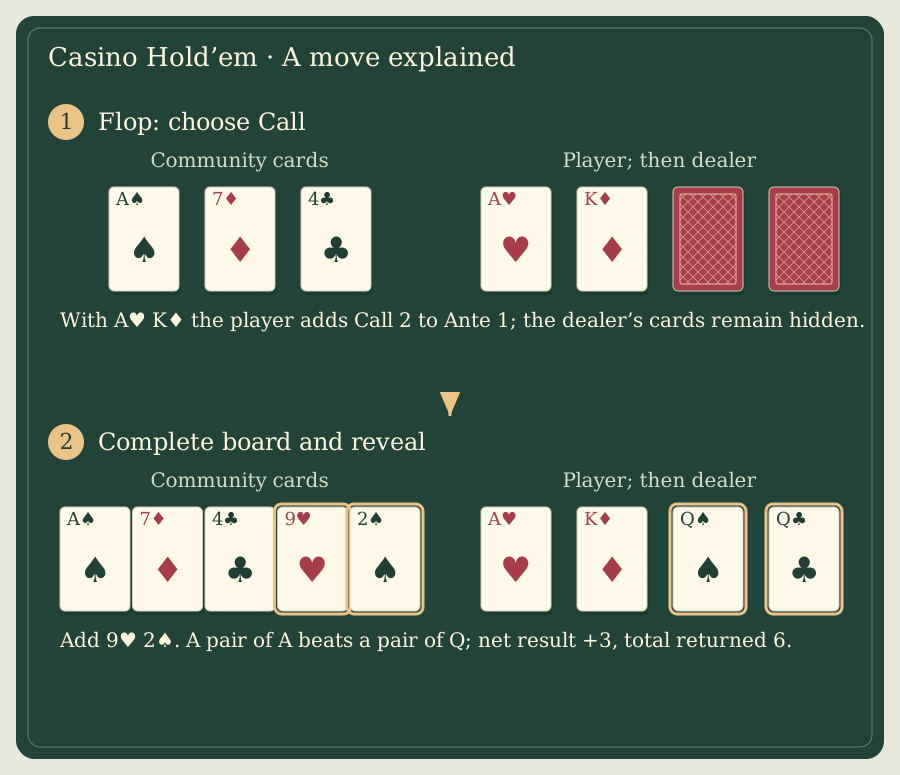
The player has A♥ K♦ and the flop is A♠ 7♦ 4♣. After Ante 1 the player adds Call 2. The final cards are 9♥ 2♠; the dealer reveals Q♠ Q♣. The player has a pair of A with K, 9, 7; the dealer has a pair of Q with A, 9, 7. The dealer qualifies but loses. Ante wins 1 and Call wins 2: net +3, total returned including stakes 6.
← On a small screen, scroll the diagram horizontally. →
Common questions
May I exchange a card?+
No. The selected base profile allows neither exchanges nor card purchases.
Which suit wins?+
None: suits never break a tie between hands.
Does the payout include my stake?+
Ratios show net winnings; the winning stake is returned separately. A push returns only the stake.