← On a small screen, scroll the diagram horizontally. →
01 /
Aim and equipment
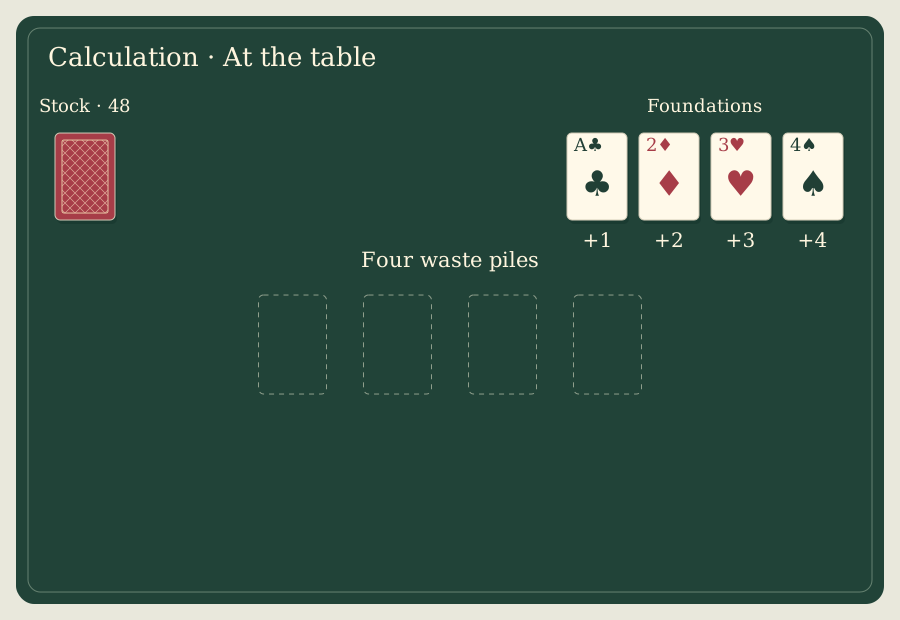
A patience for 1 player with 52 cards and no jokers. Suits and colours do not matter. Four foundations build in steps of 1, 2, 3, 4. Ace means 1, J=11, Q=12, K=13; after 13 continue from 1. Put all 52 cards into 4 sequences of 13.
02 /
Setup and deal
Before shuffling choose any A, 2, 3, 4 as foundation starters, left to right. Shuffle the other 48 as a closed stock. Leave 4 empty waste piles below. These are not single-card cells: each may hold many cards. Waste cards stay face up, only their tops available.
03 /
Legal actions
Turn stock cards 1 at a time. Before turning another, place the card on a fitting foundation or atop any waste; waste placement has no rank restriction. Any waste top may move to a fitting foundation at any time, but never between wastes, reordered or from underneath. Foundations never return cards. If several foundations accept a card, choose one. Complete foundation orders:
- A 2 3 4 5 6 7 8 9 10 J Q K
- 2 4 6 8 10 Q A 3 5 7 9 J K
- 3 6 9 Q 2 5 8 J A 4 7 10 K
- 4 8 Q 3 7 J 2 6 10 A 5 9 K
04 /
Scoring
There are no speed or suit bonuses. Optionally record cards on foundations including the 4 starters; 52 means solved. A partial total is not victory. Ranks determine order, not point awards for aces or faces.
05 /
Ending the game
Win when all foundations end in K and both stock and wastes are empty. After stock exhaustion keep moving available waste tops; no second pass is allowed. With incomplete foundations and no such move, the attempt is lost. Gather the pack and select starters again for a new attempt; no player tie needs resolving.
06 /
Context and variants
The name highlights arithmetic intervals; Broken Intervals is another name. The checked rules establish neither a sole inventor nor a reliable origin date. This selects the ordinary profile with 4 wastes and no transfers between them. More wastes or foundation returns change the puzzle and are excluded.
07 /
Worked example
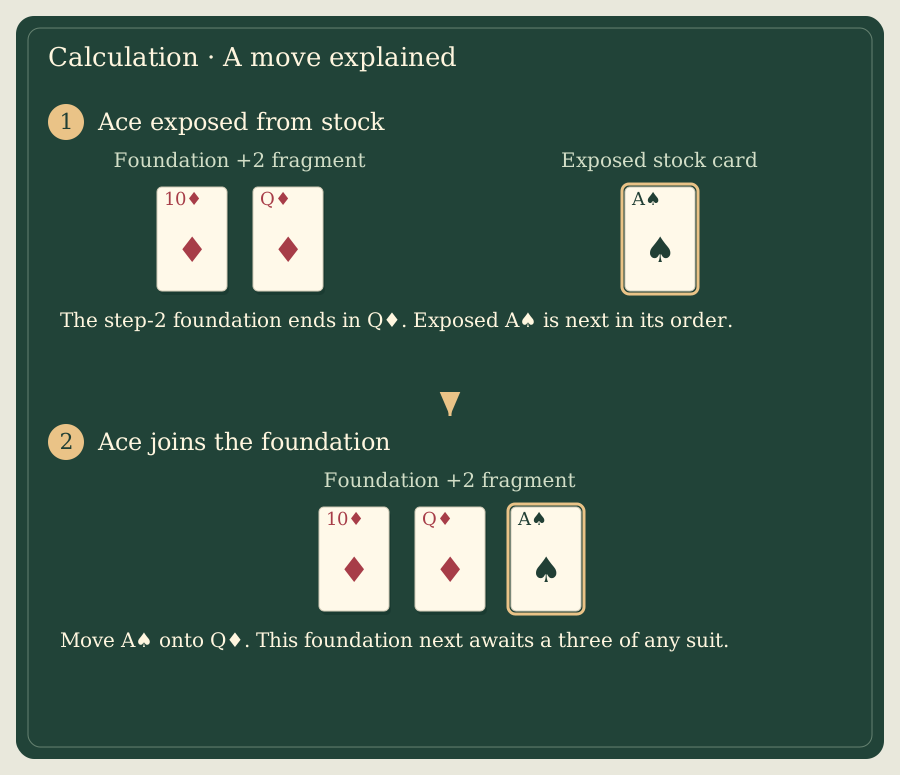
The step-2 foundation reached Q♦ via 2–4–6–8–10–Q. The exposed A♠ fits next: 12+2=14 wraps past K to A. Put it on Q♦ despite different suits. Step 1 needs K after Q, so that ace would not fit there now. Never retrieve a fitting card buried below a waste top.
← On a small screen, scroll the diagram horizontally. →
Common questions
Does foundation suit matter?+
No, only the next rank in its interval.
May I move between waste piles?+
No, a waste top may move only to a foundation.
Is there a second stock pass?+
No, the stock is passed only once.