← On a small screen, scroll the diagram horizontally. →
01 /
Aim and equipment
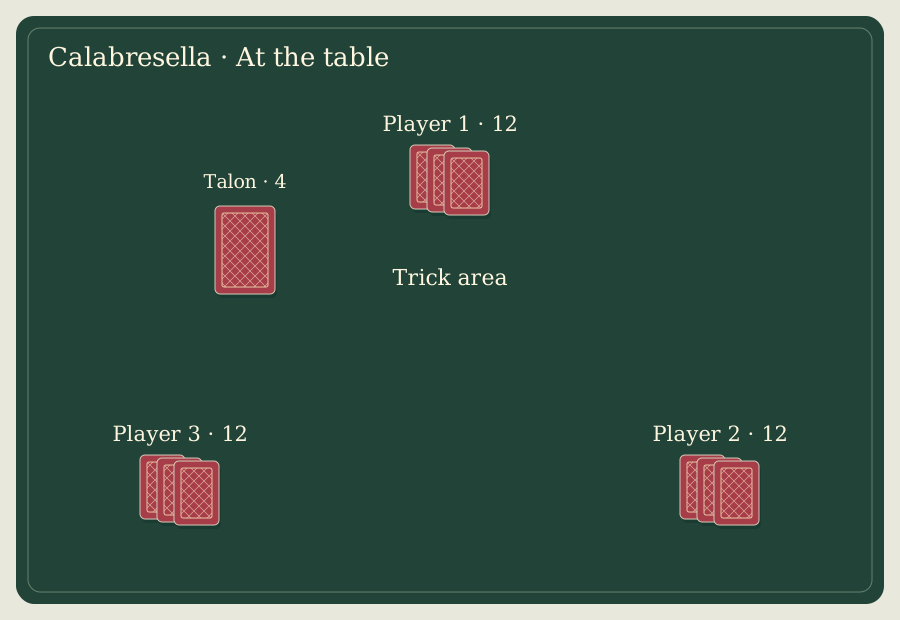
Three play individually: auction winner against two temporary defenders. Use 40 Italian cards or an ordinary pack without 10, 9, 8, with Q representing knight. Each suit ranks 3 2 A K Q J 7 6 5 4. There are never trumps. Soloist seeks at least 6 whole points from captured cards and last trick combined.
02 /
Setup and deal
Choose first dealer randomly, then rotate right. Shuffle and have the left neighbour cut. Deal anticlockwise, 12 each in packets of 4; remaining 4 face down form the monte. There is no ordinary draw after dealing. Defenders may not expose hands to each other; only their captures combine for the deal result.
03 /
Bidding and contracts
Each speaks once from dealer’s right around: pass or a bid higher than the previous. Three base levels: Chiamo, Solo, Solissimo. Solissimo ends bidding; all pass rotates dealer without scoring.
Chiamo: soloist names a card’s rank and suit. A defender holding it gives it openly. If in monte or already held by soloist, no transfer. Expose all 4 monte cards and add them to soloist. If a defender supplied the call, soloist returns 1 chosen card openly to that defender. Finally discard 4 face down: everyone again has 12. Solo uses the same monte exchange without a call.
Solissimo leaves monte untouched. After winning the auction soloist may increase the agreement: dividete lets defenders blindly take 2 each from monte, then each discards 2 of their 14 concealed; scegliete exposes monte, defenders allocate its 4 as they wish and each discards as many as taken. Everyone ends with 12 and a new monte of 4 discards. These are Solissimo enhancements, not compulsory extra bidding circuits.
04 /
Legal actions
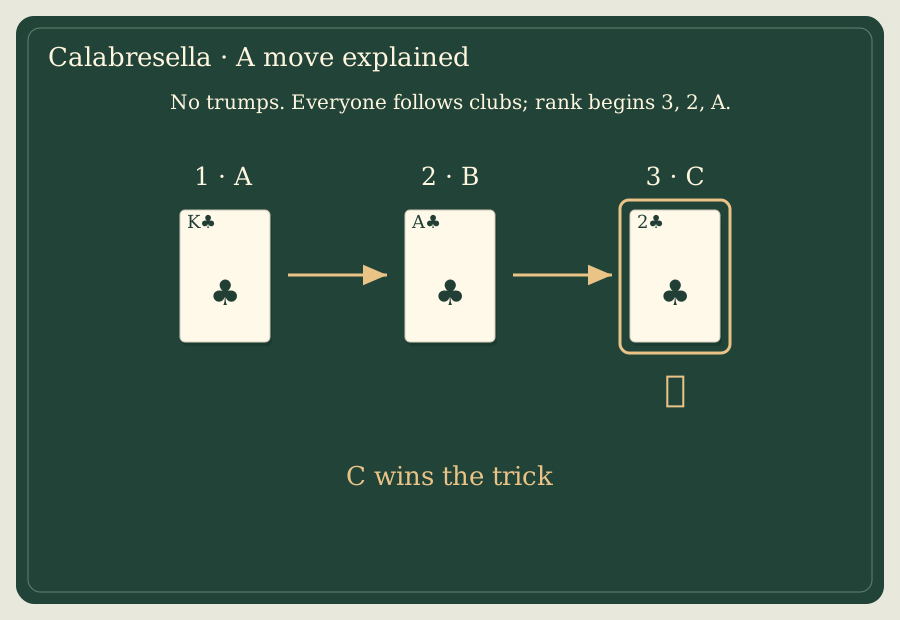
Dealer’s right leads in Chiamo and Solo; soloist leads Solissimo and its enhancements. Follow suit if able, otherwise anything. Overtaking is optional and no trump exists. Highest led-suit card takes the 3 played cards and leads next. Complete all 12 tricks. Last-trick winner also takes concealed monte, including exchange discards; it is not automatically soloist’s property.
05 /
Scoring
A scores 1 whole point; each 3, 2, K, Q, J scores 1/3; others 0. Last trick adds 1. Avoid fractions by counting thirds: A=3, the listed faces and 3/2=1, last=3, total budget 35. Give monte cards to last-trick winner, then drop remainders from each side’s combined sum. Soloist needs at least 18 thirds, or 6 whole; 17 loses. Never round individual tricks.
Value per defender: Chiamo 1, Solo 2, Solissimo 4, dividete 8, scegliete 16. Success gives soloist twice that value, each defender loses it; failure reverses transfers. Units are nonmonetary. Cappotto, soloist taking or losing every trick, multiplies value by 2. Without a full sweep, losing side with fewer than 3 thirds in captured cards makes Stramazzo, multiplier 3; exclude last-trick bonus for this test. These multipliers are alternatives, not cumulative.
06 /
Ending the game
Record personal balances, allowing negatives. Our complete session is 9 scored deals; all-pass consumes no deal. Highest total wins, exact ties share places. This is a session agreement, not a traditional fixed target of 21. Defenders may oppose each other next deal, so never merge their running balances permanently.
07 /
Context and variants
Calabresella, also Terziglio, is an Italian Tressette branch. Americanised accounts differ in spelling, deal and monte treatment. This uses the published Italian profile with three base bids and Solissimo enhancements. Checked accounts establish no sole inventor, and the name proves no precise origin town.
08 /
Worked example
K♣–A♣–2♣ goes to third player: two outranks ace here. Value 1+3+1=5 thirds; do not round that trick alone. In a separate Solo, including monte and last trick, soloist totals 18 thirds and defenders 17: 6 versus 5 whole. Without Cappotto/Stramazzo, value 2 per defender changes balances +4, −2, −2, summing 0.
← On a small screen, scroll the diagram horizontally. →
Common questions
Does ace beat two?+
No, each suit starts 3, then 2, then A.
Does soloist always get monte?+
No, final four cards belong to last-trick winner.
May I trump when void?+
There are no trumps; another suit cannot win.