← On a small screen, scroll the diagram horizontally. →
01 /
Louisiana Bourré
Bourré, also Booray, is a Louisiana trick-taking game, not poker. Pagat’s account draws on Roy Nickens’s book and player reports. We select ordinary single-ante play for 5 participants, including strict card play and cinch. Unlike CardRulesPlus’s summary, a zero-trick player funds the next pot but does not prevent the current outright winner from collecting the old one.
02 /
Ante and five cards
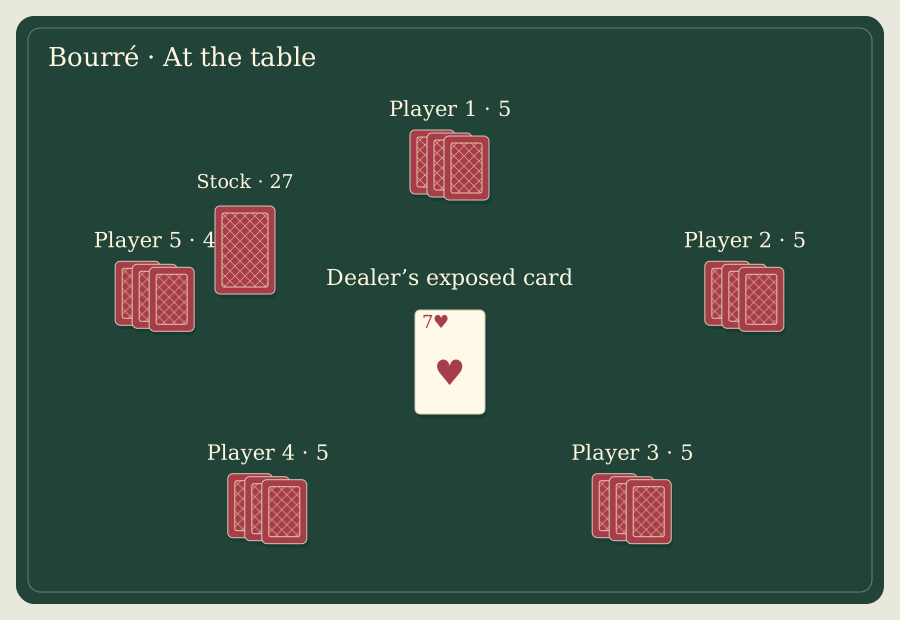
Use 52 cards without jokers, ranked A–K–Q–J–10–9–8–7–6–5–4–3–2 in every suit. Each starts with a notional balance of 100. All 5 contribute 1 to the initial pot. Shuffle, have the right neighbour cut, and deal singly clockwise from the left, 5 each. Dealer’s fifth and final card is face up, fixes trumps and belongs to dealer. Next dealer is left. The stock initially contains 27 cards.
03 /
Stay, pass and exchange
From dealer’s left, each in turn says pass or play. Passing folds the concealed hand, loses the ante, and removes further winnings or penalties for that deal. Staying immediately discards 0–5 and draws replacements before the next player decides. Standing pat is allowed. Dealer must play if the exposed trump is A. If all others pass, dealer stays and takes the pot; any sole remaining player wins it automatically.
With the selected 5 participants, 52 cards suffice even if everyone exchanges everything: 25 initial cards and up to 25 replacements. Do not inspect others’ hands or discards or signal a decision out of turn.
An early announcement or gesture about playing, passing or the number of replacements forfeits your next turn to deal.
04 /
Compulsory responses
Nearest active player left of dealer leads first, then each winner. Follow suit if held; otherwise play a trump if held. Within those constraints win the current trick whenever possible, including overtrumping. If unable to overtrump, you must still undertrump rather than discard another suit. When holding the led suit after a trump has already been played, follow with any card of that suit; you need not waste A. Only with neither led suit nor trumps is discarding free. Highest trump wins, otherwise highest led suit.
05 /
Cinch: a certain pot
A cinch means 3 tricks are already guaranteed regardless of others’ play, either initially or with tricks already taken. On lead, its holder must lead highest trump if held. On response, when normal rules permit playing trump, play highest trump. Exception: last to act only needs to win under ordinary rules. Following suit still takes priority. Equivalent adjacent top trumps are acceptable when no opposing card lies between them. After taking 3 tricks, do not conceal a remaining trump by leading a plain suit.
06 /
Pot, no tricks and carry-over
The pot P goes to a unique most-tricks winner: 3 always suffice, while 2 can win at 2–1–1–1. A tie for most pays nobody and carries the whole pot. Each active player with 0 tricks contributes another P to the next pot. With an outright winner, old P has already been awarded and the new pot starts from penalties. On a tie old P remains plus penalties.
Next deal, players who just paid for zero and those tied for most skip the ordinary ante; everyone else, including folders, pays 1. Every penalty uses the same old P, not a successively enlarged pot.
07 /
Session and errors
The teaching session lasts 12 deals. Use a notional ledger allowing negative balances, avoiding an unspecified physical-chip shortfall as pots grow. After the final deal settle winnings and penalties, but collect no new ante. Divide any remaining pot equally among all 5, recording fractions exactly. Highest balance wins; ties share position.
Illegal play uncorrected before the next card is a renege, penalised by P. Correcting before the next player avoids that P penalty for the error, but forfeits winning the pot and the next turn to deal; zero tricks still incur their penalty.
08 /
Following still comes first
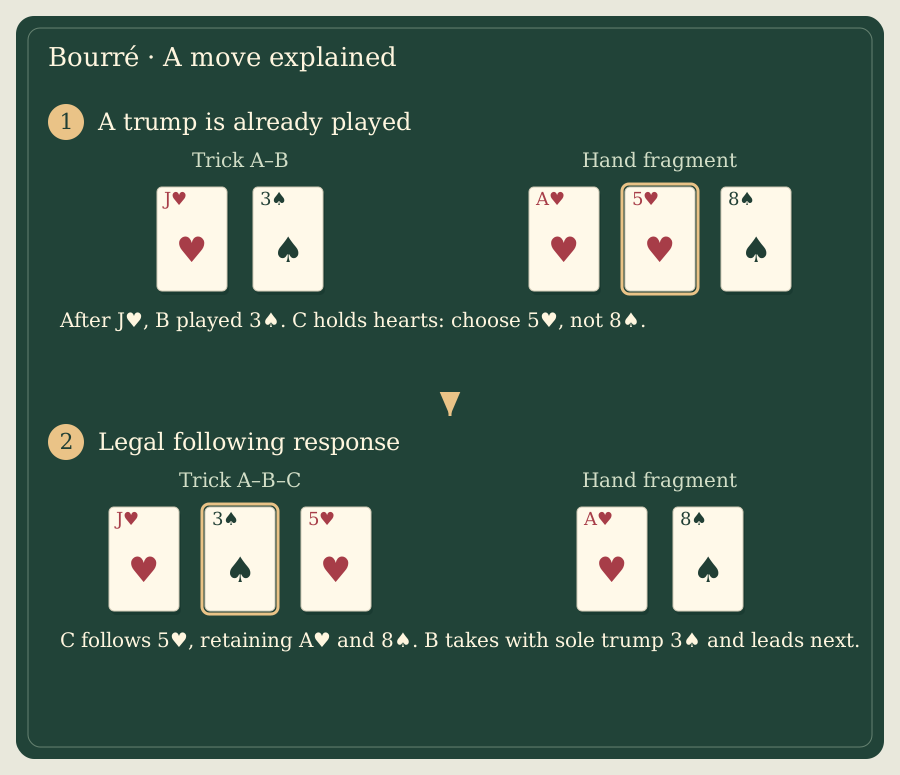
Two of 5 passed; A,B,C play with spades trump. A leads J♥; void B plays their only trump 3♠. C holds A♥,5♥,8♠: hearts must be followed, so C may choose 5♥ and retain A♥. B captures.
Initial pot was 5; trick totals A=3, B=2, C=0. A receives 5. C pays penalty 5 toward next deal; the other 4 add 1 each, making next pot 9. C’s penalty does not cancel A’s payout.
← On a small screen, scroll the diagram horizontally. →
Common questions
Does a tied maximum split the pot?+
No, the entire pot carries to the next deal.
May I discard when void with a weak trump?+
No, a trump is compulsory even if it cannot overtake.
Does the current winner take zero-trick penalties?+
No, those payments form the next pot.