← On a small screen, scroll the diagram horizontally. →
01 /
Selected table
Blackjack developed from the twenty-one family. Its name does not specify one worldwide code: pack count, soft 17 and payouts vary. We fix an American profile: 6 decks, hole card and natural check, dealer stands on soft 17, naturals pay 3:2. These are explicit teaching-table conditions, not every casino’s rules; surrender and side bets are disabled.
02 /
Cards and round setup
Shuffle 6 complete packs without jokers: 312 cards. Dealer faces 1–6 players, each independently. Cards 2–10 count face value, J/Q/K 10, A 1 or 11, choosing the highest total not exceeding 21. A soft hand uses an A as 11. Before dealing each stakes 2 notional chips, starting balance 100. Deal singly clockwise from dealer’s left: 2 face-up cards to each player, one up and one down to dealer. Players’ hands never combine.
03 /
Naturals and insurance
Original A plus a 10-value card is a natural. With dealer A up, offer insurance before checking, at most half the main stake: 1 here. With A or a 10-value upcard, dealer checks the hole card. Dealer natural ends the round: ordinary hands lose, player naturals push. Insurance pays 2:1 only for dealer natural; otherwise it loses and play continues. Winning insurance 1 yields profit 2, offsetting the lost main 2. Without dealer natural, player natural wins 3:2, even against ordinary 21.
04 /
Hit, stand and double
After the check, players finish their hands in order. Hit adds one card and another decision; stand ends drawing. At 21 the hand stops; above 21 it loses immediately, even if dealer later busts. An A drops to 1 when needed to avoid busting.
On any initial 2 cards except split aces, add exactly the original stake to double: take exactly one card and stop. No doubling after a normal hit. Doubling after non-ace splits is allowed; extra wagers must be covered by your remaining chips.
05 /
Splitting pairs
Initial cards of equal value, including different 10-valued courts, may split by adding an equal stake. Each card starts a separate hand; play them in order without exchanging cards. Resplit non-aces up to 4 total hands. Split A only once: each receives one card and stands; no resplitting, hitting or doubling these aces. Any split-hand 21 is ordinary 21, not a natural. Without the extra stake, retain normal hit/stand options.
06 /
Dealer and payments
After players, dealer reveals the hole card and must hit below 17, then stand on every 17–21, including soft 17. Bust is 22 or more: all surviving ordinary hands win. Otherwise higher non-bust total wins and equal totals return the stake. Ordinary wins pay 1:1 profit on the whole hand’s stake, including doubles; natural pays 3:2. Returning the original stake is not profit. Player busts are never rescued.
07 /
Teaching-session length
Play 10 rounds here; a player unable to stake the initial 2 stops participating. Compare players’ final gains against 100; equal results share position. This is a teaching session, not a compulsory tournament format. Never interrupt a hand or return cards mid-hand. For home practice shuffle the entire shoe before each round, keeping the same 6 packs.
08 /
Double to ordinary 21
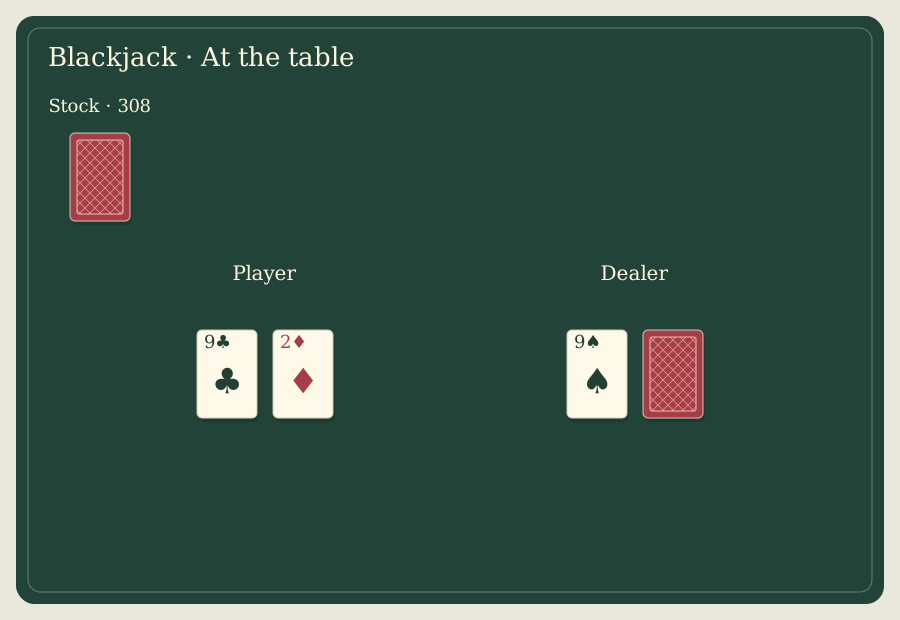
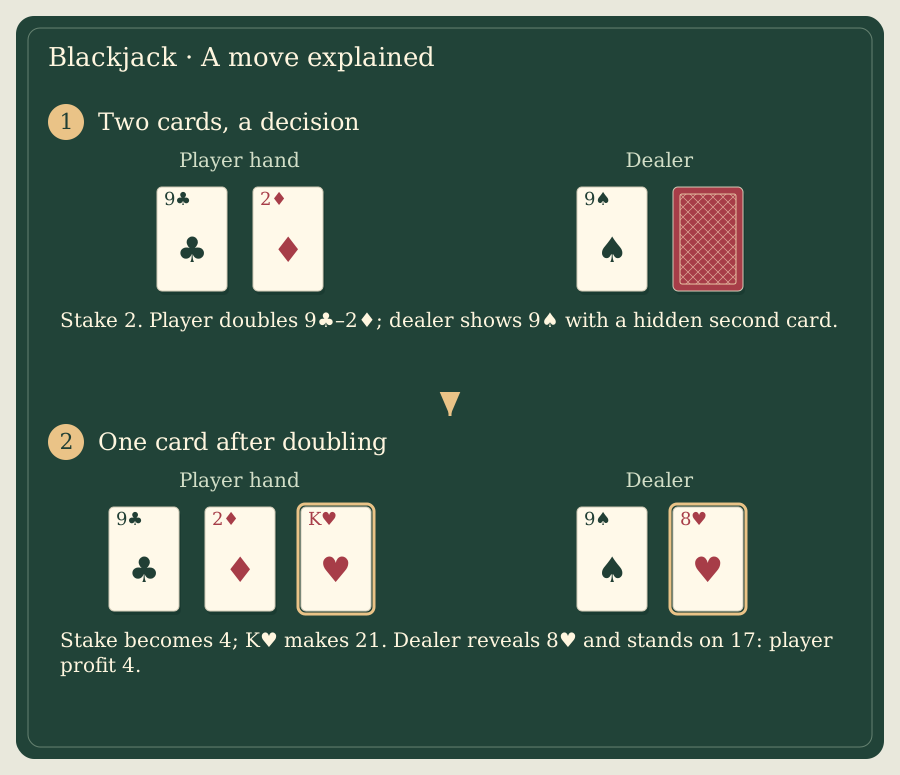
Player has 9♣–2♦ for stake 2; dealer shows 9♠. Double to 4 and receive K♥: 21, but three cards are not a natural. Dealer reveals 8♥ for 17 and stands. Player receives profit 4 plus the original stake 4 back. Separately, A–6 is soft 17; drawing 5 makes 12, not a bust, because A becomes 1.
← On a small screen, scroll the diagram horizontally. →
Common questions
Does dealer hit soft 17?+
No: this table uses S17, standing on every 17.
Is split-hand 21 a natural?+
No, it is ordinary 21 paying 1:1.
Both bust: a push?+
No, the player already lost on busting.