← On a small screen, scroll the diagram horizontally. →
01 /
Players and cards
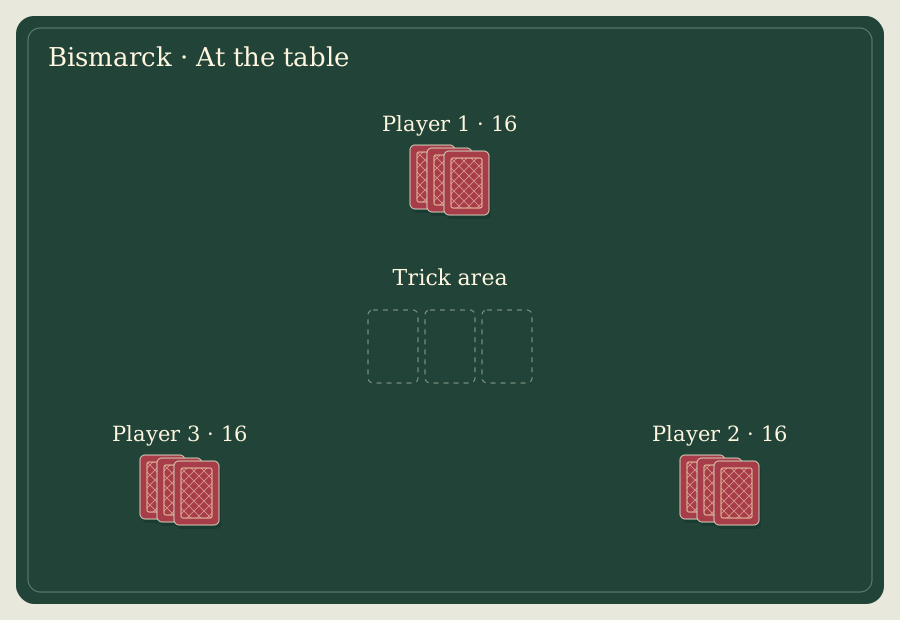
3 people play individually with 52 ordinary cards, no jokers. Rank A–K–Q–J–10–9–8–7–6–5–4–3–2. Choose first dealer randomly; pass the deal left after each hand. Deal and play clockwise. Forehand is dealer’s left neighbour, not the dealer.
02 /
Deal and opening
Shuffle, let the right neighbour cut and expose the first 4 cards. Seeing only these, forehand chooses an unused personal contract: Spel, no-trump taking; Spader, spades trump; Valfri, name any trump suit now; Pass, no-trump avoidance. Deal the remainder singly, 16 each. Forehand adds the exposed 4 to hold 20, then buries any 4 face down, keeping 16. Discards do not play.
03 /
Playing a turn
Forehand leads anything. Follow suit if able; otherwise play any card. Neither trumping nor overtaking is compulsory. Highest trump, otherwise highest of the led suit, wins and leads next. Play all 16 tricks without drawing; keep captures individually.
04 /
Scoring
Positive contracts give forehand quota 8 and the others 4 each. Score tricks minus quota. Pass quotas are 4, 6, 6; score quota minus tricks. Exact quota scores 0; negative results are allowed and the scores always sum to 0. Aces and tens have no individual point value.
05 /
Ending the game
Mark the chosen contract against forehand’s name: it cannot be repeated. Across 12 deals everyone is forehand 4 times and selects each of the 4 contracts once. Highest total wins; our tie agreement shares victory. If forehand forgets the discard and starts with 20, the same dealer redeals and the chosen contract remains compulsory.
06 /
History and selected variant
Pagat describes the modern Swedish profile and, citing Sten Helmfrid’s research, dates the first known rules to 1944. Naming after the battleship remains a historical hypothesis. British forms give the kitty to dealer and may force trumping; neither is imported here.
07 /
Worked example
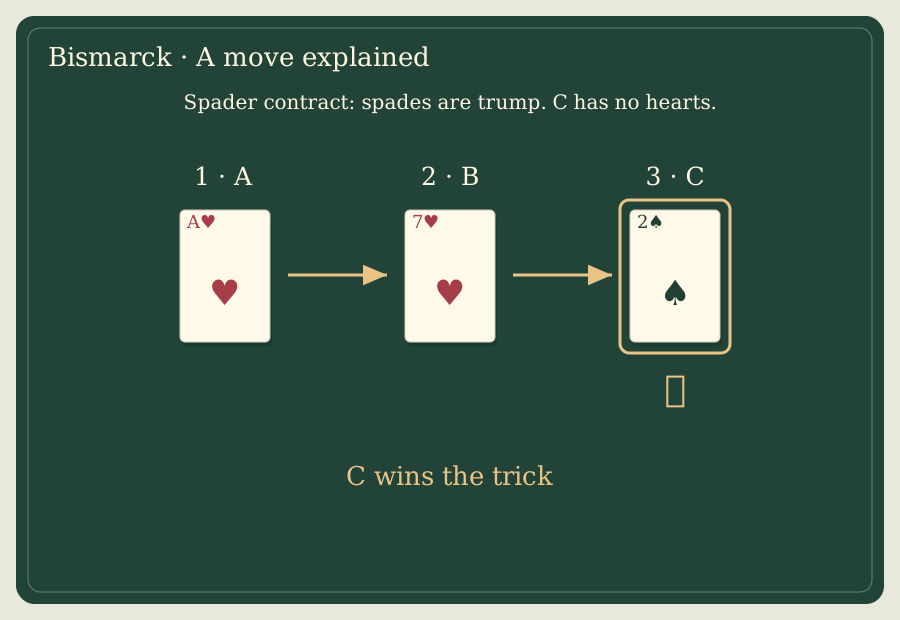
In Spader A leads A♥, B follows 7♥ and C, void hearts, plays 2♠. C wins with trump though a discard was legal. Suppose forehand A ultimately takes 9, B 3, C 4: scores +1, −1, 0. In Pass that same trick split would instead give A −5, B +3, C +2.
← On a small screen, scroll the diagram horizontally. →
Common questions
Who receives the four cards?+
Forehand, the player left of dealer.
Must I trump?+
No; when void in the led suit, any card is legal.
May I repeat a contract?+
No; each person uses every contract once.