← On a small screen, scroll the diagram horizontally. →
01 /
Players and cards
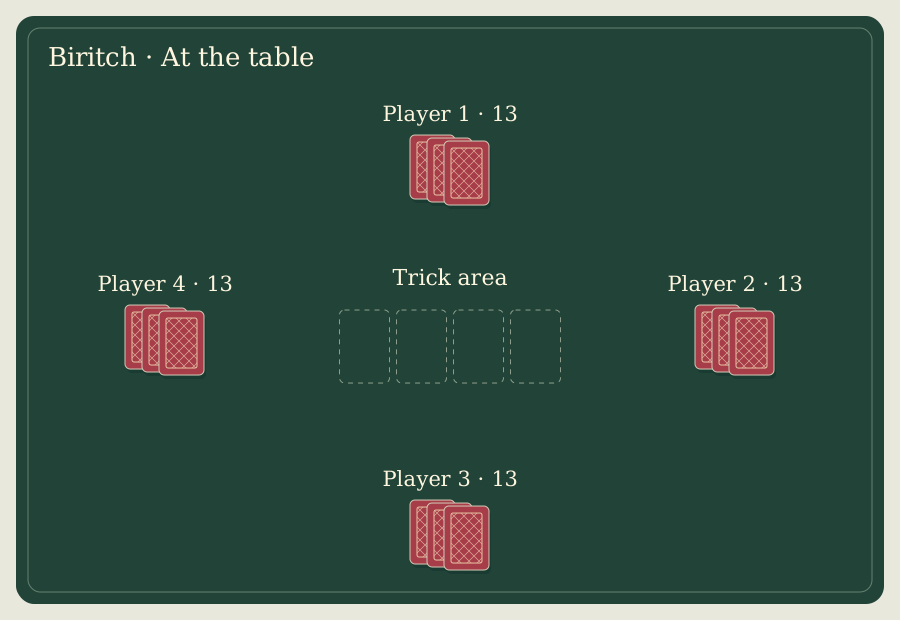
4 play in opposite-seat partnerships with ordinary 52 cards, no jokers. Rank A–K–Q–J–10–9–8–7–6–5–4–3–2 high to low. This follows Collinson’s 1886 pamphlet, not Auction or Contract Bridge. Our procedural agreement chooses first dealer randomly and retains partnerships for one rubber.
02 /
Deal and opening
Shuffle, cut right and deal singly clockwise to 13 each; next dealer is left. Do not expose a trump indicator. After seeing hands, dealer names any trump suit or says biritch, no-trump. Dealer may instead pass the choice to partner, who must name a suit or biritch and cannot pass again. There is no bid for a trick target.
03 /
Contre and repeated doubles
After selection either defender may contre, doubling trick value. Dealer’s side may sur contre to make it 4 times base; sides may then double alternately without a fixed ceiling. For clear procedure our agreement asks dealer’s left defender first, then the other; each further increase must come from the opposite side. Stop when the side due to answer declines. No increase after the opening lead.
04 /
Playing a turn
Dealer’s left leads first. Only then dealer’s partner exposes the entire hand as dummy. Dealer always controls both own hand and dummy, even if partner selected trumps. Dummy gives no advice and makes no decisions.
Play clockwise in original seat order. Follow suit if held; otherwise play anything, without forced trumping or overtaking. Highest trump or highest led-suit card wins and leads next. Play all 13 tricks; a dummy win means dealer chooses the next lead from dummy.
05 /
Scoring
The side with more than 6 tricks scores below the line for each excess: spades 2, clubs 4, diamonds 6, hearts 8, biritch 10. Multiply only these trick points by the agreed double factor. The side losing tricks has no penalty for a nonexistent contract. Put bonuses separately above the line.
Taking 12 tricks adds 20; taking 13 adds 40; these do not help win game. Reaching 30 below the current line wins game; record the entire deal, draw a new line and restart both sides’ game counts at 0. No surplus carries.
06 /
Honours and chicane
Honours depend on original holdings, not captures. At no-trump, 3 partnership aces score 30, 4 split between hands 40, all 4 in one hand 80; a 2–2 split scores nothing. With trumps, honours are A K Q J 10 of trump. Multiply base suit-trick value by: 3 honours, 2; 4 split, 4; 4 in one hand, 8; a fifth honour adds 1. Thus 5 split without four in one hand give multiplier 5, while four in one hand plus the fifth give 9.
Chicane is a hand void in trumps. If its side scores honours, add the value of 2 suit tricks; if the other side scores honours, deduct that value from its award. For the rare two-void-hands case our explicit agreement applies this adjustment once per side, not twice. Honours and chicane are neither doubled nor game points.
07 /
Ending the game
First side to 2 games wins rubber and adds 40 above the line. Sum everything above and below all lines; the difference is the final margin. Rubber winner and aggregate leader need not be the same side. Equal totals give margin 0 while retaining the rubber winner. Draw fresh partnerships for another rubber. A misdeal is redealt by the same dealer without scoring.
08 /
History and selected variant
John Collinson’s surviving Biritch, or Russian Whist pamphlet was published in 1886 and is an early printed bridge document. His later letter locates his acquaintance with the game in Constantinople, but “Russian Whist” alone does not establish one birthplace. The document’s history does not replace its rules: modern Contract Bridge bidding and undertrick penalties do not belong here.
09 /
Worked example
Dealer names hearts, without a double. Dealer’s side takes 9: beyond 6 there are 3, so below-line score is 3×8=24. If defenders originally hold 3 heart honours and no chicane applies, they score 2×8=16 above. With contre, the same tricks would give 48 below and a game, but honours remain 16.
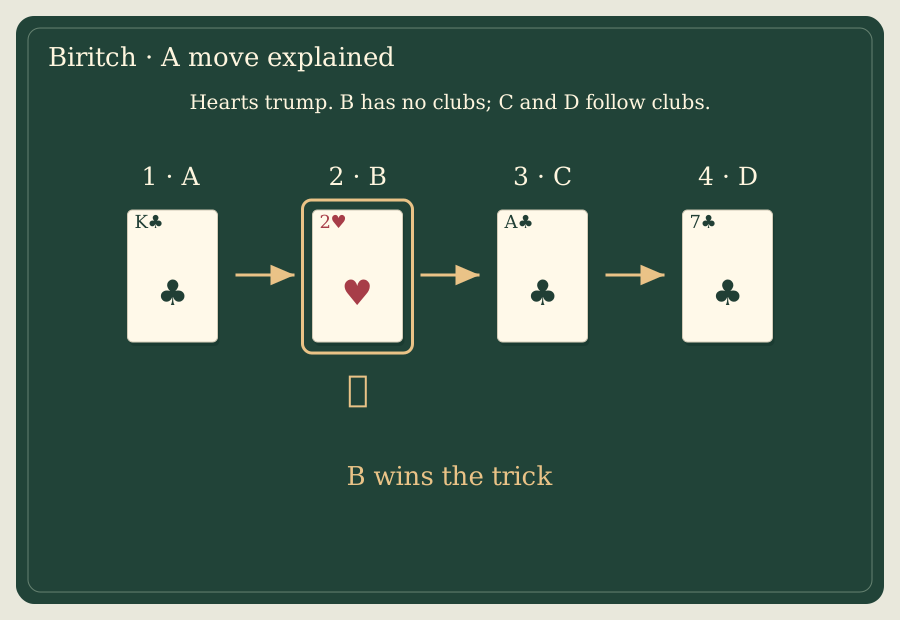
In a separate trick A leads K♣, B void clubs plays 2♥, C follows A♣ and D 7♣: B’s trump wins while those holding clubs must follow.
← On a small screen, scroll the diagram horizontally. →
Common questions
Who plays after passing the choice?+
Dealer still controls both hands; partner is dummy.
Must I promise a trick total?+
No; choose only a suit or no-trump.
Are honours doubled?+
No; only excess-trick points are doubled.