← On a small screen, scroll the diagram horizontally. →
01 /
Build the tableau and choose trump
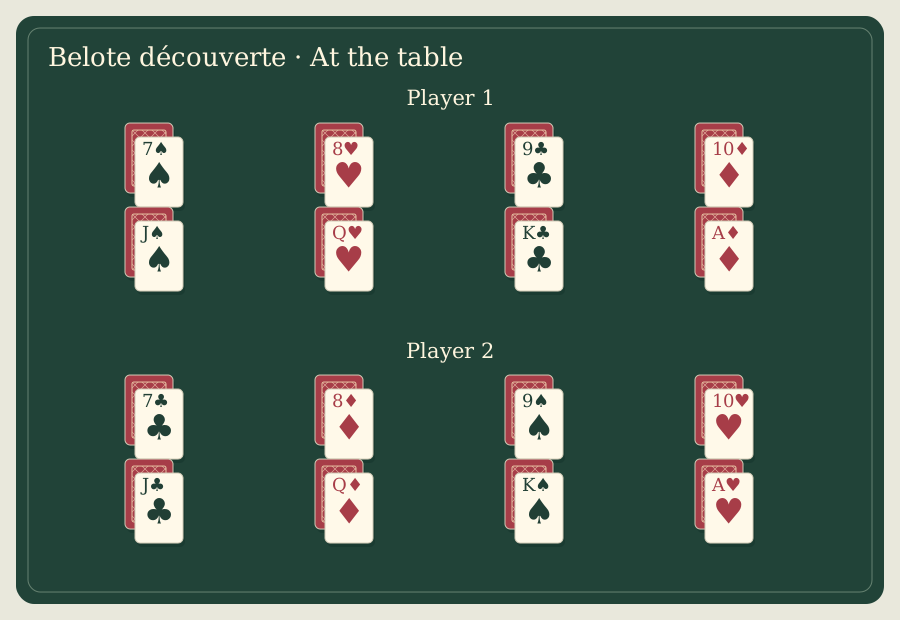
Use 32 cards, 7 through ace, for 2 players. Choose the initial dealer randomly and alternate thereafter. Shuffle initially, cut before each deal. Each player receives 8 face-down cards on the table, in 2 rows of 4, then 8 face-up cards covering them individually. Deal a row to the opponent, a row to the dealer, then the remaining rows in that order; repeat the order for the face-up layer. There are no cards in hand and no draw pile.
The dealer’s last exposed card indicates the first proposed trump suit. Non-dealer first, each player may take or pass. Taking ends the choice. If both pass, each may choose any other suit or pass. If both pass again, collect the cards and change dealer. The indicator always stays in the dealer’s tableau; taking does not transfer it.
02 /
Play from the exposed layer
Trump ranks J, 9, A, 10, K, Q, 8, 7; the corresponding values are 20, 14, 11, 10, 4, 3, 0, 0. Other suits rank A, 10, K, Q, J, 9, 8, 7, worth 11, 10, 4, 3, 2, 0, 0, 0. The player on the dealer’s right leads any card.
Non-dealer leads any exposed card. The opponent must follow suit using an exposed card if possible. On a trump lead, overtake if able. Void in another suit, trump if possible, otherwise discard any exposed card. A covered card imposes no obligation because it is unavailable. Highest trump, otherwise highest of the led suit, wins; the winner leads next. After both cards are played, expose any newly uncovered cards. An already isolated face-up card remains playable. Continue through 16 tricks.
03 /
Count the deal and the match
There are no sequence, set or belote bonuses. Add the captured card values and 10 for the last trick: 162 in total. If a player takes all 16 tricks, the last bonus becomes 100 instead, making 252. The taker must collect more than 81; equality is a failure, with no suspended score.
On success both players record their own points. On failure the taker scores 0 and the opponent 162, or 252 for taking every trick. A successful taker sweep likewise scores 252. Start each new deal from the running totals. We use a target of 1000: after a completed deal, the higher total wins if either has reached it; our explicit tie convention continues with alternating dealers until the totals differ.
04 /
Reveal at the correct moment
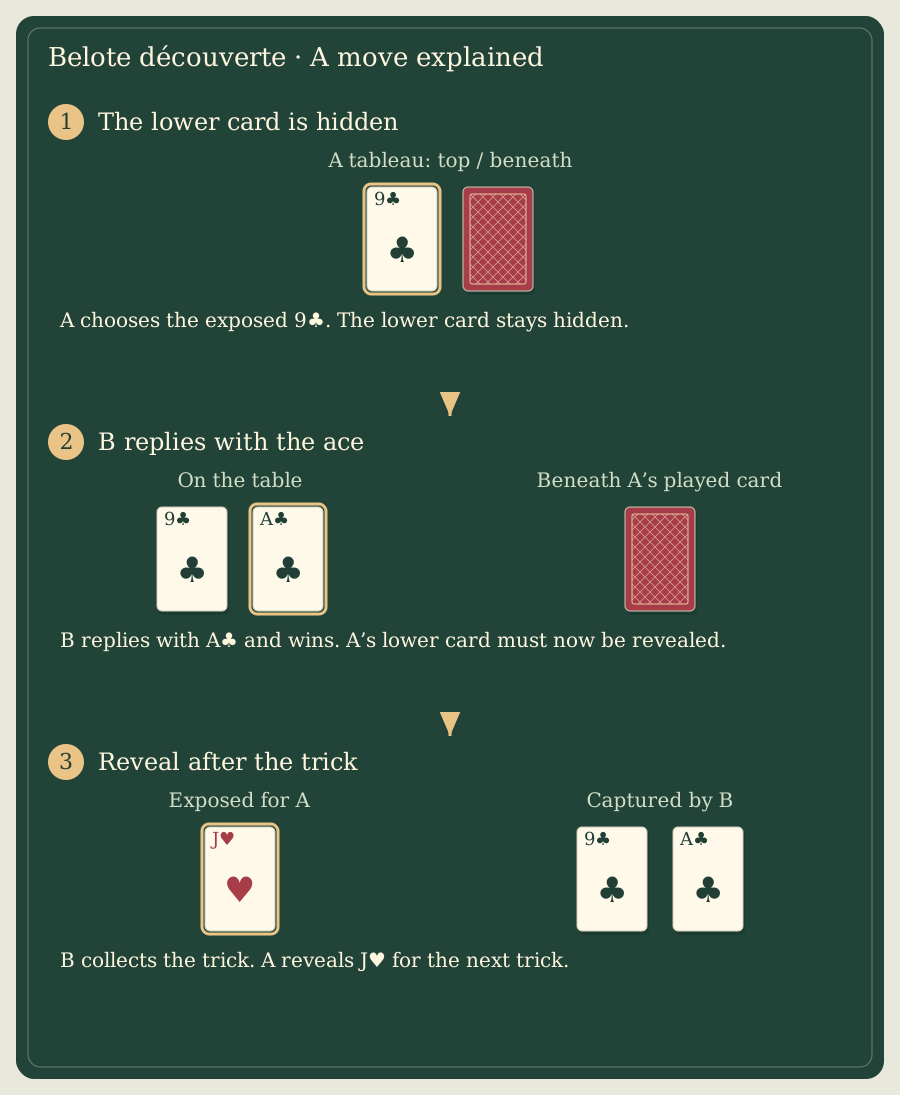
Your exposed 9♣ covers a face-down card. You lead 9♣; the opponent responds with A♣ and wins. Only after both cards have been played do you reveal the covered card, say J♥. It becomes available for the next trick, not for the response to your earlier lead. If hearts are trumps, that jack is now particularly valuable, but it cannot change the completed trick.
← On a small screen, scroll the diagram horizontally. →
05 /
Context and alternatives
Découverte means “exposed” or “uncovered”. The layout is a two-player adaptation of Belote, not a separate claim to an ancient origin. Pagat records it alongside other Belote variants and identifies its contributors; the consulted rules do not establish a first inventor or year. Revealing the leader’s hidden card immediately and counting melds are documented alternatives. Both change information or scoring, so agree them before play rather than adding them to this profile.
Common questions
May I play a covered card?+
No. Only face-up cards are playable; uncover hidden cards after the trick.
Does the taker receive the trump indicator?+
No. It remains with the dealer.
Does K–Q of trump score belote?+
Not in the selected no-declarations version.