← On a small screen, scroll the diagram horizontally. →
01 /
The session
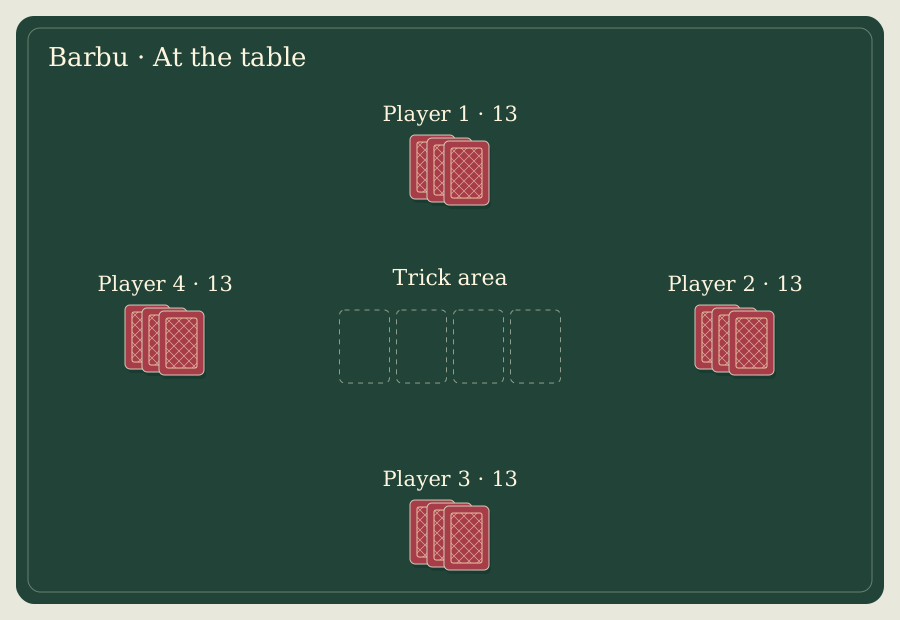
Use 52 cards, ranked A K Q J 10 9 8 7 6 5 4 3 2. The 4 players compete individually. Randomly choose the first declarer. For 7 hands that player remains declarer; the player on the right deals 13 cards each, with the opposite player cutting. Play clockwise. After looking at the cards, declarer selects an unused contract. Once all 7 have been used, the next player to the left becomes declarer. A session lasts 28 hands.
02 /
The seven contracts
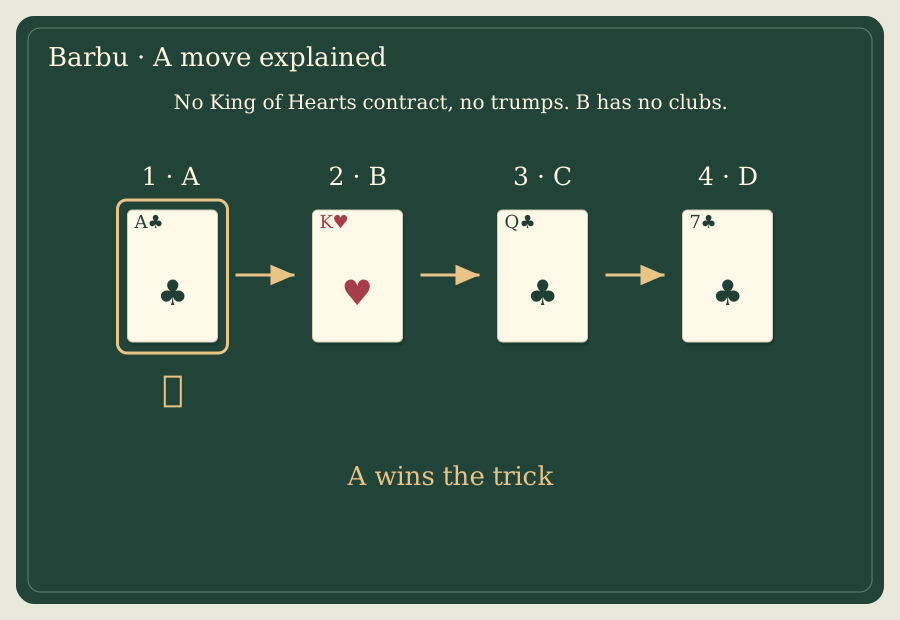
For the 5 negative contracts there are no trumps. Declarer leads, everybody follows suit if able, otherwise discards freely; highest of the led suit wins and leads again. No Tricks: −2 per trick. No Queens: −6 per queen captured. No Last Two: −10 for the penultimate trick, −20 for the last. No Hearts: −2 per heart except A♥, which is −6. No King of Hearts: K♥ costs −20. In the last 2 heart contracts, leading hearts is forbidden unless your hand contains only hearts. Display captured penalty cards; a contract may stop once every scoring card has been captured.
Trumps: declarer chooses a trump suit and leads. Follow suit; when trumps are led, overtake the highest if possible. If void in a plain suit, you must play a trump that wins the trick if you can. If unable to win with trump, discard freely. Highest trump, otherwise highest of the led suit, wins and leads. Each of the 13 tricks scores +5.
Dominoes: declarer chooses a starting rank and starts. Each turn play 1 available card: either a card of the starting rank to open its suit, or the next higher or lower card adjoining that suit’s existing run. Aces are high; there is no wraparound. Play is compulsory if possible; otherwise pass. Empty players drop out while the others continue. Finishing positions score +45, +20, +5, −5.
03 /
Doubles and the final result
After declarer announces the contract and any chosen suit or rank, each player gets 1 turn to declare doubles, beginning on declarer’s left and ending with declarer. In negative contracts, others may double any other players. In positive contracts, they may double only declarer. Declarer may only redouble players who doubled declarer. In each block of 7 hands, every other player must double declarer at least 2 times; track the obligation before passing.
First record everybody’s raw contract score. For each pair with a single double, transfer the difference between their raw scores from the lower scorer to the higher scorer. If both doubled each other, transfer twice that difference. Equal raw scores transfer nothing; calculate every pair from raw scores, never from adjusted totals. Sum all adjustments and keep a running total. Highest total after 28 hands wins; our explicit table agreement shares victory on a final tie.
04 /
Example, history and alternatives
In No Queens, Ada takes 2 queens, Ben 1, Clara 1 and Dan none: raw scores −12, −6, −6, 0. Only Ben doubles Ada. Their difference is 6, transferred to Ben: adjusted scores are −18, 0, −6, 0. No cards or partnerships are shared by making a double.
← On a small screen, scroll the diagram horizontally. →
05 /
History and variants
The French name means “bearded”, referring to the heart king. Pagat distinguishes a simpler French sequence of contracts from the modern choice-and-doubling form developed among bridge players, and reports its association with the Italian Blue Club team. This describes development, not a securely established inventor or exact birth date. Fixed contract order and games without doubles are alternatives, not rules to insert midway into this session.
Common questions
Can I decline a playable card in Dominoes?+
No. A legal play is compulsory; pass only if you have no legal card.
Are hearts allowed once somebody discards one?+
That does not lift the lead restriction in the heart contracts. You may lead hearts only when you have no other suit.
Do doubles create a partnership?+
No. They change pairwise score transfers; all players still compete individually.