← On a small screen, scroll the diagram horizontally. →
01 /
History and scope
Baccarat’s family is documented in nineteenth-century French accounts; Pagat’s research overview points to Charles Van-Tenac’s 1847 book. That account is not yet modern Punto Banco. The later variant makes drawing compulsory; an exact invention date is not asserted here.
Chemin de Fer and Baccarat Banque retain decisions absent from Punto Banco. A generic “baccarat” heading is therefore insufficient to identify the playing rules.
02 /
Cards and teaching session
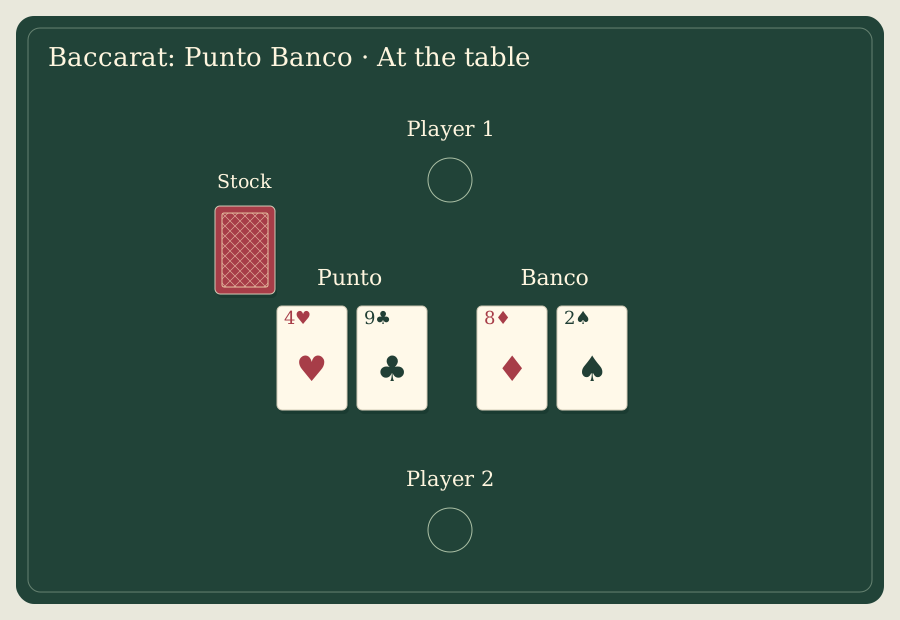
The selected eight-deck version uses eight standard 52-card decks without jokers: 416 cards. Mark Punto, Banco and Tie on the table. Choose a dealer; participants do not each receive separate hands.
Home agreement: two to eight participants start on zero and play ten deals. Before each, everybody records one prediction with a notional stake of 20 points. Dealer may also predict before revealing cards. Return and shuffle all cards after every deal. Use no money or balance restriction; negative scores are allowed.
03 /
Values and opening deal
A=1; 2–9 count their number; 10, J, Q and K count zero. Add values and retain only the units digit: 7+8=15 means five.
After predictions are fixed, deal face up in Punto–Banco–Punto–Banco order. If either initial pair totals eight or nine, neither hand draws. Compare immediately: eight loses to nine and equal eights tie.
04 /
Compulsory drawing
Without an initial eight or nine, Punto draws on 0–5 and stands on 6–7. If Punto stands, Banco draws on 0–5 and stands on 6–7.
If Punto draws, use that third card’s value and Banco’s original two-card total:
| Banco’s original total | Draws against Punto third card |
|---|---|
| 0–2 | Always |
| 3 | Anything except 8 |
| 4 | 2–7 |
| 5 | 4–7 |
| 6 | 6–7 |
| 7 | Never |
Otherwise Banco stands. Each hand has at most three cards. Recalculate final totals using the units digit. Higher wins; equal totals tie.
05 /
Settlement
For this tariff, a winning Punto prediction profits one stake; Banco profits 95% of a stake; Tie profits eight stakes. The original stake is returned separately. On an actual tie, Punto and Banco predictions push, while Tie wins.
| Prediction with stake 20 | Winning net change | Loss |
|---|---|---|
| Punto | +20 | −20 |
| Banco | +19 | −20 |
| Tie | +160 | −20 |
A push changes Punto/Banco scores by zero. After ten deals the highest total wins; equal leaders share victory. This session length is a home format, not a casino requirement.
06 /
The third-card-eight example
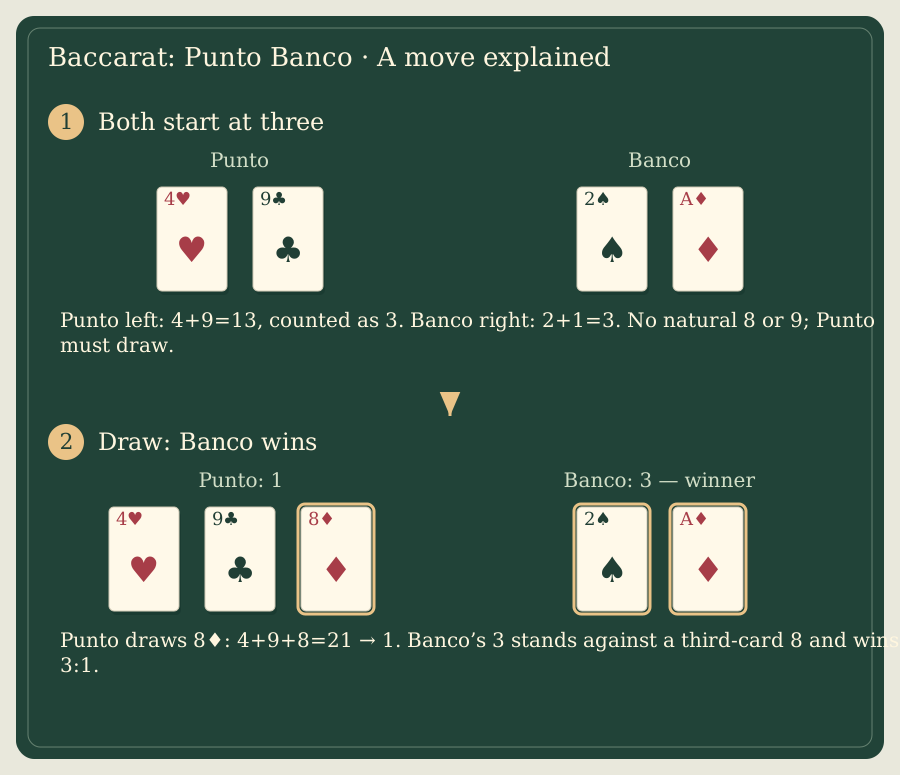
Punto receives 4♥ and 9♣: three points. Banco receives 2♠ and A♦: also three. There is no natural. Punto must draw 8♦, making its final total one: 4+9+8=21.
Banco uses the third card, not Punto’s final total. The table’s three-row says to stand against an eight. Banco keeps three and wins. A Banco prediction with a notional stake of 20 produces net +19.
Now replace only 8♦ with 7♦. Banco must draw. The starting hands are identical, but one changed digit alters the mandatory procedure.
← On a small screen, scroll the diagram horizontally. →
07 /
Keep other tariffs separate
Some tables pay Tie 9:1; others remove commission and alter particular Banco payouts. Neither is included here. Pair side bets are also omitted. To reproduce another table, use its payout terms together with its complete drawing rules.
Common questions
Does a natural eight always win?+
No. It stops further draws; nine beats eight and equal eights tie.
Can Punto refuse a card on five?+
No. Drawing is compulsory.
Is Banco the human dealer?+
It is a shared hand’s name; participants may predict that hand to win.
Why use stakes of twenty?+
Five-percent commission then gives an integer net profit of19 points.