← On a small screen, scroll the diagram horizontally. →
01 /
Four players in two partnerships
Partners sit opposite, with opponents on either side. Use 52 cards without jokers and a score sheet. The partnership objective is to reach at least 120. Partners combine points; a bid is a scoring promise, not a monetary wager.
This guide selects Barker’s four-player form, without a kitty or dealer inspection of the stock. Two procedural conventions are fixed before play: four passes move the deal to the next player; if both partnerships reach 120 in one completed hand, the successful bidding side wins. The brief primary account leaves those cases open, and Pagat explicitly discusses alternative simultaneous-finish policies.
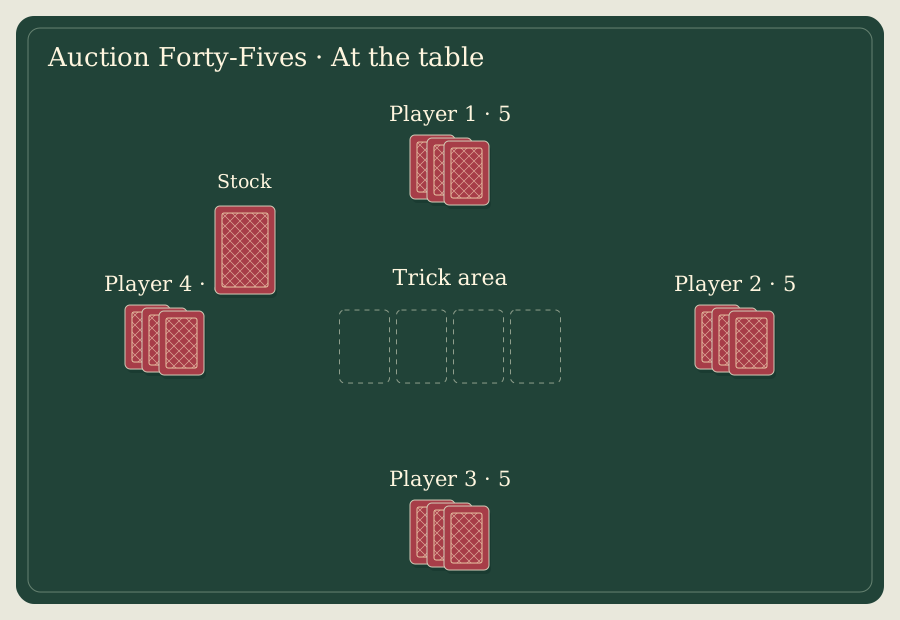
The dealer shuffles and the right-hand opponent cuts. Deal clockwise from the dealer’s left, first three cards to each player, then two. Keep the undealt stock face down for replacements. The deal moves left after each hand.
02 /
The unusual ranking
The three highest trumps are the trump five, trump jack and A♥. The heart ace is a trump regardless of the chosen suit and does not count as a heart when following suit. The rest of the order depends on trump colour:
| Trumps | Highest to lowest |
|---|---|
| ♥ | 5♥ · J♥ · A♥ · K♥ · Q♥ · 10♥ · 9♥ · 8♥ · 7♥ · 6♥ · 4♥ · 3♥ · 2♥ |
| ♦ | 5♦ · J♦ · A♥ · A♦ · K♦ · Q♦ · 10♦ · 9♦ · 8♦ · 7♦ · 6♦ · 4♦ · 3♦ · 2♦ |
| ♣ | 5♣ · J♣ · A♥ · A♣ · K♣ · Q♣ · 2♣ · 3♣ · 4♣ · 6♣ · 7♣ · 8♣ · 9♣ · 10♣ |
| ♠ | 5♠ · J♠ · A♥ · A♠ · K♠ · Q♠ · 2♠ · 3♠ · 4♠ · 6♠ · 7♠ · 8♠ · 9♠ · 10♠ |
Non-trump hearts rank K–Q–J–10–9–8–7–6–5–4–3–2; diamonds rank K–Q–J–10–9–8–7–6–5–4–3–2–A. Non-trump clubs and spades rank K–Q–J–A–2–3–4–5–6–7–8–9–10. Thus a black non-trump deuce beats its ten but loses to its ace. A five is promoted only in the trump suit.
03 /
Bid and draw
The player to the dealer’s left speaks first, and bidding proceeds clockwise. Bid 5, 10, 15, 20, 25 or 30 without naming a suit. A new bid must exceed the current one; passing removes you from further bidding. A partnership already on 100 or more cannot bid less than 20.
The dealer may say “I hold” instead of raising, taking over the current highest bid. Players who have not passed get another chance to raise; continue until one bidder remains. Nothing exceeds 30, although an eligible dealer may still hold 30 on their turn. Handle an all-pass deal using the convention above.
The winner names trumps. Then, clockwise from the dealer’s left, each player discards zero to five cards and receives as many face down. Discard before receiving replacements; discards are not recycled. With four players, even five replacements each use only 20 initial plus 20 replacement cards.
04 /
Play five tricks
The player left of the winning bidder leads first. Play one card each clockwise. Highest trump wins; with no trump, highest card of the led suit wins. The trick winner leads next. You need not overtake a card already played.
On a non-trump lead, follow suit if able or play any trump. With no card of the led suit, play anything; trumping is optional.
On a trump lead, normally play a trump if possible. The five, jack and A♥ have the privilege of reneging against a lower led trump. If your only trumps are protected higher cards, you may discard a non-trump. If you also hold an unprotected trump, you must play some trump. A higher trump lead removes the privilege from a lower protected card. A higher trump added later to the trick does not change the obligation established by the original lead.
05 /
Points, failed bids and winning
Each trick is worth 5. The partnership winning the trick containing the highest trump in the hand gains another 5. Usually 30 points are available. If nobody holds any trump after the draw, there is no bonus and only 25 are available.
If the bidding partnership takes at least its bid, record all points it won. Otherwise subtract the bid without also adding its captured points; totals may become negative. The opponents always score their own points.
In Barker’s primary account, bidding and making 30 earns +60; failing a bid of 30 costs −30, the amount bid. Taking all 30 after a lower bid earns only +30. Do not silently import a different version’s −60 failed-sweep penalty.
Complete all five tricks and verify the bid before updating totals and checking 120. If one side reaches the target, it wins. If both do, the announced successful-bidder priority applies. Otherwise deal again.
06 /
Worked trick and score
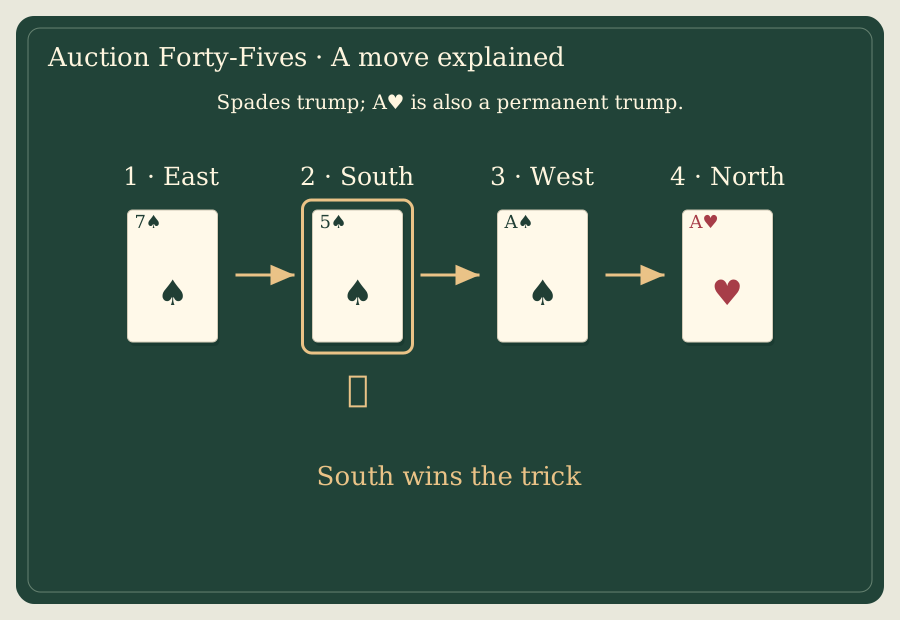
Spades are trumps. East leads 7♠; South plays 5♠, West A♠ and North A♥. South wins: the trump five beats both aces. No higher trump can exist, so this trick also secures the extra 5 points for North–South.
North–South bid 20 and win three tricks including this one. Their score is 3 × 5 + 5 = 20, fulfilling the bid. East–West earn 10 for their two tricks. A previous score of 70:85 becomes 90:95.
For the following-suit exception, suppose your only trump is J♠ and you also have 2♦. On a 9♠ lead you may discard 2♦ and preserve the protected jack. On a 5♠ lead with that same holding, you must play J♠.
← On a small screen, scroll the diagram horizontally. →
07 /
Why Forty-Fives goes to 120
The name survives from older Forty-Fives without bidding. The North American auction branch of the Spoil Five / Maw family commonly uses a target of 120 and is also called One Hundred and Twenty. Pagat associates the family’s New World spread with regions having Irish populations.
Dave Barker authored the consulted account, not an established invention of the game. These sources do not establish an exact origin date for the auction form. Regional rules differ considerably; this guide stays with one selected procedure rather than adding a kitty, forced dealer or another ranking.
Common questions
Why does Forty-Fives have a target of 120?+
The auction version inherited the name of older non-auction Forty-Fives; it is also called One Hundred and Twenty.
May I trump when I can follow a non-trump lead?+
Yes. Either follow the led suit or play a trump.
Is A♥ a heart when spades are trumps?+
No. It counts as trump, including for following-suit obligations.
Does taking all 30 always score 60?+
No. +60 requires bidding 30; taking all points after a smaller bid scores +30.