← On a small screen, scroll the diagram horizontally. →
01 /
Pack and deal
Use forty cards. From a standard pack remove eights, nines, tens and jokers, leaving A, 2–7, J, Q, K. Capture values are ace 1, pip cards face value, jack 8, queen 9 and king 10. Diamonds substitute for Italian coins.
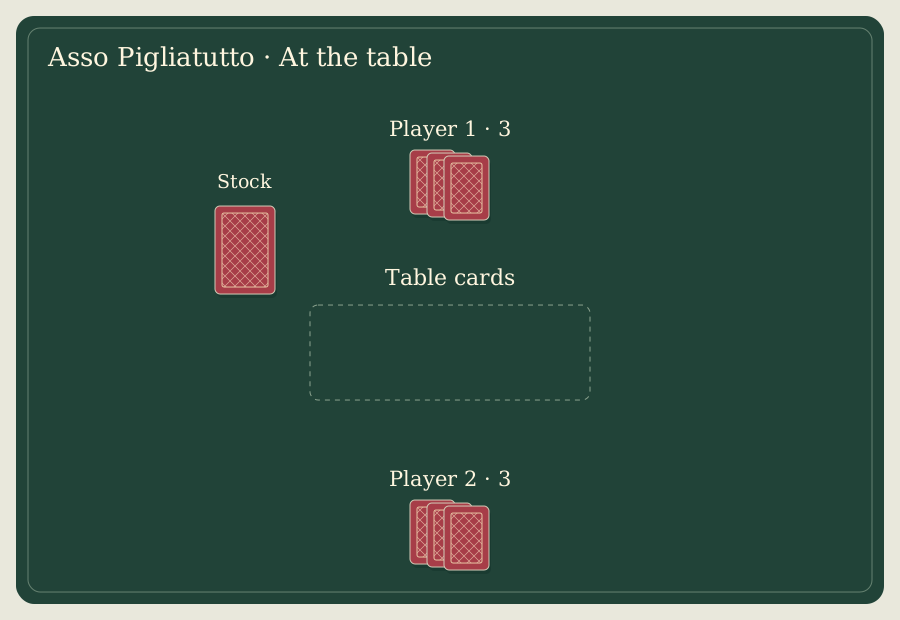
Deal three cards each and four face up to the table. Redeal if those four include three or four kings. Keep the remainder face down. The non-dealer starts; players then alternate.
02 /
Ordinary captures and the special ace
Play one card. If it matches a single table card’s value, capture that card, choosing one if several match. Only without a single-card match may you capture a set with the same sum, choosing between available sets. Capturing is compulsory when possible; otherwise your card stays on the table.
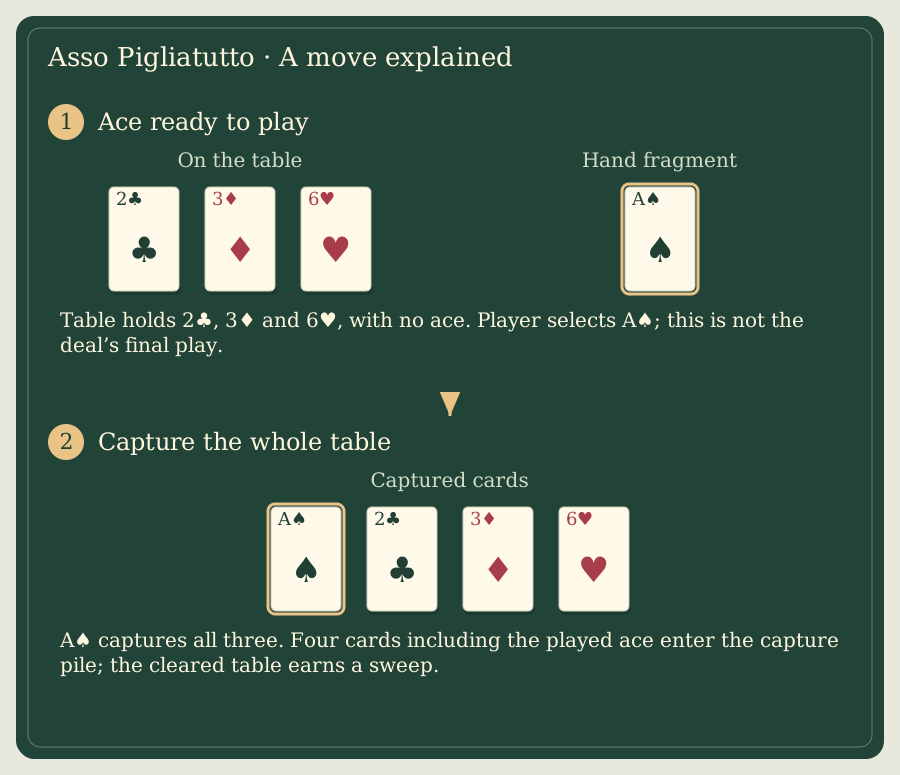
An ace sweeps a nonempty table containing no ace. If an ace is already there, the played ace captures just that ace under the ordinary match rule. On an empty table it stays: it does not capture itself. Each clearance earns a sweep point, except on the very last play of the deal.
03 /
Further hands and scoring
When both three-card hands are spent, deal three more each without adding another four table cards. Continue through the pack. The last player to capture receives the leftover table cards; this collection is not a sweep.
Score one per sweep, plus one each for most cards, most diamonds, 7♦ and the best primiera. Tied majorities or primiera score nothing. For primiera choose the best card in each suit: 7=21, 6=18, A=16, 5=15, 4=14, 3=13, 2=12, courts=10. Missing a suit makes you ineligible.
After a fully scored deal, reaching eleven or more wins. If both cross the target, the higher total wins; a tied lead requires another deal. Alternate dealers.
04 /
When the ace does not sweep
The table holds 2♣, 3♦ and 6♥. Playing A♠ captures all three plus your ace and earns a sweep unless it is the final play. Add A♦ to the table: now A♠ takes only that ace, leaving the two, three and six.
A six played to 6♥, 2♣ and 4♦ must capture the lone six rather than 2+4. For primiera, four sevens total 84; three sevens and a six total 81. This is a separate scale from capture values.
← On a small screen, scroll the diagram horizontally. →
05 /
Family and variants
This Italian member of the Scopa family is often presented as an accessible children’s variant. The sources used here do not establish an invention date. Its name also became an Italian expression for someone who takes everything.
Scopa d’Assi often awards no point for an ace clearance, and some local rules change what happens on an empty table. These are real variants, not printing errors. This guide uses the opening profile; check those specific points with a new opponent.
Common questions
Does an ace on an empty table score a sweep?+
No. In the selected form it remains on the table.
Does the last clearance score?+
Not on the very last play of the deal, even with an ace.