← On a small screen, scroll the diagram horizontally. →
01 /
Cards and setup
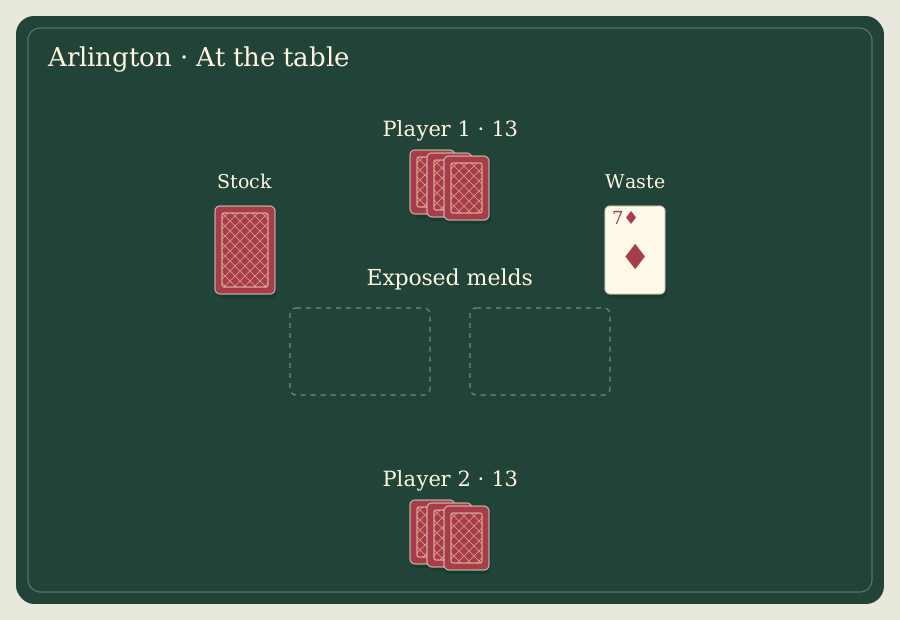
Two to five play individually with two 52-card packs, no jokers. Deal thirteen each. Stack the remainder face down and turn one card to begin the discard pile. For a definite table procedure, start left of dealer and move play and the next deal clockwise. These organisational details do not change the melding system.
02 /
Valid combinations
A set contains three or four cards of one rank; a run contains three or four consecutive cards of one suit. No meld may exceed four cards. Aces may be low in A–2–3 or high in Q–K–A, never around the corner in K–A–2. Twos substitute for missing cards: state what each represents. A separate set of at least three twos is also legal. Add cards only to your own melds, never another player’s.
A two may represent Q♠ only when its meld is otherwise entirely natural, such as J♠–2–K♠. A two representing an ace scores twenty, the value of the card it represents.
03 /
A complete turn
Draw the top stock card or take the entire discard pile. To take discards, first meld its top card with at least two cards from your hand in a new valid combination. Only after demonstrating that meld take the rest. Taking only part of the pile or its top card is not allowed. Keep discards squared so only the uppermost card is visible.
You may then make additional melds and extend your own. End by discarding one card. Q♠ cannot be discarded at all: it must be melded. Going out by melding or discarding your last card ends the hand immediately.
04 /
Values and penalties
| Card | Melded | In hand |
|---|---|---|
| Q♠ | 50 | −100 |
| Ace | 20 | −20 |
| K–8 except Q♠ | 10 | −10 |
| 7–3 | 5 | −5 |
| Two | value of represented card; 25 in a twos-only set | −20 |
Add your table values, subtract your remaining hand, and award the player going out another 100. After a completed deal, reaching 1,000 triggers a highest-total finish; our explicit tie agreement shares victory. If stock runs out, retain the top discard and turn the rest over without shuffling as new stock. If no cards can be recycled, our teaching convention ends the hand with normal scoring and no going-out bonus.
05 /
One run’s contribution
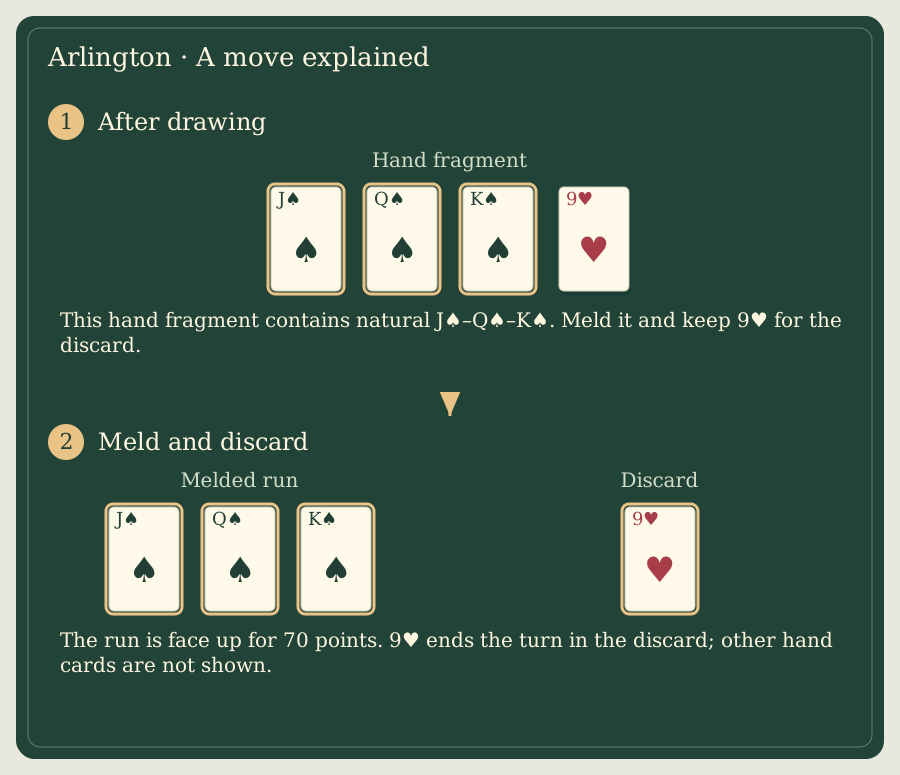
You meld J♠–Q♠–K♠, worth seventy. At the ending you retain 2♦ and 4♥, costing twenty-five, for a net +45. If a two replaces Q♠ in that otherwise natural run, it scores fifty. You cannot make an arbitrary two expensive merely by calling it the spade queen.
← On a small screen, scroll the diagram horizontally. →
06 /
Context and variants
Arlington is also called Oklahoma Rummy, distinct from Oklahoma Gin. Howard Fosdick’s account compares it with its relative Fortune Rummy and distinguishes Parlett and Scarne variations. It does not establish an invention year. Other versions change discard access, wild-card values or add a joker. The seven-round Skarney game has different rules and should not be mixed into this one.
Common questions
May I extend opponents’ melds?+
No. Extend only your own.
Can I draw just one discard?+
No. A legal discard pickup takes the whole pile.
Why not discard the spade queen?+
The selected Denexa version forbids discarding it entirely.