← On a small screen, scroll the diagram horizontally. →
01 /
Preparation
Three players use 40 cards: remove 8, 9, 10 from a standard pack. Rank A–3–K–Q–J–7–6–5–4–2; values A=11, 3=10, K=4, Q=3, J=2, others zero. Queen represents the Spanish horse.
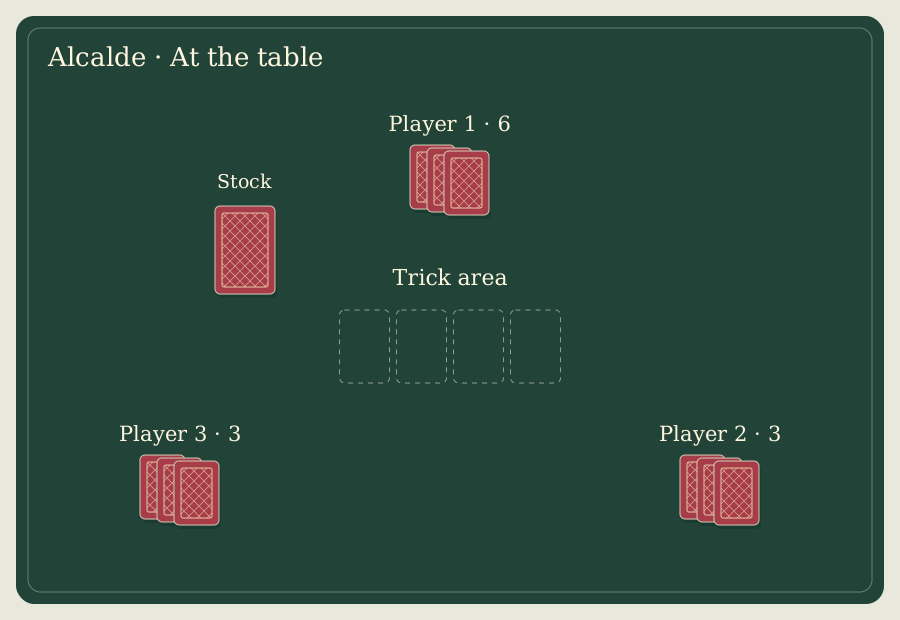
Choose the first mayor randomly. Deal anticlockwise: three each to opponents, six to mayor. Place remaining stock over a face-up trump indicator. Opponents may see each other’s cards.
02 /
Play
Mayor’s right leads. Opponents play one card each, mayor two on their turn; when mayor leads, the first sets suit. Any cards are legal. Highest trump, otherwise highest led-suit card, captures all four and leads next.
Draw anticlockwise from the winner: mayor two, opponents one each. Indicator is last. Finish hands without replenishment.
03 /
Keeping office
After ten tricks, count 120 points. Mayor retains office on 60 or more; otherwise their right neighbour becomes mayor. Thus 60–60 keeps the mayor. Treat one deal as a complete game here.
04 /
A four-card trick
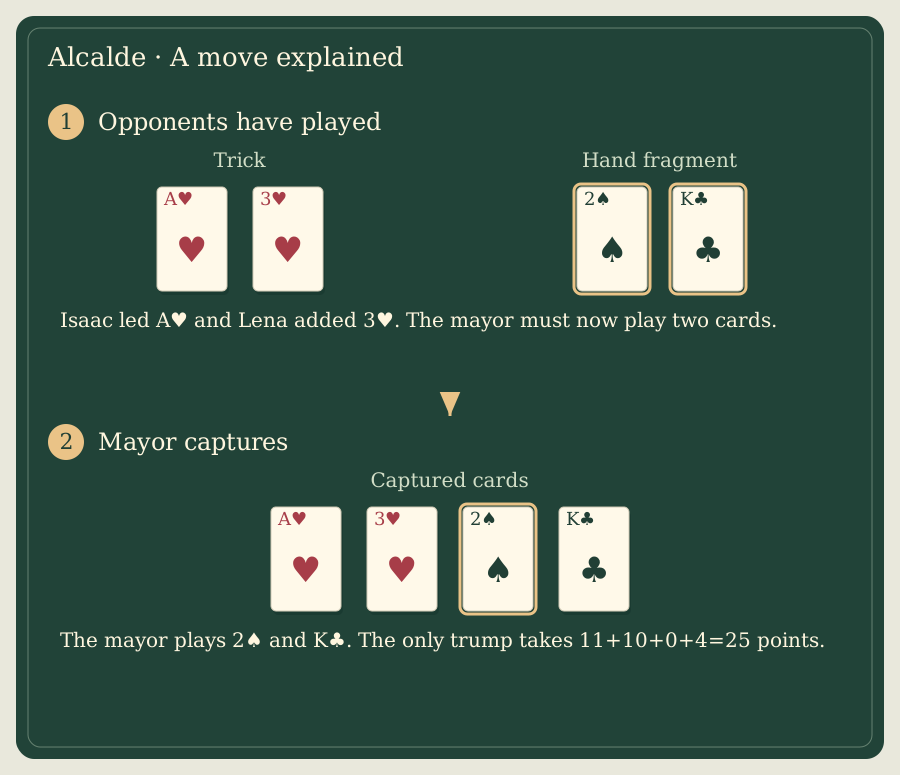
Spades are trump. Isaac leads A♥, Lena adds 3♥, and the mayor plays 2♠ and K♣. The mayor captures 11 + 10 + 0 + 4 = 25 points. The two is weak against higher spades, but as the only trump here it captures all the valuable cards.
Replace 2♠ with 2♦ and Isaac wins with his ace. The mayor cannot select a convenient winning suit after looking at the completed trick: the original lead, and any trump cards, decide the comparison.
For a scoring check, give the mayor a total of 58. Their opponents must have 62. A result adding up to 119 or 121 needs checking before the next dealer is appointed. Separate the question of who wins a trick from how much that trick is worth.
← On a small screen, scroll the diagram horizontally. →
05 /
Background and agreements
The game is documented in Puerto Rico as a Brisca relative. The primary author records a family teaching tradition; a precise invention date is not established.
Exchanging the trump indicator is optional. Leave it disabled for the first game. The four-card variant changes hand size, trick count and winning threshold; merely dealing four instead of six does not produce a complete alternative.
Common questions
Why are there four cards in a trick?+
Each opponent contributes one; the mayor contributes two.
Must I follow suit?+
No.
Does a tie remove the mayor?+
No: 60–60 is enough to retain office.