← On a small screen, scroll the diagram horizontally. →
01 /
Set up a teaching table
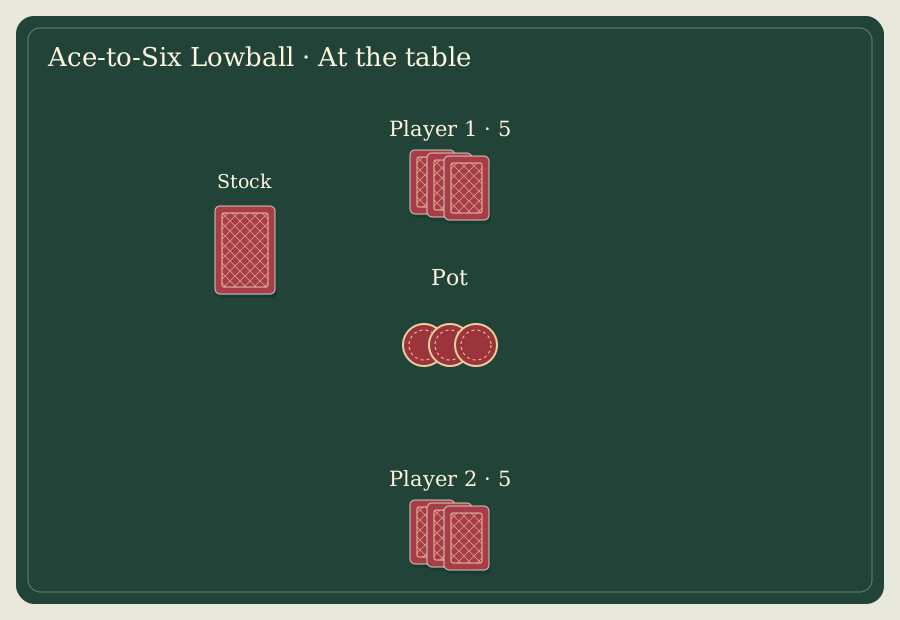
Use 52 cards for 2–5 players. Each player antes 1; there are no blinds. Bets and raises are 1 before the draw and 2 afterwards, with one opening bet and at most three raises per round. Require a starting reserve of at least 13 for each new deal: the ante plus maximum betting contributions of 4 and 8. This avoids all-ins and side pots.
Deal five cards face down to each player, singly and clockwise from the dealer’s left. Move the dealer position clockwise after every completed deal. The particular limits and player cap are chosen for this teaching version.
02 /
Reading the lowest hand
Aces rank low, but straights and flushes count against you. Categories from best to worst are no pair, one pair, two pair, trips, straight, flush, full house, quads, straight flush. An unsuited K–9–7–4–2 therefore beats A–2–3–4–5: the wheel is a straight.
Within a category favour the lower main group and then lower kickers. Compare unpaired hands and flushes from their highest card down; compare straights by their top card. Compare the higher pair first in two-pair hands and the triplet first in full houses. Aces form the lowest pair. Our agreed convention counts A–K–Q–J–10 as the highest straight and forbids wraparound sequences. The best low is 6–4–3–2–A of mixed suits.
03 /
Bet, draw once, bet again
The player to the dealer’s left starts the first round. With no outstanding bet, check or bet. Facing a bet, call, raise or fold the whole hand. Check-raising is allowed here, and an all-check round proceeds to the draw: these are explicit table conventions.
Starting to the dealer’s left, active players discard zero to five cards and receive that many replacements face down. Discard before receiving replacements; you cannot retrieve a discarded card. Keeping all five cards is standing pat. With five players even a complete five-card replacement for everyone uses only 50 cards, so this no-burn teaching version cannot exhaust the pack.
The player who opened the first round starts the second; if that player folded, action begins with the next active player clockwise. If everyone originally checked, start with the first active player left of the dealer. There is no second draw.
04 /
Showdown and chip results
A betting round closes when all remaining players have answered the final raise, or everyone checks. If everyone except one player folds, that player receives the pot immediately. Otherwise expose hands after the final round: the lowest five-card hand wins the entire pot. There is no high half and no qualifying ceiling.
Equal hands split the pot; suits have no priority. Give an indivisible chip to the first tied winner clockwise after the dealer. To record a player’s result, subtract their ante and bets from their award. Combinations earn no separate points.
05 /
Worked hand comparisons
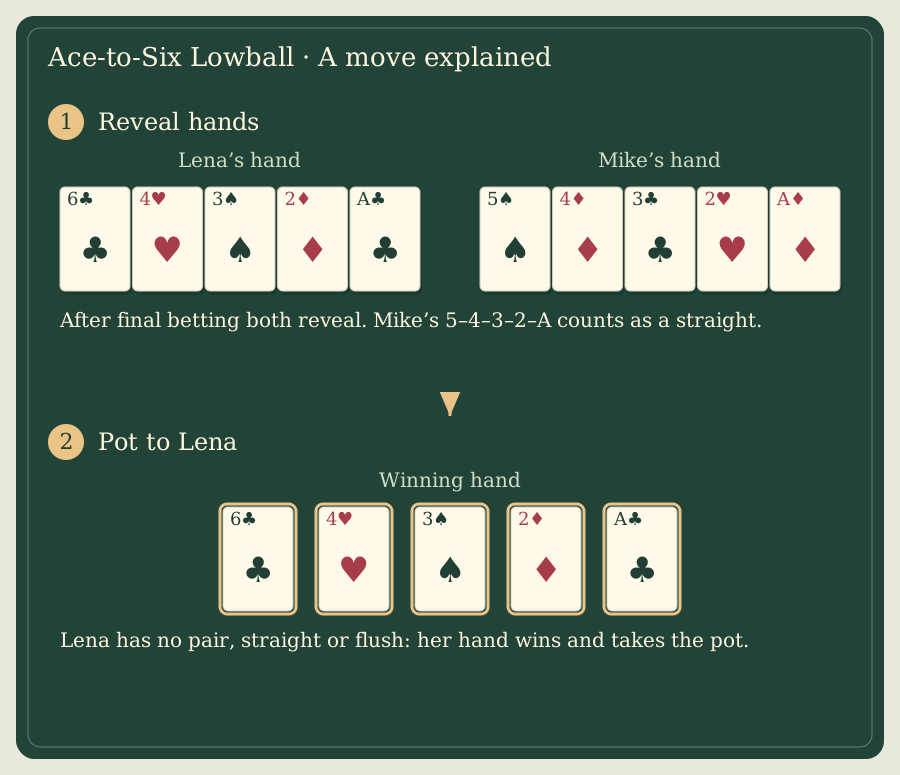
Lena stands pat with 6♣ 4♥ 3♠ 2♦ A♣. Mike has 5♠ 4♦ 3♣ 2♥ A♦. His highest card appears lower, but his hand is a straight. Lena’s unpaired mixed-suit six wins the pot.
In another comparison, 7♠ 5♠ 4♠ 3♠ A♠ is low-looking but is a flush. An unpaired 8♣ 6♥ 4♦ 3♣ A♦ beats it. Always identify the category before comparing numerical values. When drawing to four consecutive cards, remember that one apparently helpful low replacement may accidentally complete a straight.
← On a small screen, scroll the diagram horizontally. →
06 /
Context and alternative formats
Ace-to-six is a historical low-hand ranking system, not necessarily the name of one dealing format. The consulted sources establish neither a single inventor nor a reliable invention date.
London Lowball applies this scale to seven-card stud, usually with pot-limit betting. Its card count and betting schedule do not belong in this five-card draw version. Extra draws create another variant. Our game has no joker, sevens rule or eight-low qualifier. Agree the treatment of the ace before dealing: descriptions of home games can differ on the broadway straight and the lowest pair.
Common questions
What is the best possible hand?+
6–4–3–2–A of mixed suits, neither a straight nor a flush.
Must I have eight-low or better?+
No. This low-only version has no qualifying ceiling.
Can I keep all five cards?+
Yes. Drawing zero cards is standing pat.