← On a small screen, scroll the diagram horizontally. →
01 /
History and selected rules
Tiến Lên (“go forward”) is a Vietnamese shedding game; no exact inventor or date is established here. Select Pagat’s main 4-player profile, including twos in runs and special counters to twos. Local forms differ substantially. Use 52 cards, no jokers; ascending ranks 3–4–5–6–7–8–9–10–J–Q–K–A–2. Within a rank, ♠ < ♣ < ♦ < ♥.
02 /
Setup and deal
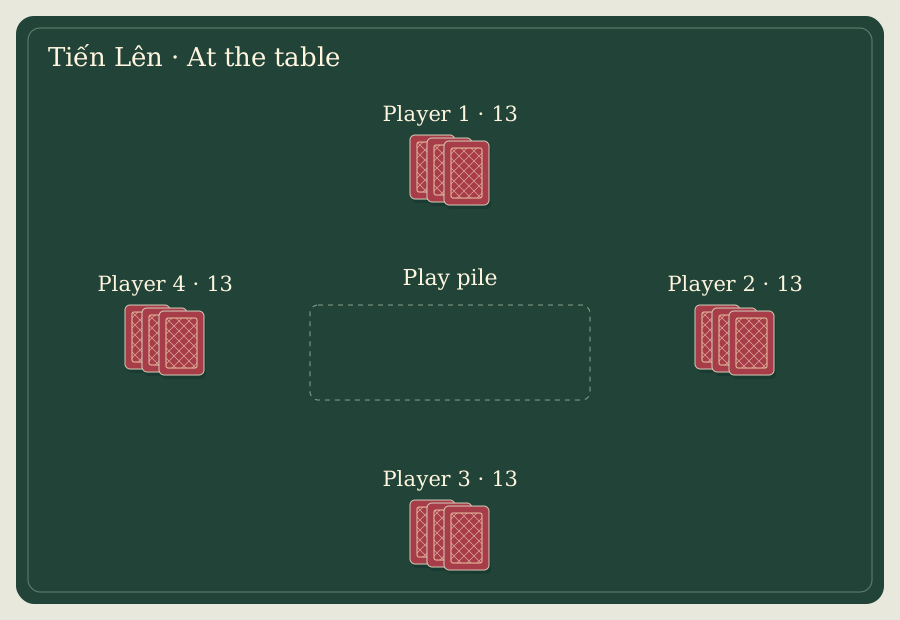
Choose the first dealer randomly; later the last player with cards deals. Deal 13 each clockwise. First game begins with the 3♠ holder, including it in the opening. Thereafter the previous first finisher leads any combination. There is no high-card exchange or automatic winning starting hand here.
03 /
Playing a hand
Play clockwise. Legal groups: single, equal pair, triple or quad, run of at least 3 ranks in any suits, or at least 3 consecutive pairs. A 2 may end a run; A–2–3 cannot wrap. Normally answer with the same type and length, strictly higher by its highest card including suit.
You may pass when able, but are locked out until the table clears, except for a bomb below. When all other active players decline, clear the table; last player opens freely. If that player has finished, next active clockwise opens. Skip finishers; their last combination can still be beaten.
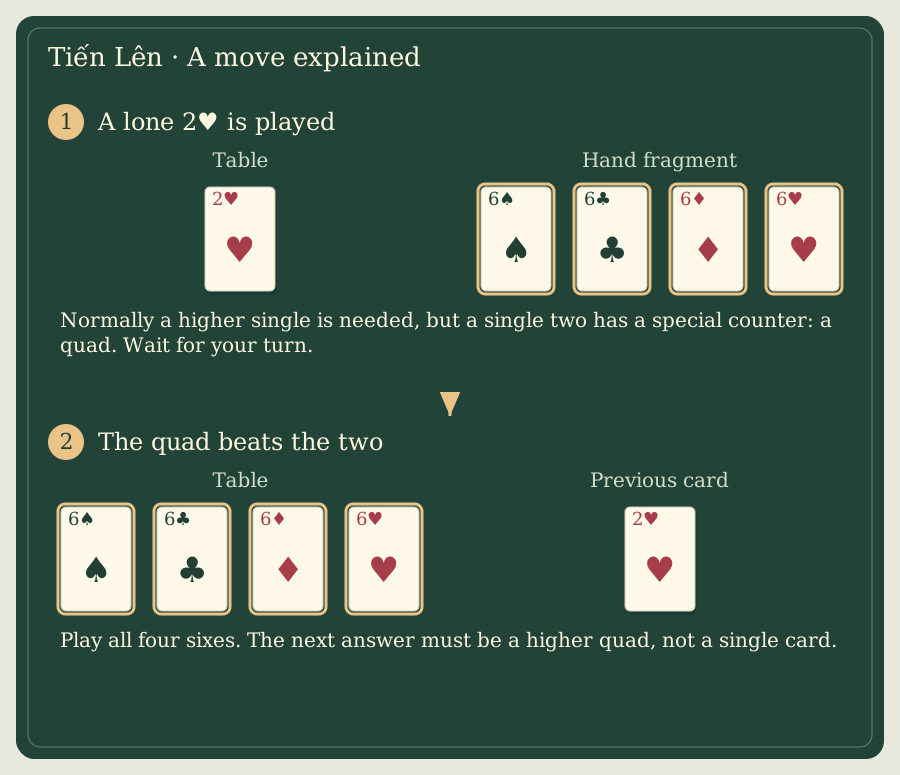
Exceptions: a quad or exactly 3 consecutive pairs beats a single 2; 4 consecutive pairs beat a pair of 2; 5 consecutive pairs beat triple 2. Such bombs may be played on your turn even after passing, never out of turn. A bomb is subsequently beaten only by a higher group of the same type and length; quads and pair sequences have no mutual priority. Bombs do not beat an A or other ordinary rank. No separate bomb bonus or penalty applies.
04 /
Ending and result
Empty hands leave until one player has cards. Score that loser −3 and everyone else +1, a nonmonetary equivalent of the source’s fixed payment, not a first-place-only award. Agree the number of games; highest total wins, ties draw. Respect concealed hands and turn order regardless of other local customs.
05 /
Worked example
Against single 2♥, 6♠–6♣–6♦–6♥ is legal: the bomb overrides normal rank comparison. That quad cannot beat a single A♥. Pair 8♥–8♠ beats 8♦–8♣ because of its highest heart.
← On a small screen, scroll the diagram horizontally. →
Common questions
Is this the same as Big Two?+
No. Suit order, passing restrictions and special counters to twos differ.