← On a small screen, scroll the diagram horizontally. →
01 /
Deal seven, keep the rest aside
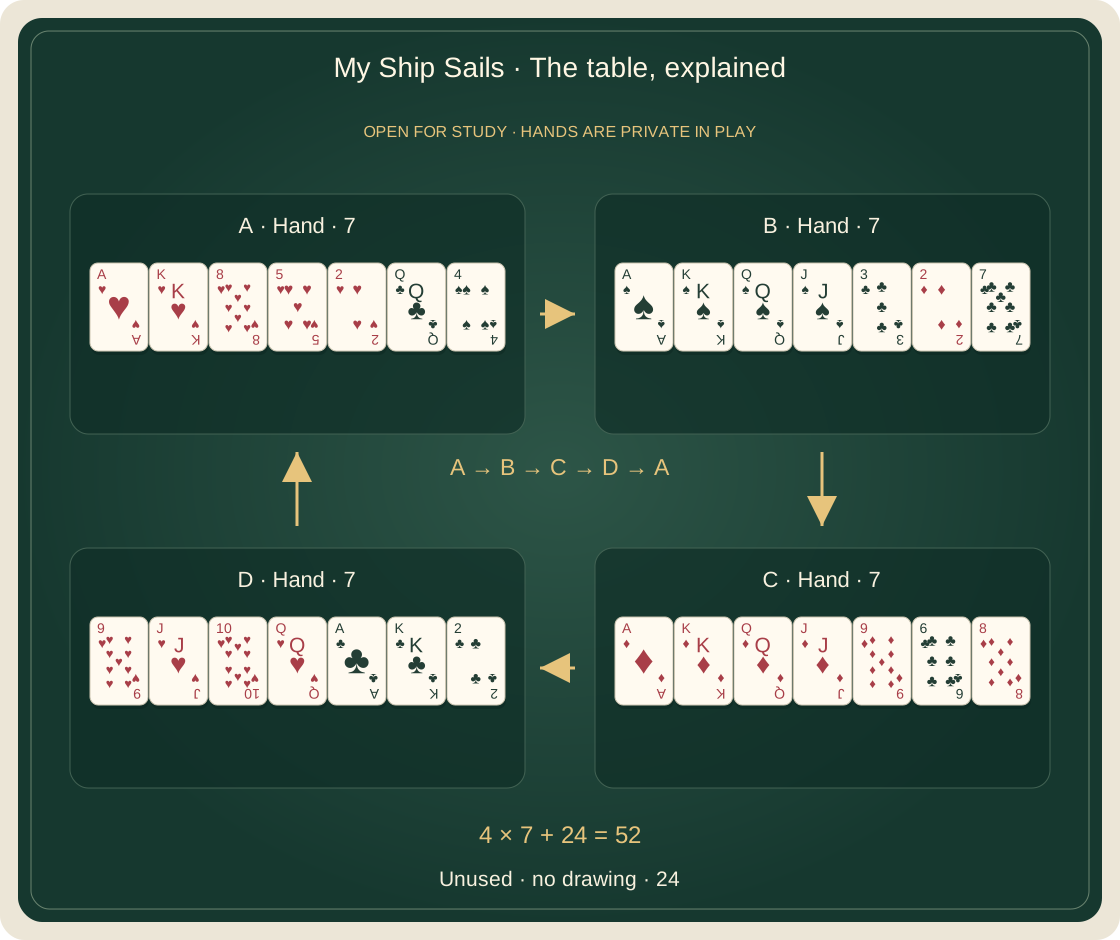
For 4–7 players shuffle 52 cards, without jokers. Deal 7 to each, clockwise, keeping hands secret. With 4 players, 28 are dealt and 24 are unused. Do not trim specific ranks before shuffling. Rank has no effect on the goal.
02 /
Send first, receive second
Everyone selects one unwanted card and puts it face down for the neighbour on the left. Wait until everyone has committed a card; then pick up the card from the right. Repeat together. Never inspect an incoming card before choosing your outgoing card. Each completed exchange restores your seven-card hand.
03 /
What you may change
You may change your target suit whenever you wish. Matching ranks, runs and pairs have no special value. Keep your own hand private; do not give advice about another hand. There is no discard pile, drawing or stock recycling: the same dealt cards circulate. Agree a passing rhythm rather than rewarding who grabs fastest.
04 /
Call, verify and score
When all 7 cards share a suit, call “My ship sails!” and show them. A qualifying initial hand may call before the first pass. The first valid call earns 1 win. Our tie agreement awards 1 to each indistinguishably simultaneous caller. Play a fixed 5 deals; most wins takes the match, equal totals share. Rotate dealer left.
05 /
From five hearts to seven
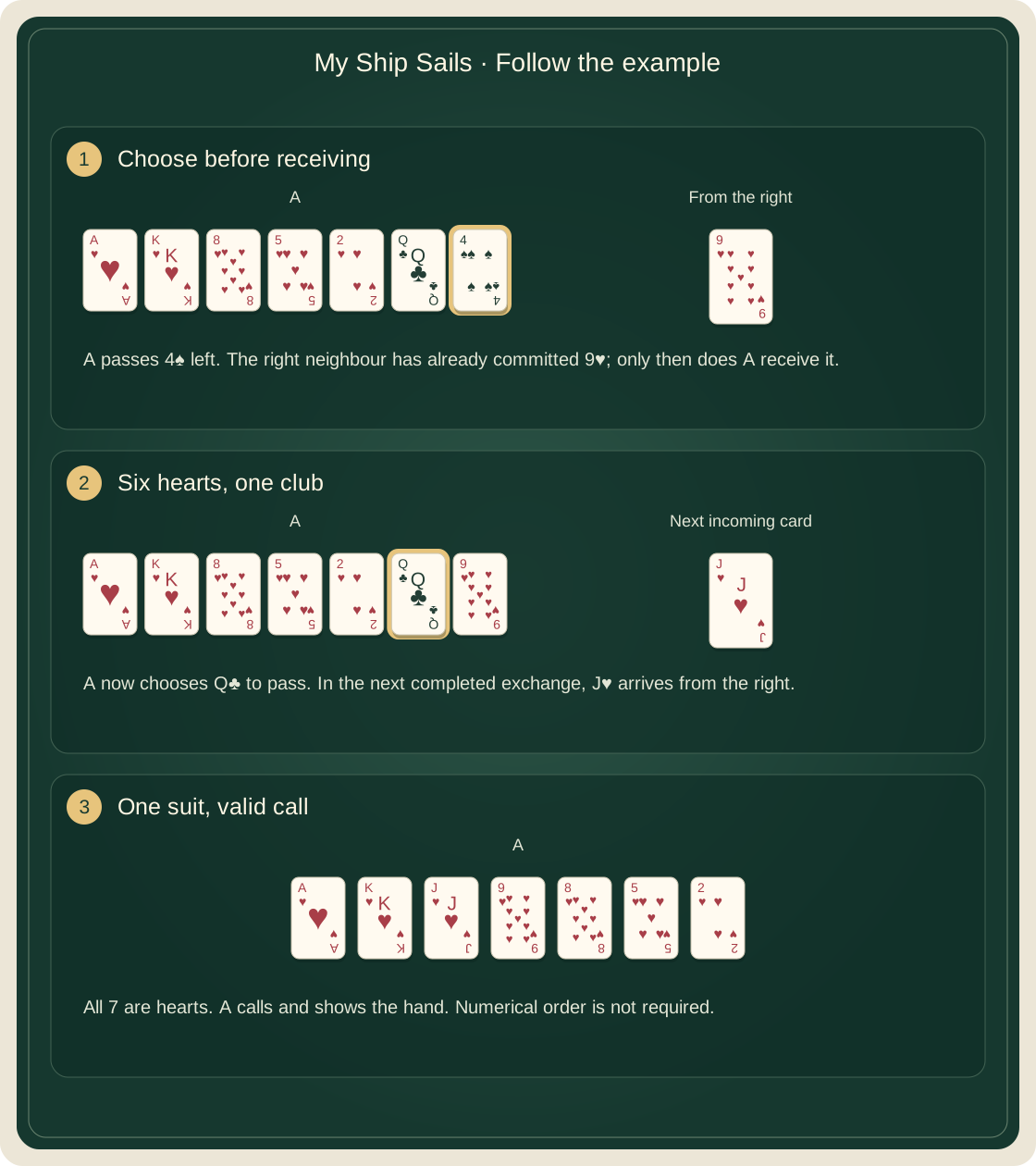
A holds A♥ K♥ 8♥ 5♥ 2♥ Q♣ 4♠. First A passes 4♠ left and receives 9♥ from the right: six hearts. Next A passes Q♣ and receives J♥: A♥ K♥ J♥ 9♥ 8♥ 5♥ 2♥ is a winning hand. Each received card was already held by a neighbour; neither comes from the unused reserve. The diagrams show this teaching sequence, not a promised result.
← On a small screen, scroll the diagram horizontally. →
06 /
An old name, several sets of rules
The phrase appears in older card-game collections, including an account of Commerce with successive exchanges. That does not establish that those older games used today’s seven-card simultaneous rules. Modern children’s collections describe the closed-circle game taught here. Stock-fed variants and passing right also exist; agree the version before dealing.
Common questions
Do the cards need to form a run?+
No. Only the suit must match.
May I take a card from the reserve?+
No. The undealt cards are excluded for the whole deal.
Can I change my target suit?+
Yes, but choose the outgoing card before seeing the incoming one.