← On a small screen, scroll the diagram horizontally. →
01 /
A name used for different rummy games
Mexican Rummy is not one universally standardised game. Some groups mean Conquian, others a Crazy Rummy schedule with a changing wild rank. This article selects the seven-contract, growing-hand form described in the discovery catalogue. It combines contract-rummy openings with rotating wild ranks. The name does not prove Mexican invention, and a precise inventor or origin date is not established here. The chosen table conventions below resolve matters that short summaries leave open, especially the final hand’s extra cards and fixed wilds.
02 /
The hand grows while the wild rank rises
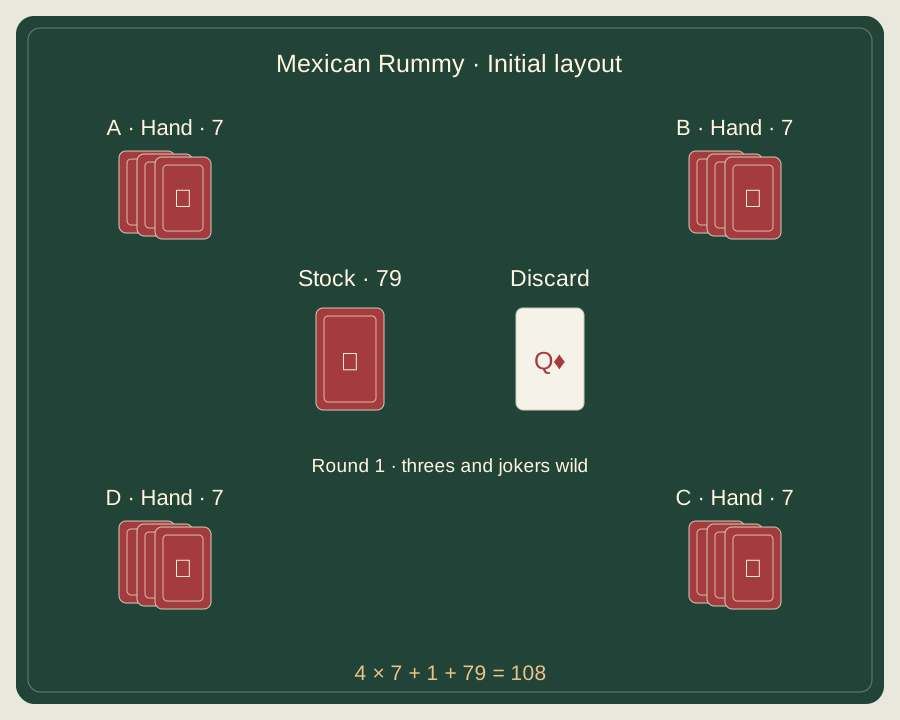
For 2–6 players use 2 full packs plus 4 jokers, 108 cards. Random first dealer, then rotate left; shuffle and deal clockwise, left neighbour begins. Across rounds 1–7 deal 7, 8, 9, 10, 11, 12, 13 cards each. Wild ranks are respectively 3, 4, 5, 6, 7, 8, 9; printed jokers always wild. Turn 1 discard, rest stock. For 4 players in round 1, 28 are held, 1 exposed, 79 stock. Everyone advances rounds together, even after failing a contract. State the current wild rank aloud before play.
03 /
Seven required opening patterns
Book means at least 3 equal ranks, duplicate suits allowed. Run means at least 4 consecutive same-suit cards, ace low or high, never K A 2. Contracts in order: 2 books; 1 book + 1 run; 2 runs; 3 books; 2 books + 1 run; 1 book + 2 runs; 3 runs. These are required patterns, not maximum lengths. Open all required components together, without reusing a card. Our profile permits longer initial components and separate contiguous same-suit runs; once exposed, components stay separate. No partial opening and no unrelated extra melds later.
04 /
Draw, open or add, then discard
On turn take 1 stock card or latest discard. You may open your full contract, or if you opened on an earlier turn, add to any existing book or run end. No layoffs during the opening turn in this profile. End rounds 1–6 by discarding 1, reserving a final discard to go out. Do not buy out of turn. Round wilds may stand naturally or replace a missing identity; any number is allowed, but name the represented book rank or run and all missing identities. Once played, wilds are fixed, including printed jokers: no reclaiming, moving or table rearrangement. This fixed-wild choice is an explicit variant rule.
05 /
The last round must use the whole hand
In round 7 do not expose an unfinished contract: after drawing, use every held card in 3 runs, each at least 4, with no final discard. Starting from 13, drawing gives 14, so lengths 5 + 5 + 4 are possible; exactly three short runs would leave 2 cards and is not a win. Longer runs may contain assigned wilds. Recycle old discards except the top when stock empties. If neither drawing nor taking the top is possible, our finite-session convention ends the deal and scores all held cards, without a winner. A mistaken layout is restored before the turn continues.
06 /
Wild-card penalties follow the round
Winner records 0, others every card still held. Printed joker or current wild-rank card costs 20, ace 15, 10 J Q K 10, all other ranks 5. A wild costs 20 even if you intended its natural role. In round 2 a held 4♠ A♥ K♣ 2♦ costs 20 + 15 + 10 + 5 = 50. Completed table melds score no penalty. After 7 rounds least total wins; if tied use most round wins, then share a remaining tie. A card’s future wild status never changes a score already written for an earlier round.
07 /
Open with a four standing for a seven
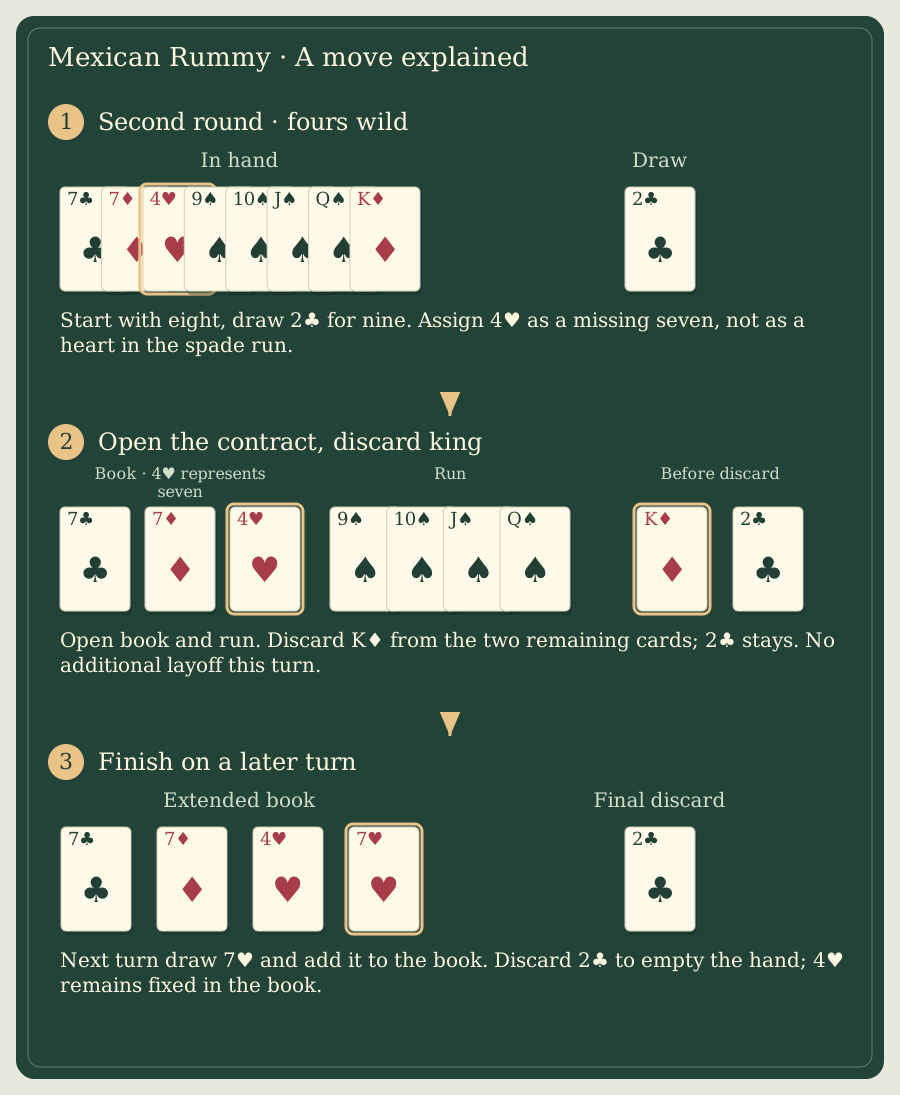
Round 2, fours wild. Hold 7♣ 7♦ 4♥ 9♠ 10♠ J♠ Q♠ K♦, then draw 2♣: 9 held. Open 7♣ 7♦ 4♥ as a book, declaring 4♥ represents 7♠, plus the spade run 9♠ 10♠ J♠ Q♠. Discard K♦, leaving 2♣; no layoff on this opening turn. On your next turn draw 7♥, add it to the exposed book and discard 2♣ to go out. The 4♥ stays fixed. The opening alone was not a win, and being a heart did not prevent the four from representing a spade.
← On a small screen, scroll the diagram horizontally. →
Common questions
Is every round the same hand size?+
No, the dealt hand increases on every round.
Can wilds be reclaimed?+
Not in the fixed-wild profile selected here.
Is a short final contract enough?+
No, all held cards must fit the final runs without a discard.