← On a small screen, scroll the diagram horizontally. →
01 /
Marriage games before modern sixty-six
Mariage means marriage: a king and queen held together form the game’s named combination. It belongs to an old central-European family documented in the early eighteenth century, later connected with games such as Sixty-six and Schnapsen. Historical descriptions differ in side payments, extra combinations and end conditions. This is a modern teaching profile using 32 cards, marriage points and a claim at 66; it is not a transcription of an eighteenth-century rulebook. We keep historical side payments and modern scores separate.
02 /
Two hands and a twenty-card stock
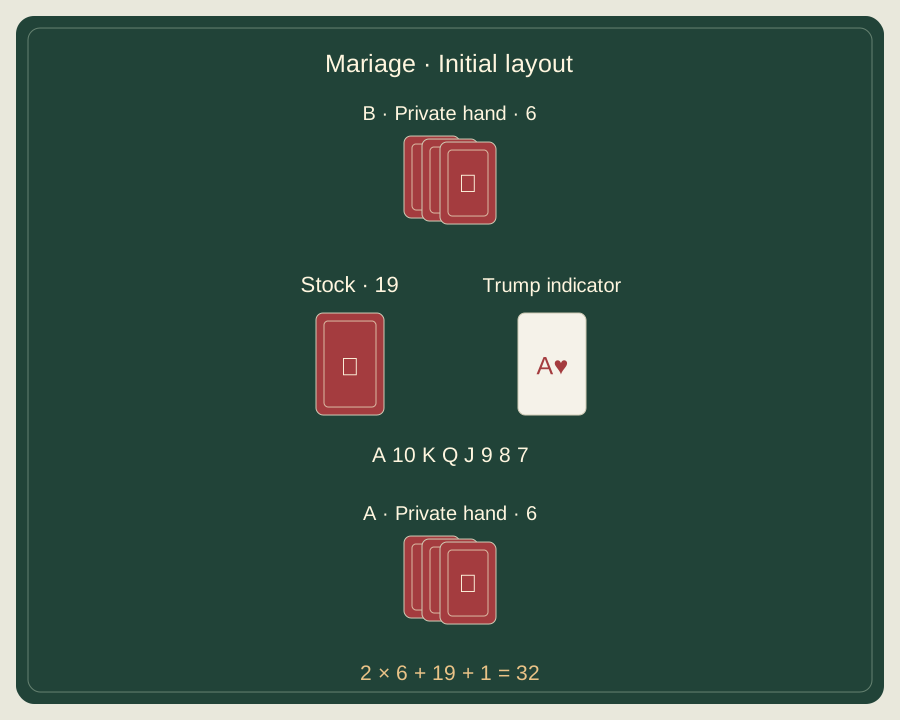
For 2 players use 32 cards, A 10 K Q J 9 8 7 in each suit, no jokers. This is also high-to-low rank. Values are 11, 10, 4, 3, 2, 0, 0, 0: 120 card points. Choose dealer randomly and alternate. Deal 6 each in packets 3 + 3. Turn 1 trump indicator and put 19 face-down stock cards across it, leaving its suit visible. Indicator belongs to the 20-card draw supply, not an extra card. Non-dealer leads first; winner of a trick leads next. Wrong hand counts or accidental exposure during dealing require a fresh deal.
03 /
Free play while the stock is open
Play 1 card each. While stock remains open, the follower may play anything: no duty to follow, beat or trump. Highest trump wins; without trump, higher card of the led suit wins. Capture both, then winner draws first and loser second, restoring hands to 6. The exposed indicator is the very last draw. Thus 10 tricks exhaust the original draw supply, leaving 6 cards per player for the strict phase. A trump seven may be exchanged for the indicator only by the current leader before leading, while stock is open and after that player has won a trick.
04 /
Declare a held king and queen
When leading during the open phase, with at least one trick already won, show K and Q of the same suit held together and lead either card. Add 20 card points, or 40 for trumps, immediately; keep the other in hand. Each pair scores once, and each declaration needs its own lead. No declarations after stock empties or is closed. These bonuses augment captured-card points; they are not match points. A player reaching 66 must claim on their own lead turn, after collecting a trick or making a legal declaration and before leading the next card.
05 /
An empty or deliberately closed stock
After natural exhaustion or deliberate closing, follow suit and beat the lead if possible; unable to follow, trump if possible, otherwise discard freely. No more drawing, exchanging or declarations. To close, the leader after replenishing turns the indicator face down before leading, with at least 2 draw-supply cards remaining. Record opponent’s card points and whether they have won a trick at that instant. Closer undertakes to reach and correctly claim 66 using the current hand. Unused stock stays out of play. A closed deal has no last-trick bonus.
06 /
Card points and match points
A correct 66 claim ends the deal: winner gets 1 match point if opponent has at least 33 card points, 2 if below 33 but with a trick, 3 if no trick. After closing use opponent’s recorded position at closure. If closer fails, or opponent claims first, opponent receives at least 2, or 3 if they had no trick at closure. An ordinary false claim loses 2. If natural exhaustion ends without a claim, add 10 for the final trick and compare totals: higher wins at the normal rate; a tie scores nothing. First to 7 match points wins. These explicit end conventions are part of this teaching profile.
07 /
A marriage can make the claim
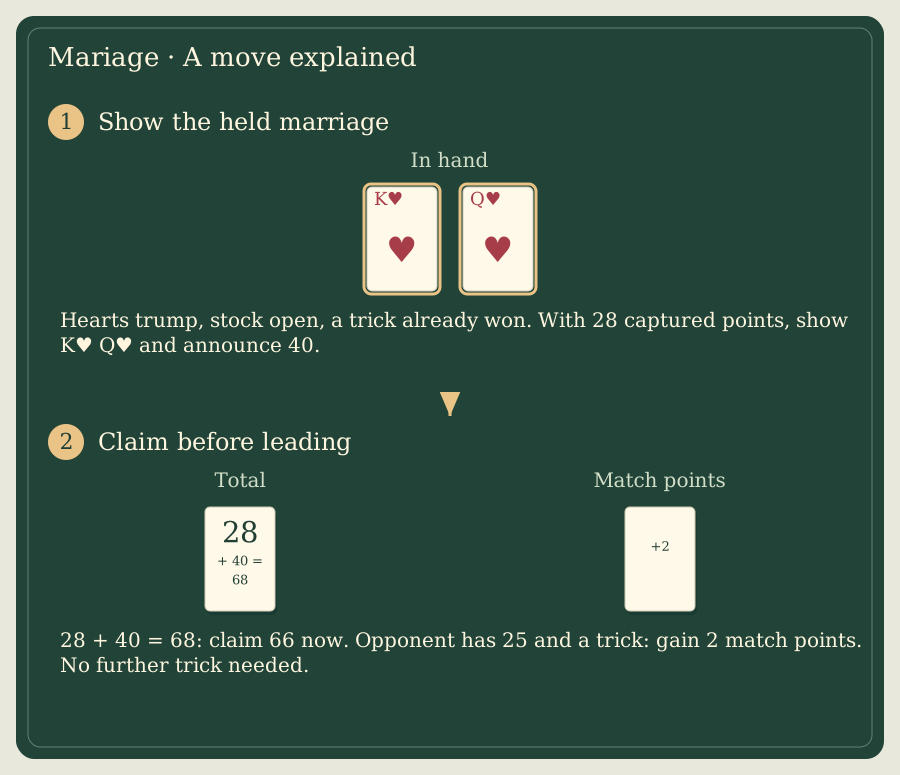
Hearts are trumps; stock is open and you have won a trick. Your captured cards total 28. On lead you hold K♥ and Q♥ together: show both, announce 40, and your total becomes 28 + 40 = 68. Claim 66 before playing the lead card. The deal ends without needing to win another trick. Opponent has 25 and a trick, so you gain 2 match points. If you instead played first, play continues until your next lawful opportunity to claim; passing 66 is not an automatic stop.
← On a small screen, scroll the diagram horizontally. →
Common questions
Is this identical to Sixty-six?+
No. This stated Mariage profile uses a larger short pack and explicit local conventions.
Is reaching the target automatic?+
No, claim on your own lead turn before playing.
Can I announce after closing?+
No marriage declarations in the closed phase of this profile.