← On a small screen, scroll the diagram horizontally. →
01 /
Reconstructing an old English game
Laugh and Lie Down appears in early English references, but Francis Willughby’s seventeenth-century notes preserve the detailed play. David Parlett reconstructed its unusual five-person fishing game. “Lie down” means surrendering the hand to the table when no capture is possible. We follow Parlett’s reconstruction, including the bonus to the last survivor; other readings award that bonus to the last capturer instead. Neither is a modern tournament standard.
02 /
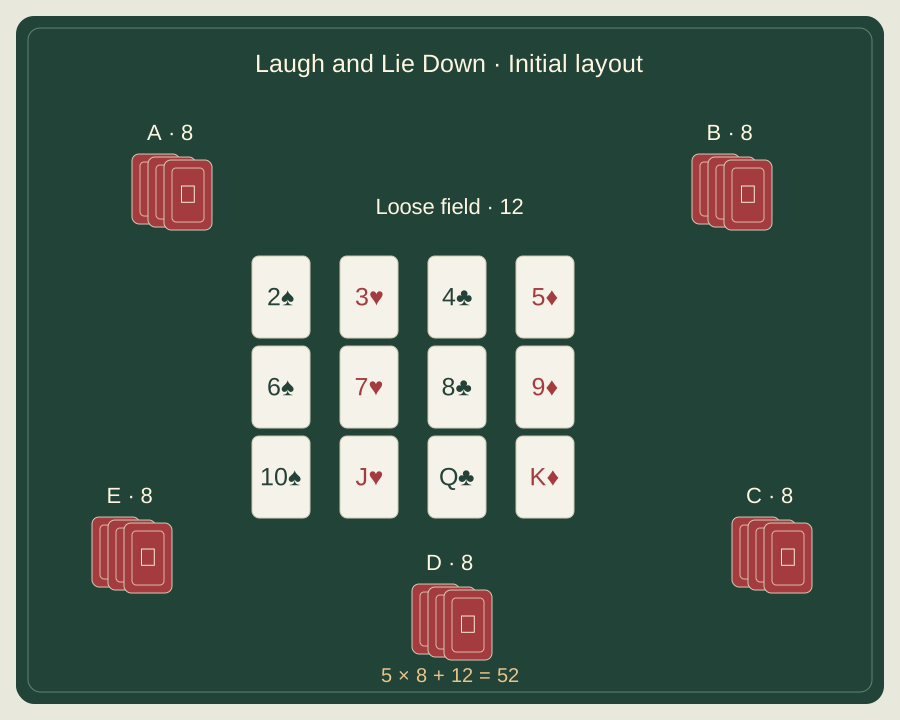
Eight each and twelve on the table
Use 52 ordinary cards, no jokers, with exactly 5 players. Lowest cut deals, ace low; rotate dealer clockwise. The dealer contributes 3 counters and each other player 2, making 11 in the pot. Deal 8 each singly clockwise, then expose the remaining 12 as loose table cards. There is no draw stock. Suits do not affect captures. Captured cards stay face up in each player’s separate collection, counted in pairs.
03 /
Capture or lay down your hand
The dealer’s left neighbour starts; play clockwise, skipping empty hands. Play a hand card to capture a table card of equal rank, taking both. If the table has all 3 other cards of that rank, take all of them. A hand pair may capture a table pair of the same rank. You must capture if possible; otherwise lay your entire hand face up among the table cards and leave the ordinary turn rotation. Do not merely discard a convenient unmatched card.
04 /
Claims and missed opportunities
A triple in hand lets you claim a pair, keeping the remaining card; a quartet lets you claim all 4. A quartet in the opening field belongs to the dealer. When a table pair is captured, whoever holds its matching hand pair may claim that pair, even out of turn. Missed opening quartets, the pair left after an incomplete triple capture, and eligible pairs exposed by someone laying down may be claimed by the first observer, including an eliminated player. Announce claims clearly; captured piles are never ordinary table cards.
05 /
Survivor bonus and pair accounting
Stop as soon as only one player has hand cards; that survivor takes 5 counters from the pot. The dealer receives the remaining hand and field cards as captures. Count each collection: below 8 cards, pay 1 per missing pair; above 8, receive 1 per extra pair. This settles the remaining 6 in the pot. Play a complete rotation of 5 deals and compare net counter balances. Keep a reserve or a signed ledger so settlement is never limited by someone’s loose chips.
06 /
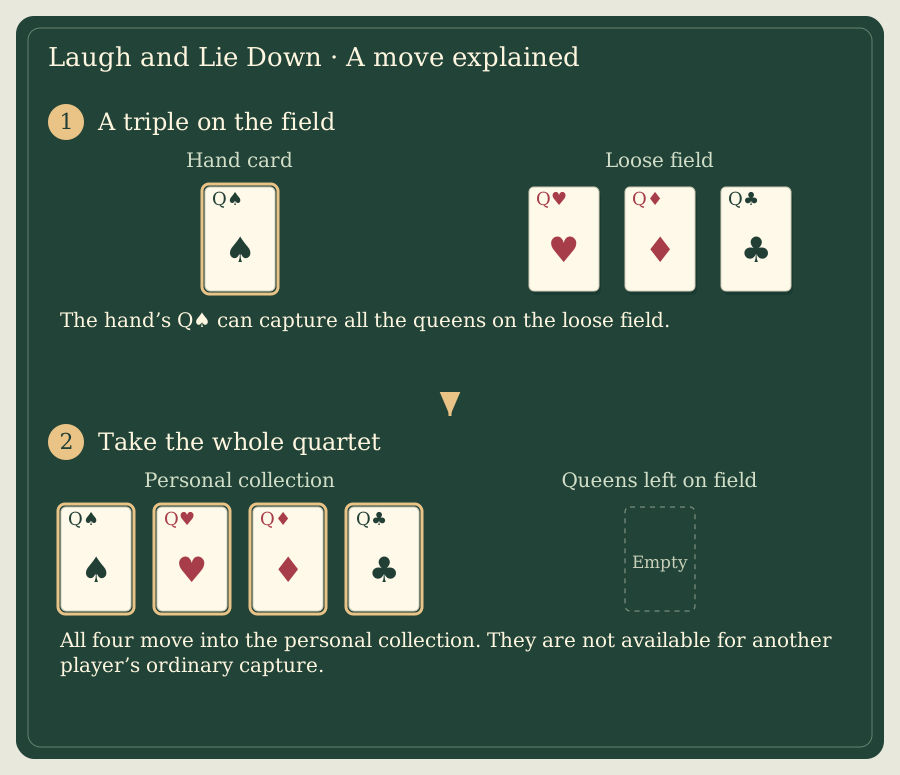
One queen captures three
You hold Q♠; Q♥, Q♦ and Q♣ lie on the table. Play Q♠ and collect all 4 queens, making 2 pairs. Taking only Q♥ would leave a claimable pair for an alert observer. For a separate final ledger, suppose collections contain 16, 12, 10, 8 and 6 cards. Their pair adjustments are +4, +2, +1, 0 and −1, totaling +6. The survivor’s separate +5 exactly uses the starting pot of 11 after the missing-pair payment.
← On a small screen, scroll the diagram horizontally. →
Common questions
Can I discard one unmatched card?+
No; without a capture, lay down your whole hand.
Can an eliminated player claim an oversight?+
Yes, the first observer may claim eligible missed cards.
Does the last survivor take the field?+
No; the dealer collects the remaining field and hand.