← On a small screen, scroll the diagram horizontally. →
01 /
Flower cards and a decision to continue
Koi-Koi is a Japanese two-player game with hanafuda, the flower-card family. Nintendo began manufacturing hanafuda in 1889, but that does not establish an inventor or first date for Koi-Koi itself. The appeal is a visible race: captured cards form yaku, and a player may risk an earned combination by continuing. Deck traditions and yaku values vary. Here we state the entire selected chart and use a single continuation per round. The diagrams are original labelled teaching cards, not reproductions of a commercial deck.
02 /
Recognise months and card classes
Use a real 48-card hanafuda pack: 12 months of 4, not a Western deck with suits renamed. Month plants are 1 pine, 2 plum, 3 cherry, 4 wisteria, 5 iris, 6 peony, 7 bush clover, 8 pampas grass, 9 chrysanthemum, 10 maple, 11 willow, 12 paulownia. Cards divide into 5 brights, 9 animals, 10 ribbons and 24 plains. Brights show crane, curtain, moon, rain man and phoenix. The cup is an animal and also counts as a plain in this profile. Printed individual card-point values from other hanafuda games do not determine Koi-Koi scores.
Animal cards are plum warbler, wisteria cuckoo, iris bridge, peony butterflies, clover boar, pampas geese, chrysanthemum cup, maple deer and willow swallow. The bridge and cup belong to animals despite their subject. Other non-bright, non-ribbon cards are plains.
03 /
Eight, eight and eight on the field
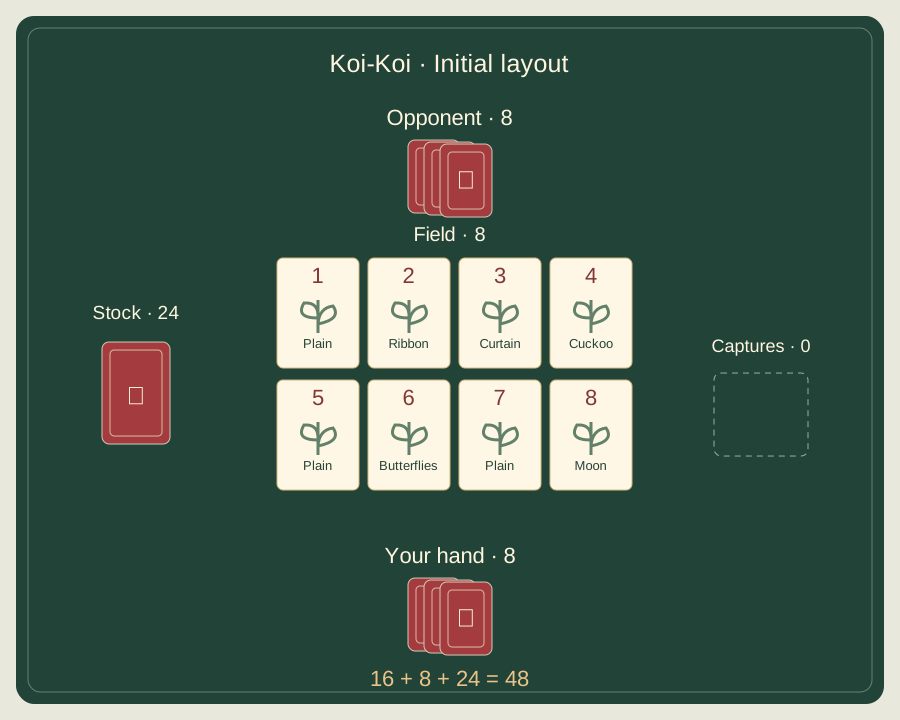
Choose dealer by drawing months, earlier month wins; redraw a same-month tie. Reshuffle. In batches of 2 deal opponent, field, dealer, repeating until both have 8 and field has 8 exposed. Stock holds 24. Dealer plays first; winner deals next, draw switches dealer here. Before playing, a hand with all 4 of one month or 4 pairs of different months wins 6 points immediately, without multipliers. If both qualify, void and redeal; also redeal a field containing all 4 of a month. Invalid deals do not use a match round. Agree a 12-round match; highest total wins, tied totals share.
04 /
Resolve both parts of a turn
Play 1 hand card. If no field card has its month, leave it on the field. With 1 match, capture both. With 2 possible matches, choose 1. With 3 cards of that month already on field, capture all 4 together. Matching is compulsory when available. Then turn up 1 stock card and resolve it by the same rules. Captures stay face up in your own area, arranged by class. Only after both parts check yaku. You cannot skip the stock reveal after a successful hand capture. The revealed stock card never replaces a card in your hand.
05 /
Brights and named yaku
Five brights score 10; four excluding rain man score 8; four including rain man score 7; three excluding rain man score 5. Score only the highest qualifying bright yaku, never their sum. Boar–deer–butterflies, from months 7, 10, 6, score 5. All 3 poetry ribbons, months 1, 2, 3, score 5; all 3 blue ribbons, months 6, 9, 10, score 5. The two ribbon triples together score 10, not an extra third award. Curtain plus cup scores 5, moon plus cup scores 5; we enable both viewing yaku and they can coexist. The crane and phoenix are brights, not animals.
06 /
Counted yaku and shared cards
At least 5 animals score 1 plus 1 per additional animal; at least 5 ribbons score 1 plus 1 per additional ribbon; at least 10 plains score 1 plus 1 per additional plain. Add these to independent named yaku, even when cards overlap. The boar triple itself gives no extra animal-extension points: extra animals improve the separate animal-count yaku only once that threshold is reached. Similarly extra ribbons improve the ribbon-count yaku. Cup can count in animals, plains and viewing yaku simultaneously, but it is only one physical card. No monthly yaku or extra plain-card values are used.
07 /
One continuation, then settle
At the end of a turn that first forms a yaku, stop and bank all current yaku or call Koi-Koi. We use one continuation total per round: after that call, the next player to form a new yaku or improve a counted yaku ends the round automatically, including the original caller. No points are safe merely because a call was made. Only the round winner scores; the other scores zero. A base total of at least 7 doubles. If winner is the opponent of the caller, double again; both multipliers can stack. Calling alone never doubles the caller’s own win. Repeated-call play is another variant.
08 /
Hands can end before the stock
After both hands have used all 8 cards, resolve the final turn’s draw and yaku check normally. If no player ends with a new or improved yaku, the round is a draw: both score zero, including any caller’s suspended combinations. Do not keep drawing to exhaust stock; normally 8 cards remain after the 16 turns. There is no final award for leftover field cards. Gather the entire pack, update the match round and deal anew. This profile does not award a dealer point for an otherwise empty draw.
09 /
A month match is not an animal match
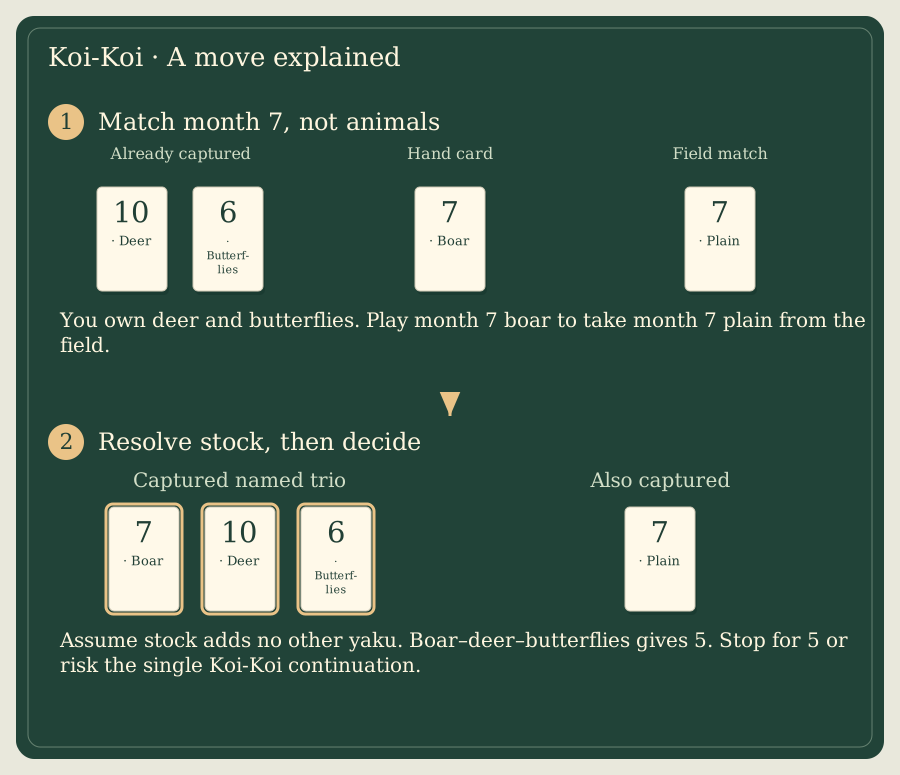
You already captured the maple deer and peony butterflies. Field has a plain bush-clover card; play your bush-clover boar to capture both. The stock reveal then resolves, and boar–deer–butterflies gives 5. You can stop for 5 or call. If the opponent next captures cup with a chrysanthemum match while already holding moon, moon viewing gives 5, doubled to 10 because you called; you score zero. In a separate win with base 8 against a caller, both multipliers give 8 × 2 × 2 = 32. Cards of different months do not match merely because both show an animal.
← On a small screen, scroll the diagram horizontally. →
Common questions
Can an ordinary deck replace hanafuda?+
Not without creating a fully labelled custom mapping of all months and classes. Use hanafuda for these rules.
Does my own Koi-Koi call double my win?+
No. This profile doubles for a high base score and for beating an opponent who called.
Must the stock become empty?+
No. End after the hands are used if nobody ends with a new or improved yaku; remaining stock is unused.