← On a small screen, scroll the diagram horizontally. →
01 /
Gops, Goofspiel and equal hands
Gops is short for Game of Pure Strategy; Goofspiel and Goofenspiel are other names for the same bidding family. Both players begin with identical bidding ranks, so nobody receives a stronger hand. The game appears in mid-century game-theory literature, but its precise inventor is uncertain. The title does not mean that choices are visible or that chance is absent from every version: bids are secret, and the shuffled prize order is unknown. This guide uses low aces and carry-over prizes after tied bids. Commercial games inspired by the mechanism may add different prizes and tie rules.
02 /
Separate the suits
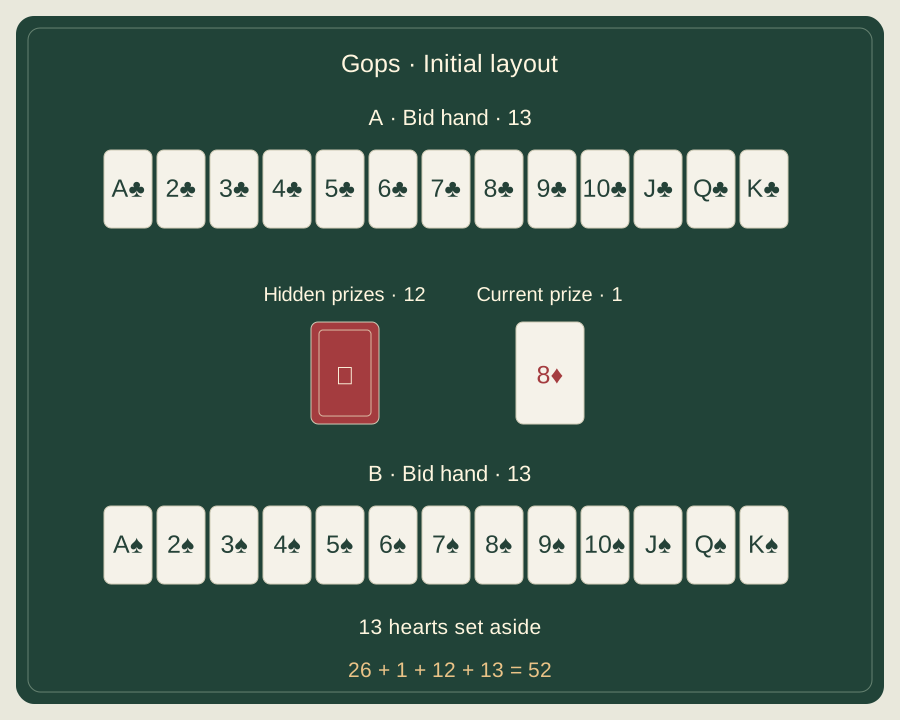
For 2 players take a standard 52-card pack without jokers. Give all 13 clubs to A and all 13 spades to B. Shuffle the 13 diamonds face down as the prize pile; set aside all 13 hearts. Only 39 cards participate. Each player holds every bidding rank from A to K. Do not shuffle these hands or deal random mixtures. Before the first bid, expose the top diamond, leaving 12 hidden prizes. Provide separate spaces for spent bids, captured prizes and any tied prize pool. No dealer or first bidder is needed because choices are simultaneous.
03 /
One simultaneous bid
A is the lowest bid, followed by 2 through 10, then J, Q and K. Each player secretly selects an unused hand card, puts it face down and waits. Reveal together only after both choices are committed. The higher rank wins every diamond currently on offer. Put both bid cards in the spent area, whether they won or lost; they never return to a hand and never add score. Expose the next diamond and repeat. Do not draw replacements, follow suit or play a second card to rescue a losing bid. Keeping spent bids visible lets both players check which ranks remain.
04 /
Carry-over and final ties
If bids have equal rank, spend both cards but leave the prize unclaimed. Add the next diamond to that pool: the next winning bid takes the entire pool, not just the newest card. Repeated ties keep accumulating prizes, while each player still spends a card per bid. If the last bid ties, nobody wins the remaining pool; set those diamonds aside without points. Do not draw extra bids or split that pool in this profile. A common alternative discards a tied prize immediately. That produces different scoring opportunities and must be agreed before play, not chosen after seeing a tie.
05 /
Count prizes, not bidding cards
Play 13 bids, exhausting both hands and the prize pile. Count captured diamonds: A = 1, 2–10 = face value, J = 11, Q = 12, K = 13. The complete prize pool is worth 91. The larger captured total wins; equal totals are a draw. Because final tied prizes can remain unclaimed, the winning score need not reach 46, and equal totals are possible despite the odd full-pool value. For example, with 5 points unclaimed, 43–43 is a draw. For a longer session agree to add results over 3 fresh games; the highest cumulative total wins, with equal totals sharing the result.
06 /
A tie makes the next prize larger
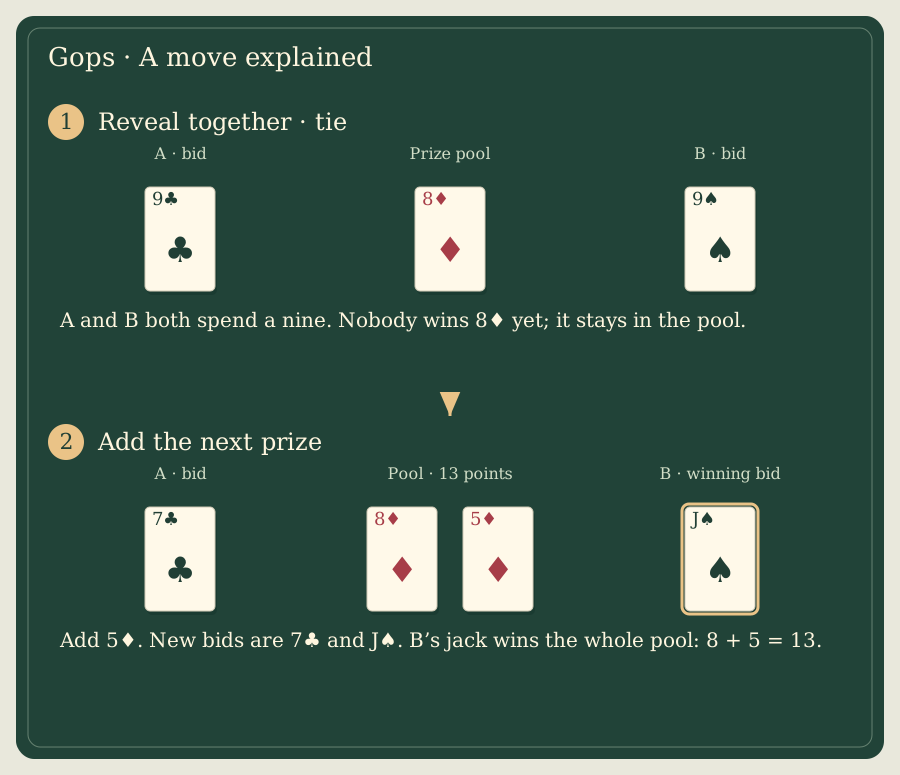
The first prize is 8♦. A bids 9♣ and B bids 9♠: tie. Both nines are spent, and 8♦ stays in the centre. Next reveal 5♦. A chooses 7♣ while B chooses J♠; the jack wins both diamonds for 8 + 5 = 13 points. The winning J♠ is spent too: its bidding rank does not add 11 points. This illustrates why valuing only the newest diamond is a mistake. Track the whole pool and the opponent’s remaining ranks, but avoid predictable rules such as always bidding exactly the prize value; identical predictable choices can tie every round.
← On a small screen, scroll the diagram horizontally. →
Common questions
Do bidding cards score points?+
No. Only captured prize diamonds score. Both bids are spent after every reveal.
What if the last bids tie?+
In this carry-over profile the remaining prize pool is unclaimed, with no extra bidding round.
Is the shuffled prize order public?+
No. Reveal the next prize only after resolving the previous bid. Remaining ranks can be deduced, not their order.