← On a small screen, scroll the diagram horizontally. →
01 /
Six-card Golf and its relatives
Card Golf turns a small hidden grid into a contest for the lowest score. It is a family game of memory, replacement and timing, separate from Golf Solitaire. This guide selects the six-card form with negative twos and immediate round ending. Other tables use larger grids, jokers or an extra final turn; those agreements change decisions and should be settled before dealing. The sporting name describes the low-score objective and a match divided into holes. A precise inventor or first date for this particular ruleset is not established.
02 /
Deal and arrange the table
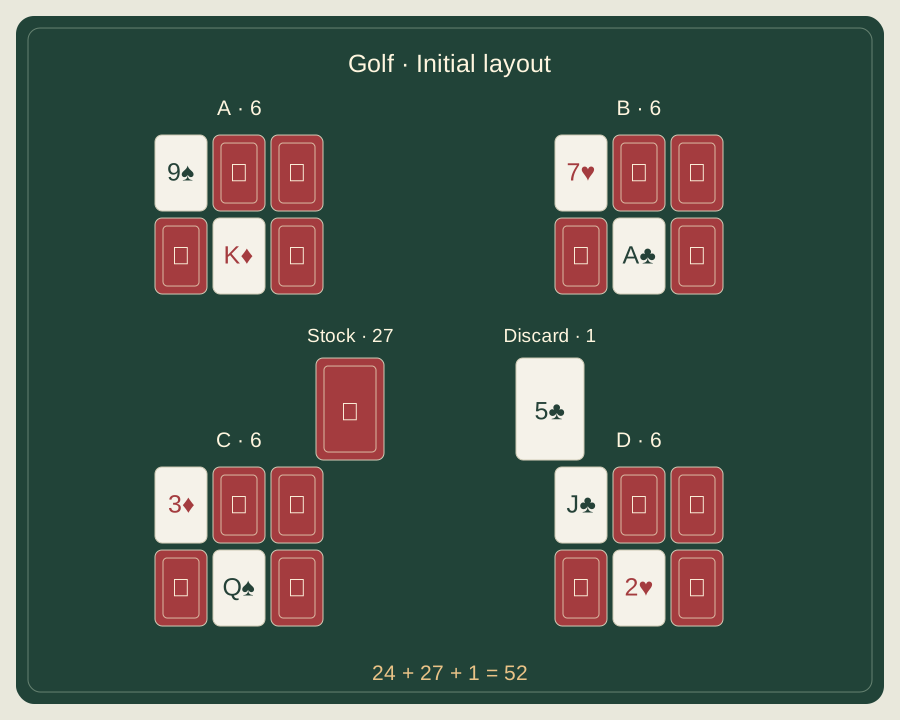
For 2–4 players use 52 ordinary cards, without jokers, plus paper for scores. Deal 6 cards face down to each player, arranged as 2 rows of 3. Everyone chooses any 2 of their cards to turn face up; nobody may inspect the remaining hidden cards. Keep positions fixed: the vertical columns matter for scoring. Put the undealt cards in a face-down stock and expose its top card as the discard. With 4 players, the grids hold 24 cards, the discard 1 and the stock 27. The player left of the dealer begins; turns and the next dealer move clockwise.
03 /
Draw, replace or reject
Take the stock’s top card secretly or take the visible top discard. A card taken from the discard must replace a card in your grid. A stock card may replace any grid card, hidden or visible, or be rejected straight onto the discard. For a replacement, first choose the position without peeking underneath, then put the new card there face up and discard the displaced card face up. Never move cards between positions. Rejecting a stock card does not force you to reveal another card in this version. Do not simply flip a hidden card instead of drawing. Keep only the discard’s top card available; earlier discards cannot be retrieved.
04 /
Values and vertical pairs
Score ranks as follows: A = 1; 2 = −2; 3–10 = face value; J and Q = 10; K = 0. Before adding individual values, inspect every vertical column. If its cards have the same rank, that whole column is worth 0 regardless of suits. This also cancels a pair of twos: it is not worth −4. Equal cards across a row or on a diagonal do not cancel. Leave pairs in their places until scoring; they are not removed during play. Low individual cards help, but matching a high card already in a column can improve the score more than an unrelated low draw.
05 /
End a hole and the match
As soon as a player’s entire grid is face up after a turn, stop immediately. Nobody receives an extra turn. Reveal every remaining grid, total its columns and add the result to the score sheet. Play 9 deals, reshuffling all cards each time; the lowest cumulative score wins, with equal totals sharing victory. For stock exhaustion we specify a table agreement: after resolving the last stock draw, if no grid has already ended the hole, stop and score. Do not reshuffle the discard under this agreement. This is a practical limit, not a universal Golf rule. An extra final turn for opponents or a recycled stock belongs to a different agreed version.
06 /
A replacement that saves points
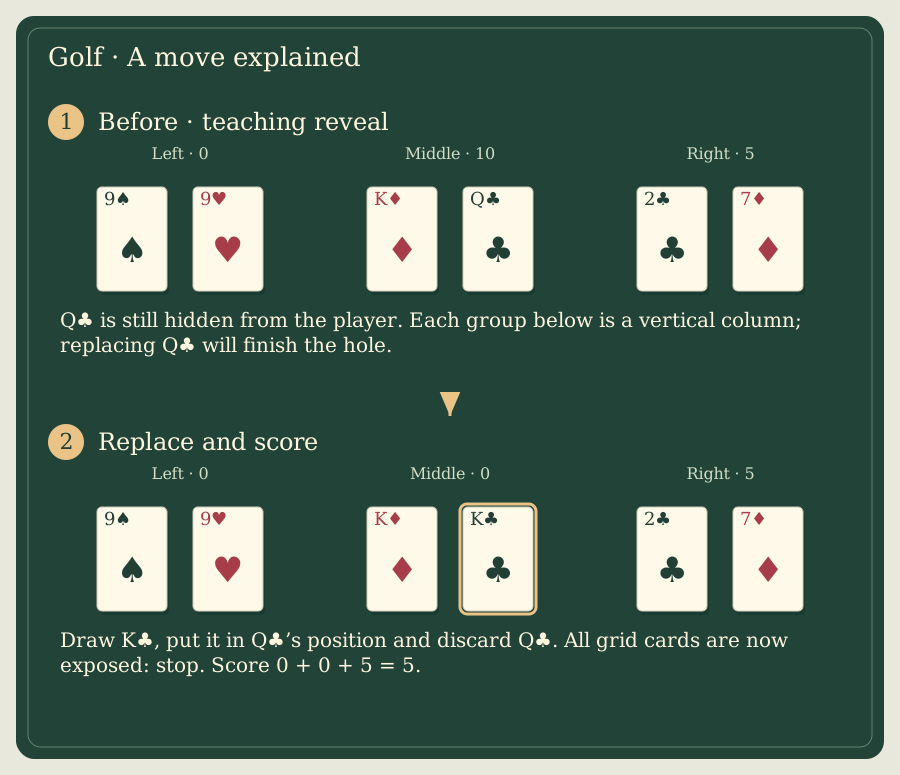
The teaching picture reveals values to the reader: upper row 9♠, K♦, 2♣; lower row 9♥, Q♣, 7♦. Only Q♣ is still face down for the player. If scored unchanged, the columns would be 0, 10 and 5: total 15. Draw K♣ and choose that hidden position without peeking, then replace Q♣ and discard it. The whole grid is now exposed, so the hole stops immediately. The columns score 0 + 0 + 5 = 5, saving 10. This example shows the possible benefit of a hidden replacement; the player did not know the queen’s value when choosing.
← On a small screen, scroll the diagram horizontally. →
Common questions
Can a pair of twos score negative points?+
Not in this profile. An isolated two is −2, but matching twos in a vertical column cancel to 0.
Do opponents receive a final turn?+
No: our selected profile ends immediately when a grid is fully exposed. Agree on any extra-turn variant before dealing.
Is this Golf Solitaire?+
No. Card Golf is a multiplayer replacement game; Golf Solitaire is a separate solo sequence-building game.