← On a small screen, scroll the diagram horizontally. →
01 /
Context, pack and deal
Tarot began in fifteenth-century Italy as a trick-taking card game; surviving Visconti-Sforza packs document its courtly setting. The Met and Morgan distinguish this history from later divinatory interpretations. The cards’ origins do not establish the modern French auction or scoring: the rules below follow the present FFT code.
Tarot has several European game traditions. This guide describes the French federation’s four-player game, not divination or five-player king-calling. Use 78 cards: four suits ranked K, Q, Cavalier, J,10 down to 1;21 permanent trumps numbered 21 highest to 1 lowest; and the Excuse. Bouts are trump 1, trump 21 and Excuse.
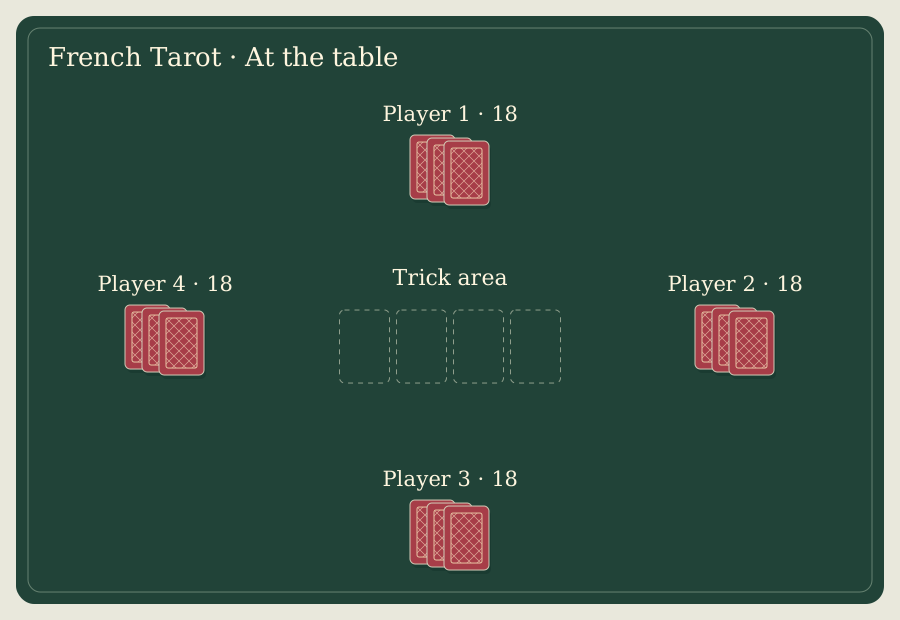
Choose the first dealer randomly as our table agreement. Play and deal counterclockwise; next dealer is on the right. Opposite player shuffles, left neighbour cuts. Give 18 each in packets of three, interspersing six single face-down chien cards; neither first nor last card may enter the chien. A player with trump 1 as their only trump and no Excuse must expose the hand: cancel and pass the deal right. All-pass deals also pass right.
02 /
Auction and discard
Starting right of dealer, each speaks once: pass or overcall. Ascending bids are Prise×1, Garde×2, Garde Sans×4, Garde Contre×6. Highest bidder becomes taker against the other three. Prise/Garde: expose the six-card chien, add it to the hand and discard six secretly. Never discard kings or bouts; discard other trumps only if unavoidable, showing them. The discard counts for taker. Sans leaves chien unseen for taker; Contre leaves it unseen for defenders. All keep 18 cards for play.
03 /
Eighteen tricks
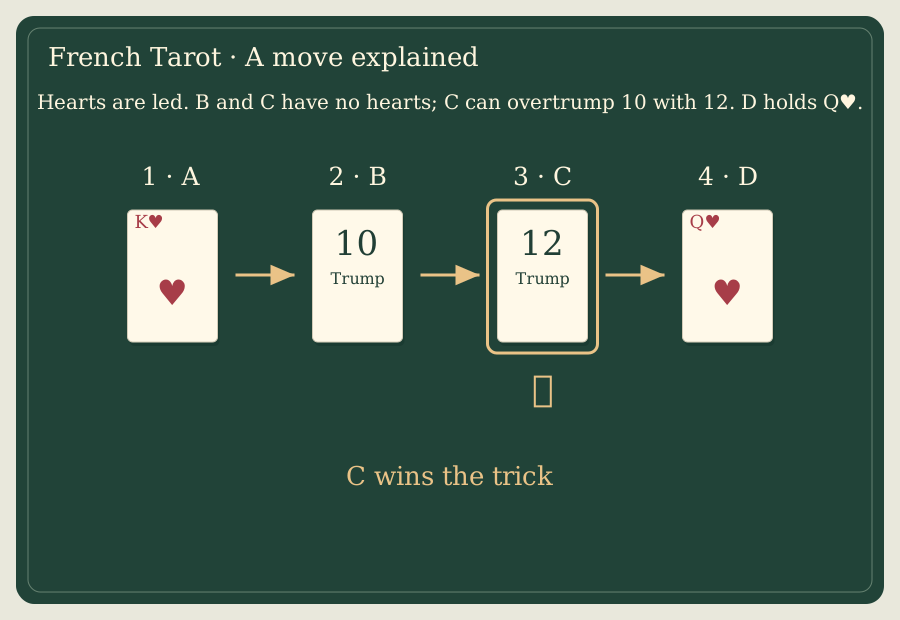
Dealer’s right leads unless a slam has been announced, when its announcer leads. Follow suit if possible; no duty to beat in a plain suit. If void, trump. When playing a trump, exceed the highest trump already in the trick if possible, even a partner’s; otherwise undertrump. With neither suit nor trump, discard. Highest trump wins, otherwise highest led-suit card; winner leads next. No draw. Defenders pool tricks.
04 /
The Excuse
The Excuse may be played instead of obeying suit or trump obligations. It normally cannot win. If led, the next card determines the requested suit. Before the last trick, its side keeps it and transfers one 0.5-point card to the trick-winning opponents if necessary; the debt can wait until a small card is captured. On the last trick it changes sides, regardless of who wins, except for the slam rule.
A side that has won every earlier trick may lead the Excuse last and win that trick too. If a slam-winning taker does not own the Excuse, a normally played Excuse stays with defence, net 4 points after replacement. This exception allows a slam without capturing every card.
05 /
Card points and success
Bouts and kings are worth 4.5 each, queens 3.5, cavaliers 2.5, jacks 1.5, all others 0.5; total 91. Count in pairs where convenient. Include the proper chien/discard and Excuse transfers. Taker needs 56 with 0 bouts,51 with 1,41 with 2,36 with 3. Exactly reaching the target succeeds. These captured bouts, not those originally held, determine the target.
06 /
Bonuses
Before playing their first card, anyone may show a sorted poignée of exactly 10,13 or 15 trumps for 20,30 or 40. Excuse may supply a missing trump but showing it states no further trumps are hidden. The bonus goes to the hand’s winning side, even if its opponents announced.
Petit au bout: the side capturing trump 1 in the last trick earns 10 times the contract multiplier, independently of who wins the contract. Slam means every trick: announced and achieved earns 400, unannounced earns 200, announced and failed costs 200. Announce before play. In an Excuse-last slam, trump 1 in the penultimate trick counts as petit au bout. Poignée and slam bonuses are not multiplied.
A rare FFT exception: if the taker has 4 kings and 15 trumps before discarding and must discard a trump, show that discarded trump again with the triple poignée. It counts towards establishing the 15 trumps; the forced discard does not remove the bonus. The card stays in the discard, not back in hand. Defence can also make a slam: for winning every trick, each defender receives an additional 200 beyond the normal result, not the taker.
07 /
Ledger, example and end
Let the taker’s card-point margin be the absolute difference from the target. Start with 25+margin, positive for success, negative for failure. Add+10 if taker’s side earns petit au bout, −10 if defence does; multiply by the contract factor. Add poignée bonuses with the sign of the winning side and any signed slam bonus. Call this signed amount S. Taker records 3 S; each defender records−S, so the total is zero.
Our session ends after eight valid played or all-pass deals; cancelled lone-petit or defective deals do not count. Highest cumulative score wins, equal totals share places. This session length and tie rule are home agreements; three- and five-player rules are separate.
For a defensive slam, include this bonus once: subtract 200 from S before distribution. The slam component adds −600 for the taker and +200 for each defender; do not award the same bonus again.
08 /
Worked example
Example: Garde, taker 48 points with 2 bouts needs 41, so margin 7. Defence wins petit au bout, but a declared simple poignée goes to successful taker: S=(25+7−10)×2+20=64. Taker+192, each defender−64;192−64−64−64=0.
← On a small screen, scroll the diagram horizontally. →
Common questions
Must I overtrump a partner?+
Yes, whenever legally playing a trump and a higher one is available.
Does a poignée lower the card-point target?+
No. It changes the ledger only, never the target.