← On a small screen, scroll the diagram horizontally. →
01 /
Context and cards
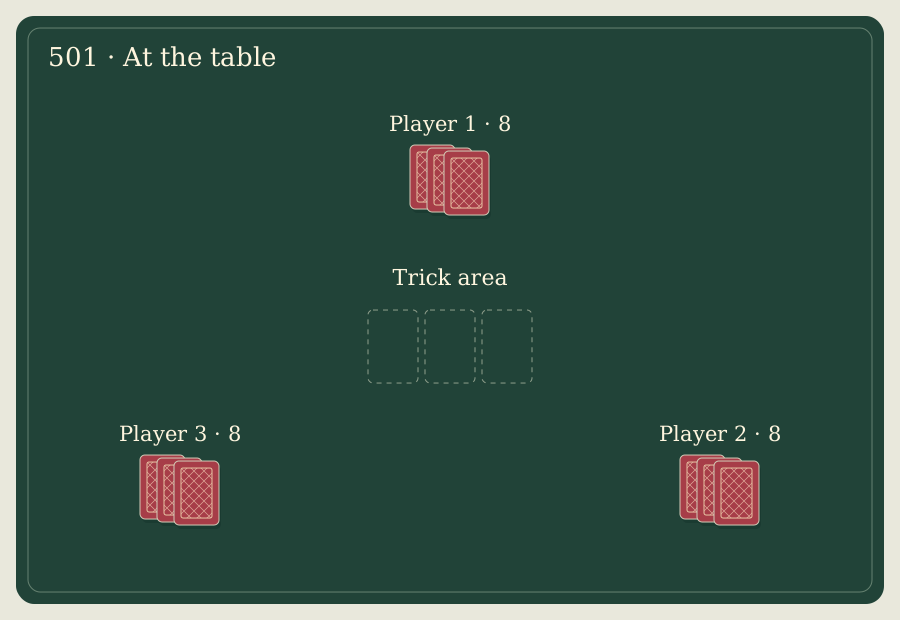
Michael Latash described this Russian game as learned from his father in Moscow. Its published account compares Thousand and Sixty-Six, but a proposed historical link is a hypothesis, not an established origin. Use 24 cards, A 10 K Q J 9 in each suit, ranked in that order and worth 11,10,4,3,2,0, total 120. Three play individually; with four, the current dealer sits out without scoring. Everyone starts 501.
02 /
Deal and auction
Choose first dealer randomly, then rotate left. Shuffle, cut on the right and deal clockwise singly: seven to each active player, plus three face-down talon cards inserted during the first three rounds. Dealer’s left begins. Pass or name an integer bid at least 66 and higher than the previous bid. Continue until a bid is followed by two passes. Our auction clarification makes passes final. All-pass means zero scores and the next dealer.
You may bid blind with your cards untouched face down. Looking before the auction ends makes you seen and removes the doubling. If the final winner remained blind until winning, all their positive or negative contract scoring doubles, even if they increase the contract after seeing the talon. Defenders’ results never double.
03 /
Contract and exchange
Expose all three talon cards and add them to winner’s seven. Declare any trump suit or no-trump and a final target no lower than the last bid; then give one unwanted card face down to each opponent, everyone keeping eight. Trumps remain fixed for the hand. Instead, at talon exposure the winner may abandon: add the last bid to their own score, double if blind, and subtract 25 from each opponent’s score. No play follows.
04 /
Eight tricks and marriages
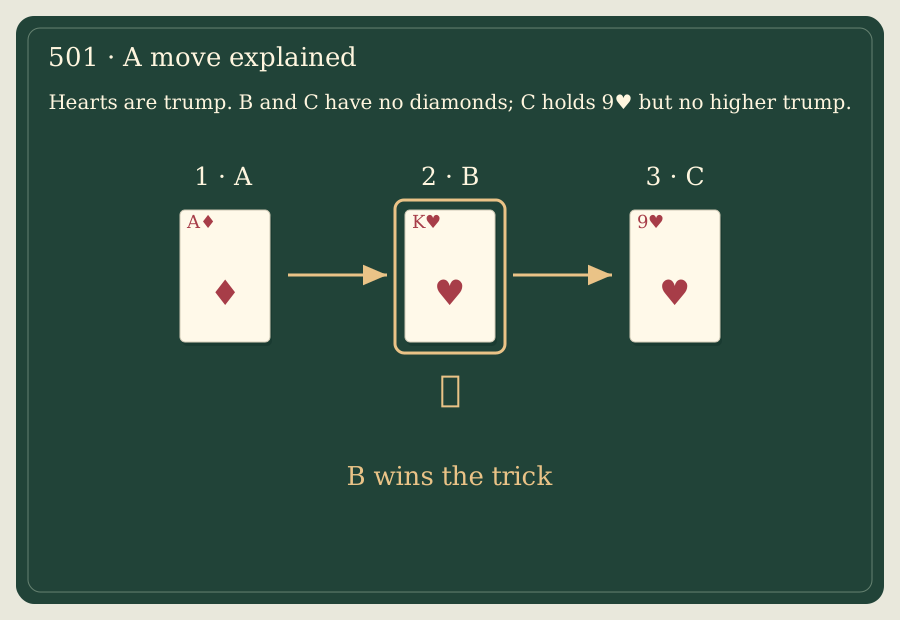
Dealer’s left leads first, regardless of who bid. Follow suit if possible; otherwise play trump if held, even one unable to win; otherwise anything. No obligation to beat or overtrump. Highest trump wins, or highest led-suit card; winner leads next. No draw.
When leading, hold K+Q together, show both and lead either to declare 40 in trumps or 20 otherwise. First-trick declaration is allowed, but a bonus counts only if that player wins at least one trick during the hand. No-trump marriages all score 20. You cannot declare after either member left your hand. Marriages never change trumps.
05 /
Scoring and finish
After eight tricks add captured values and effective marriages for each player. Successful bidder subtracts exactly the contract from their running score; failure adds it. Blind winner subtracts/adds twice the final contract. Defenders subtract their own actual points without rounding, whether the contract succeeds or not.
After the whole hand, any score at zero or below ends the match. If several qualify, our table awards victory to the lowest residual score, sharing an exact tie. This simultaneous-finish clarification is not a claimed historical rule. Otherwise rotate dealer and continue.
06 /
Worked blind contract
A wins blind at 80, then raises the final contract to 100. A captures 68 and declares a nontrump marriage 20, total 88: the target fails and 501+2×100=701. B captures 32 and C 20;68+32+20=120. B goes 501−32=469, C 501−20=481. The valid 20-point marriage does not change trumps, and the 100-point contract still fails. If A had fulfilled 100, the running score would instead be 501−200=301.
← On a small screen, scroll the diagram horizontally. →
Common questions
Does the bidder always lead first?+
No. Dealer’s left leads in this 501 profile.
Can a marriage change trumps as in Thousand?+
No. Trumps are chosen before play and remain fixed.