← On a small screen, scroll the diagram horizontally. →
01 /
A game with spoken formulas
Earl of Coventry is a traditional relative of Snip Snap Snorum. Foster’s Complete Hoyle describes successive matching of four equal ranks, with four formulas and remaining-card payments to the winner. We select that profile, without a forgotten-rhyme penalty or intermediate Snip/Snap fines. The name and rhyme do not establish that any particular earl invented it.
02 /
The whole pack in hand
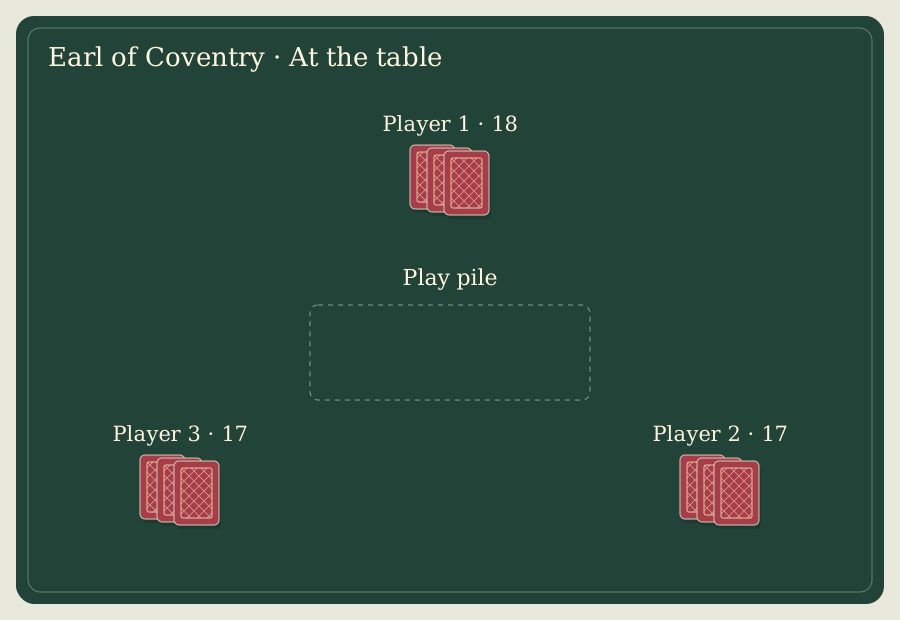
Play with 3–6 and one 52-card pack without jokers. Ranks only match: there is no hierarchy, trump or card value. Choose dealer by lot, shuffle and cut at the right. Deal everything singly clockwise from dealer’s left. Unequal hands are fine: with 3 players the first receives 18, others 17 each. No stock remains. Dealer’s left starts with any card.
03 /
Complete the quartet
After the lead, turns run clockwise. Holding the current rank, you must play one; otherwise pass. Suit is irrelevant. Do not play another rank or several matches together. If the turn returns and you have another match, play one again: one person can contribute several cards of a rank. Whoever plays its fourth and final card immediately starts a new cycle with any remaining card. Completed quartets are set aside and never reused.
04 /
Four spoken formulas
For the first card say “There’s as good as Queen can be”, substituting its rank. Second: “There’s a Queen as good as he.” Third: “There’s the best of all the three.” Fourth: “And there’s the Earl of Coventry.” Other languages may agree equivalent formulas; turn order and rank matching remain compulsory. Stumbling over a formula does not make you take cards back.
05 /
Ending and notional settlement
First to play the last card legally wins immediately, even in an unfinished quartet; do not complete it. Each opponent loses 1 notional unit per card left in hand and winner receives the total. Negative scores are allowed. Our agreed series is 6 deals starting at 0, dealer moving left; highest final total wins, equal totals share place. Without a series you may stop after one deal.
06 /
Fourth queen gives the next lead
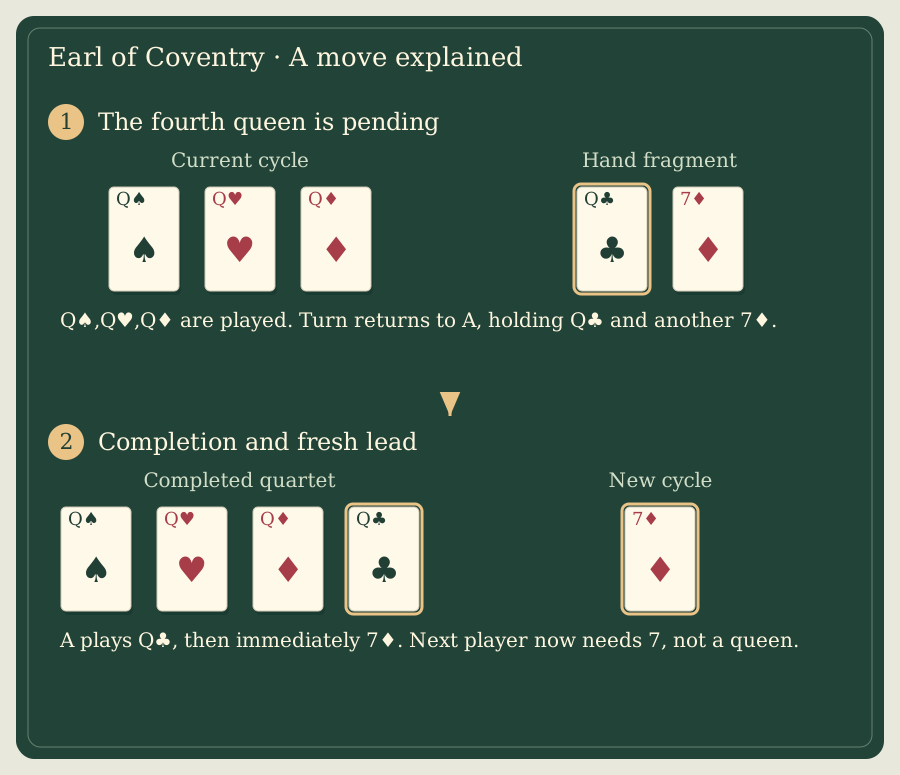
A led Q♠, B played Q♥ and C Q♦. A still has Q♣ and 7♦: on returning turn A plays fourth Q♣ and immediately leads 7♦, starting a new cycle. If Q♣ were A’s last card, A would win before another lead. In a separate finish opponents retain 3 and 5 cards: winner receives 3+5=8, others −3 and −5.
← On a small screen, scroll the diagram horizontally. →
Common questions
Must I complete a quartet to win?+
No. The last legal card immediately ends the deal.
May I pass while holding a match?+
No. Play a matching card on your turn.
Does a stumbled formula incur a penalty?+
Not in this profile; the card play remains valid.