← On a small screen, scroll the diagram horizontally. →
01 /
Donkey without a stock
Donkey belongs to the Pig and Spoons family, combining four-of-a-kind collection with reacting to a gesture. We select Pagat’s no-stock version with six lives spelled DONKEY. Touching the nose replaces grabbing spoons. This is neither poker nor an odd-card game. No single precise invention date is established.
02 /
Sixteen selected cards
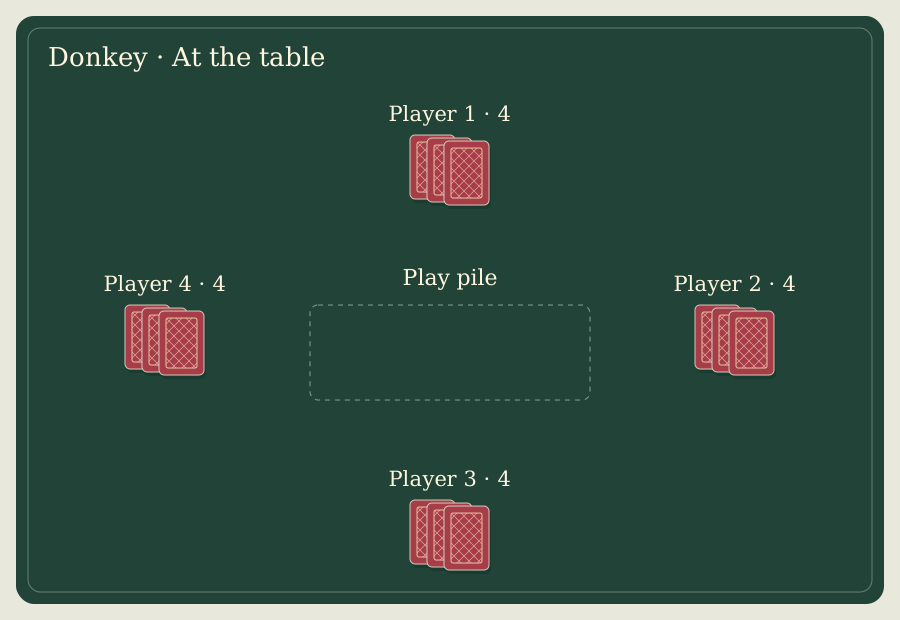
Exactly 4 start. From a 52-card pack keep all A,K,Q,J: 4 per rank, 16 total, setting the other 36 aside. There is no rank order or card value. Sit where faces and hands are visible; agree on an index-finger-to-nose signal. A dealer chosen by lot shuffles and gives 4 face down each. There is no stock, discard or communal layout. Passing is always left.
03 /
Pass, then pick up
Everyone simultaneously selects one unwanted card and places it face down left. Only after releasing yours may you pick up the one received from the right: never hold more than 4. Repeat one-card passes; never pass a group or take another person’s unpassed card. Dealer may set a common rhythm, but there are no individual turns. Pass even when no useful exchange is apparent; you cannot keep your whole hand by passing the action.
04 /
Four matching cards and the signal
On collecting four of a kind, silently touch your nose and hold the gesture. Once you notice a valid signal, copy it regardless of your cards. Last to copy receives the next letter of DONKEY. After stopping, the initiator shows the quartet. Our explicit error agreement makes a first signaller without a quartet take the letter instead; an indistinguishable last-place tie causes a scoreless redeal. No shout or grabbing objects is required.
05 /
Letters, elimination and result
Record successive letters D,O,N,K,E,Y. After 6 losses a player leaves. Collect every card, remove one whole rank and redeal to survivors: for 3 players keep A,K,Q, total 12, again 4 each. Dealer moves left among survivors. This selected no-stock version ends with two survivors as joint winners, unlike stock versions that continue to one winner. There are no separate points for initiating the signal fastest.
06 /
A pass completes the quartet
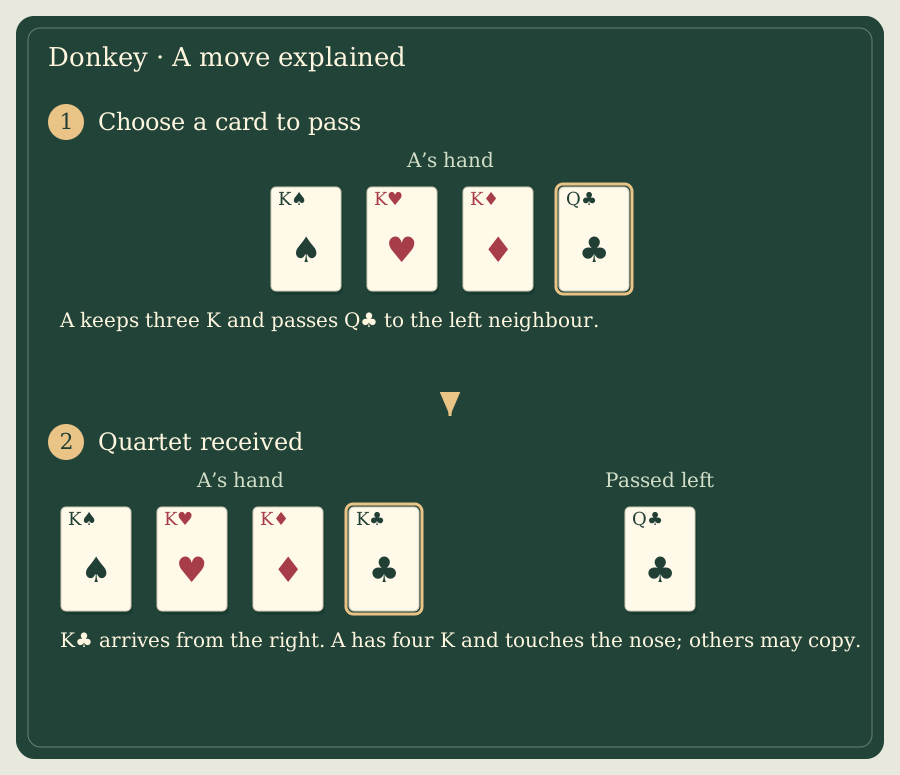
A has K♠,K♥,K♦,Q♣. A passes Q♣ left, then receives K♣ from the right. All 4 K are now held, so A silently touches the nose. B and C copy, D notices last and receives D if previously unmarked. K♣ does not become a fifth card: Q♣ was released first.
← On a small screen, scroll the diagram horizontally. →
Common questions
Do we use the whole pack?+
No. This starting table uses 16 cards of four ranks.
May I pick up before passing?+
No. Release yours before picking up the received card.
Is there one final winner?+
In this selected version the final two share victory.