← On a small screen, scroll the diagram horizontally. →
01 /
Deal the whole pack
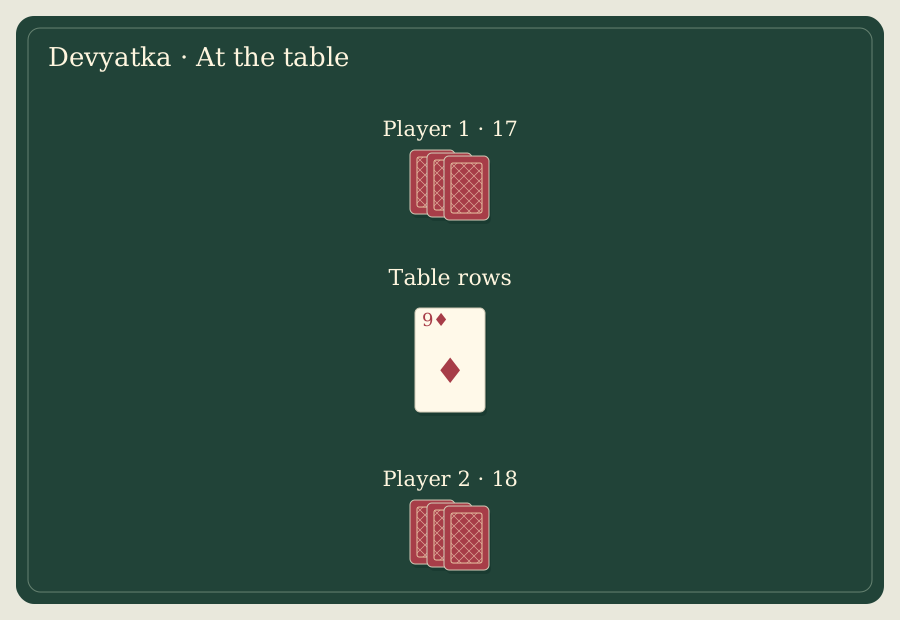
Two to six people play individually. Use 6–7–8–9–10–J–Q–K–A in each suit. Shuffle and deal all 36 cards one at a time clockwise. There is no drawing stock; some hands may receive one extra card.
The holder of 9♦ plays it first. Turns then pass clockwise. Leave room for four separate suit rows.
02 /
One card per turn
Each nine starts its suit. Any other card must extend an exposed end of that suit’s existing row without a rank gap. Ace ends the upper side, six the lower; do not wrap from king to six.
Play exactly one card. Choose freely between legal options. You must play if able; otherwise pass without drawing.
03 /
One player loses
A player leaves after playing their last card. Continue among those still holding cards, skipping empty hands. The last person with cards loses; the first exit does not stop a multiplayer game.
There are no tricks, trumps, exchanges or card-point totals. A home series may record one loss per game as a separate agreement.
04 /
An original diamond-row example
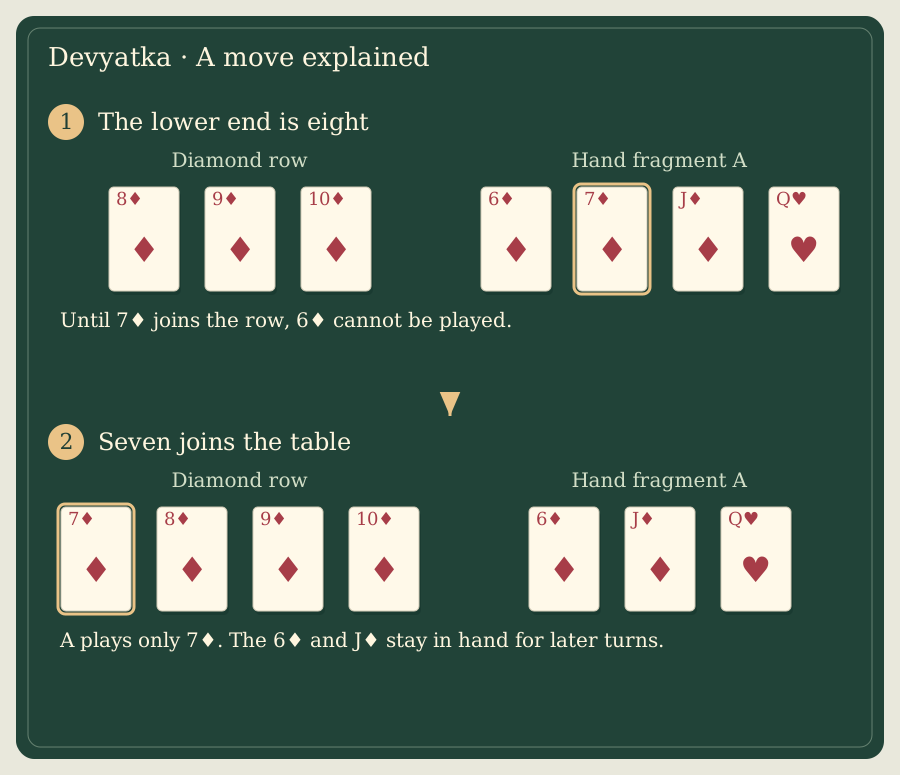
The table shows 8♦–9♦–10♦. You hold 6♦, 7♦, J♦ and Q♥. Either 7♦ or J♦ is legal. The six must wait for the seven; the heart queen needs its own suit to be opened and extended.
Playing 7♦ keeps J♦ for later. Although 6♦ becomes playable, you cannot add it as a second play on the same turn.
← On a small screen, scroll the diagram horizontally. →
05 /
Related layout games
Devyatka belongs to the suit-building family alongside Sevens / Fan Tan. This version starts with nines in a 36-card pack; do not silently import the 52-card Sevens setup. The club source records playing practice rather than an invention date.
Common questions
May I pass while keeping a playable card?+
No. Any available legal play must be made.
Can a trump bridge a gap?+
There are no trumps; build each suit without gaps.