← On a small screen, scroll the diagram horizontally. →
01 /
Players and cards
This patience for 1 player uses 2 ordinary 52-card packs without jokers. Remove all 8 aces, leaving 96 cards. Every card has one identical copy. The goal is to fit the complete set into 24 suited piles of 4 cards, with completed piles in their correct rows.
02 /
Deal and opening
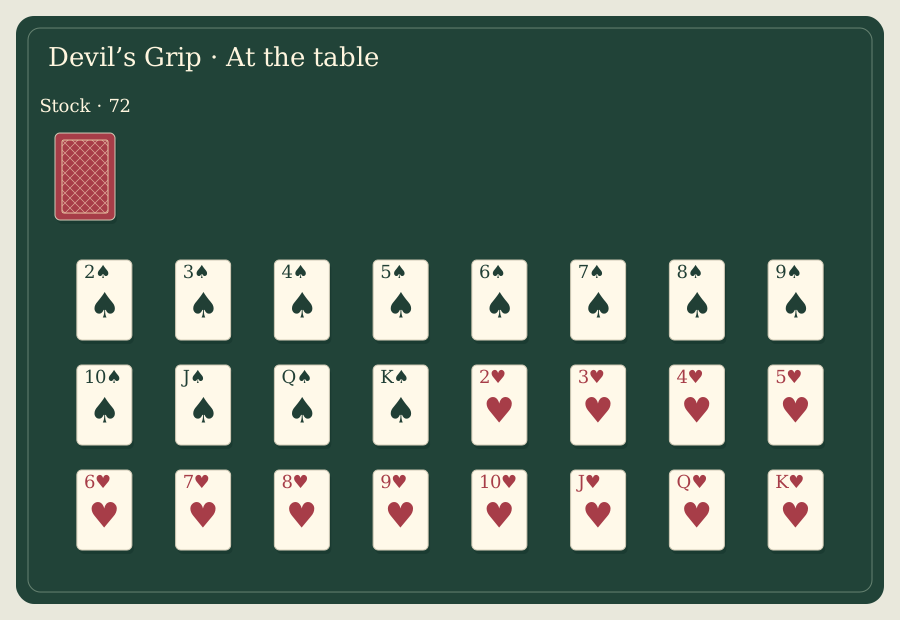
Shuffle the stripped set. Deal 24 single cards face up in 3 rows of 8. The other 72 form a face-down stock; the waste, called the talon, begins empty. There are no separate foundations: build directly in grid cells. At any time exchange the positions of two whole grid piles without changing their internal order. This is a swap, not a merge or a draw.
03 /
Playing a turn
Build in suit from bottom to top in steps of three ranks: the top row must finish 2–5–8–J, the middle 3–6–9–Q, the bottom 4–7–10–K. A pile allows only adjacent members of one of those sequences. Thus 8♠ goes on 5♠ even if no 2♠ is underneath yet. Equal ranks or a different suit do not fit; nothing continues beyond the picture card.
04 /
Pile moves and spaces
To merge, move a single card or a whole correctly built pile: its bottom card must fit the destination’s top. Never cut out an interior card or part of a pile. Building may temporarily occur in any row, followed by a whole-pile swap into the correct row. A pile holds at most 4 cards. Immediately fill a vacated cell with the face-down stock’s top card; no choosing. After stock exhaustion, spaces remain empty and cannot take talon cards.
05 /
Talon and the single pass
With no empty cells, turn the next 3 stock cards as one ordered packet onto the common talon; only the last, fully exposed card is available. It may join a fitting grid pile, not start a separate base cell. Removing it exposes the previous top. Turn a final short packet as it stands. Never turn the talon back: this selects a single pass without redealing. Do not inspect or select hidden stock cards.
06 /
Scoring
A win requires all 96 cards in 24 complete suited piles of 4 in the correct rows, with stock and talon empty. When no further card can enter the grid, end the attempt and count talon cards left: fewer is better. Bicycle rates 10 or fewer as good, 5 or fewer as excellent and 2 or fewer as brilliant. These grade the remainder, not the probability of winning.
07 /
Ending the game
While stock remains, continue exposing it when no mandatory space needs filling. With stock empty, check available merges and the talon top. Whole-pile swaps do not change available ranks, but may finish the correct row arrangement. Failure to complete the solution is an unfinished patience, not a draw. A fresh shuffle starts a new attempt.
08 /
History and selected variant
Bicycle publishes this patience as a grid puzzle with three-rank intervals. The checked rules do not identify a reliable inventor or origin date. Do not confuse it with Klondike: there are no separate foundations, covered column cards or A bases. The original title is retained where no verified local name is available.
09 /
Worked example
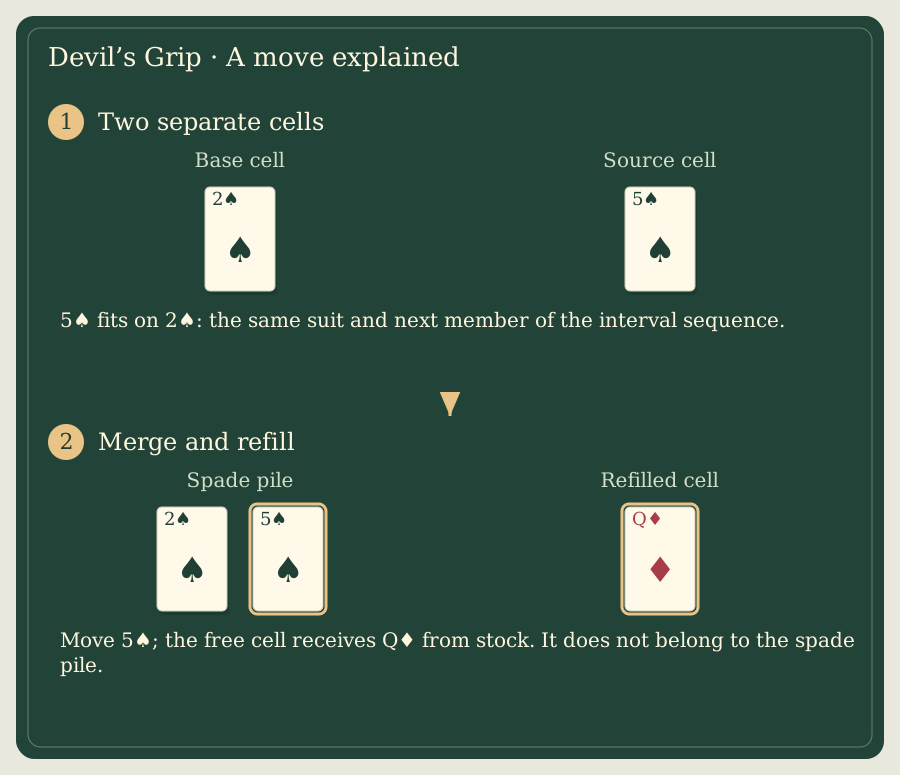
The grid has separate 2♠ and 5♠. Move 5♠ onto 2♠, forming the correct start of a top-row pile and vacating the five’s cell. Immediately expose the next stock card there, for example Q♦. This does not attach Q♦ to the spades: it is separate. Later 8♠ and then J♠ can complete the spade pile; Q♦ needs to follow 9♦.
← On a small screen, scroll the diagram horizontally. →
Common questions
Are aces used for foundations?+
No, all aces are removed and there are no separate foundations.
May an eight go on a five without a two?+
Yes, in the same suit: the starting base may still be missing.
May I redeal the talon?+
Not in this profile: there is only one pass.