← On a small screen, scroll the diagram horizontally. →
01 /
Players and cards
This patience for 1 player uses an ordinary 52-card pack without jokers. Build 4 foundations by suit from A to K. Colours do not matter. This selects Semicolon’s profile: move single top cards, leave empty spaces closed, and redeal in order at any time without a numerical limit.
02 /
Deal and opening
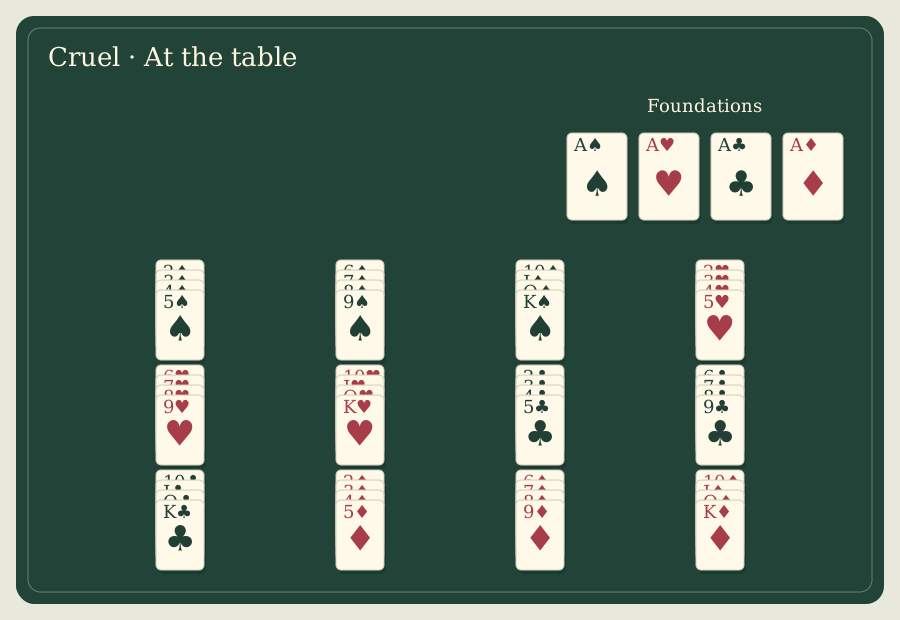
Remove the 4 aces as foundations. Shuffle the remaining 48 and deal them face up into 12 piles of 4, completing the first pile before the second and so on. A grid of 3 rows of 4 piles is convenient; number them left to right, top to bottom. Preserve each pile’s bottom-to-top order; its last dealt card is available. There is no stock or waste.
03 /
Playing a turn
For an action move only a pile’s top card, either to the next position on its suited foundation or onto a card one rank higher of the same suit in another pile. Thus 8♣ goes on 9♣, not 9♠. Foundations run A–2–3–4–5–6–7–8–9–10–J–Q–K without wrapping. Never return foundation cards. Do not move groups or take from a pile’s interior. An emptied pile stays empty until redealing.
04 /
Redeal without shuffling
Leave foundations in place. For an exact redeal, read remaining cards in numbered pile order, each bottom to top. Repartition that single sequence into packets of 4 starting at the first pile; the final packet may be shorter. Other positions stay empty. Physically, collect piles in reverse order, turning each face down and placing it above those already collected, then deal from that face-down packet. Never shuffle or reverse individual card order. You may redeal before running out of moves.
05 /
Scoring
No point score is required: completing the foundations determines success. For a personal record, count foundation cards out of 52, including the initial aces, and record redeals. This measures progress rather than promising a win rate. Redealing creates no cards and never randomises their order.
06 /
Ending the game
Win with all 52 cards on foundations. If a redeal leaves no useful move and another redeal repeats the layout, the attempt is blocked. Repeating forever cannot help; stop or separately allow undo-assisted search. A fresh shuffle begins a new attempt; there is no draw.
07 /
History and selected variant
Cruel is familiar as a computer patience with a fully exposed layout and an unshuffled collection. Semicolon describes adding it at Windows players’ request, which does not prove that the game itself originated on Windows. No securely established inventor or exact date is asserted here. Related patiences may allow sequence transfers; this Cruel profile does not.
08 /
Worked example
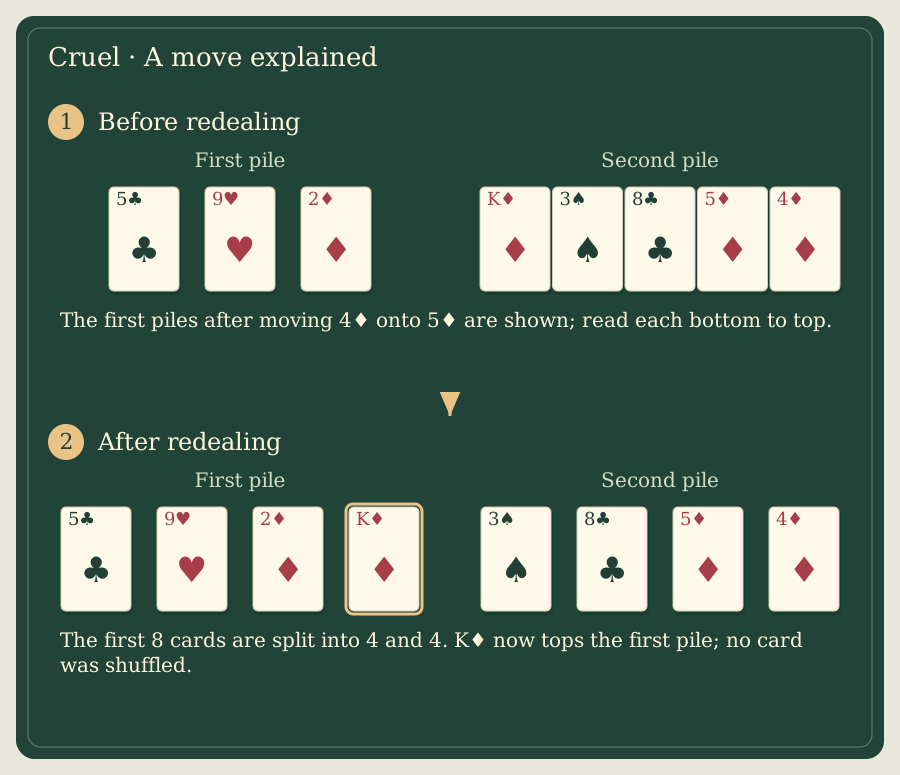
After moving 4♦ onto 5♦, the first piles bottom to top are 5♣ 9♥ 2♦ and K♦ 3♠ 8♣ 5♦ 4♦. Redealing reads those 8 cards consecutively. The first 4 form the new first pile, 5♣ 9♥ 2♦ K♦; the next 4 form the second, 3♠ 8♣ 5♦ 4♦. Order is preserved, but the first pile now exposes K♦ instead of 2♦. Other piles follow in their former order.
← On a small screen, scroll the diagram horizontally. →
Common questions
May I fill an empty space?+
Not by an ordinary move. Cards enter it only through an ordered redeal.
Does redealing shuffle cards?+
No, pile boundaries change, not the global order.
May I transfer a built run?+
No, only one exposed top card at a time.