← On a small screen, scroll the diagram horizontally. →
01 /
Aim and equipment
For 4–5 players use two 52-card packs and 2 jokers altogether: 106 cards. Deuces and jokers may represent a needed rank and suit; other cards are natural. This is Bicycle’s 15-card, runs-only profile. It has no changing contracts and allows no equal-rank sets. Everyone plays individually.
02 /
Setup and deal
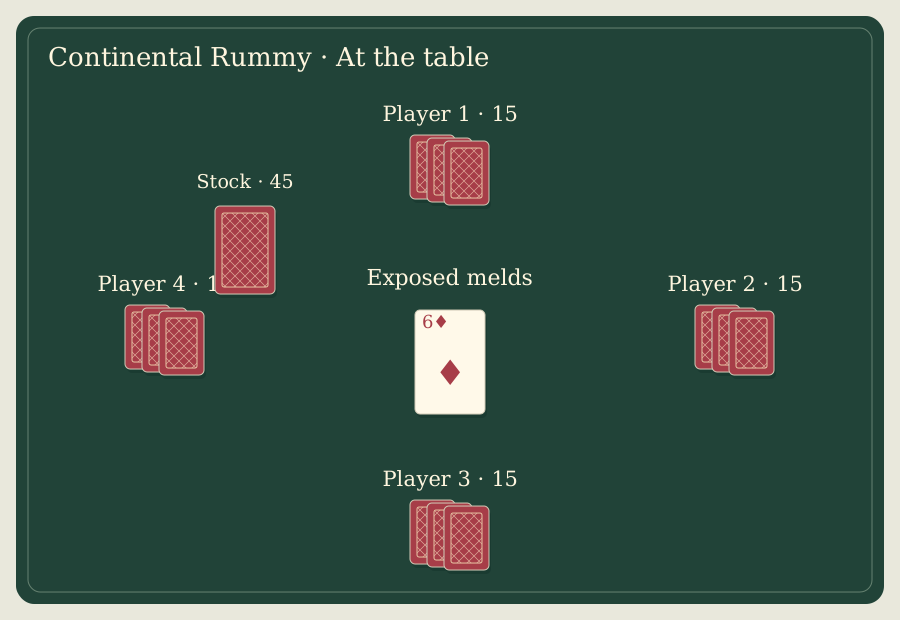
Choose the first dealer randomly; deals and turns then move left. Shuffle the combined pack, cut and deal 15 concealed cards each in packets of 3. Turn the next card up to start the discard pile; the rest form concealed stock. Dealer’s left starts. With 4 players, stock initially contains 45 cards and the discard another 1.
03 /
Declarations
Each run uses one suit in order A 2 3 4 5 6 7 8 9 10 J Q K A. Ace may be low or high, never K–A–2 wrapping. One physical card cannot count twice, and identical natural cards cannot appear in one run. To go out divide exactly 15 cards as 3+3+3+3+3; 4+4+4+3; or 5+4+3+3. Our explicit clarification requires at least one natural card in each run and a declared position for every substitute. A natural 2 may occupy its own position but still counts as a deuce for payment.
04 /
Legal actions
On your turn take only the stock top or discard top, then discard a card face up. There is no out-of-turn buying. Keep all combinations in hand: no partial exposure, laying off on others or temporarily displaying ready runs. When the remaining 15 fit after discarding, expose everything at once and end the deal. If the dealt 15 already fit, go out at the start of your first turn without drawing or discarding. Previously rejected cards are available only if they become the discard top again.
05 /
Scoring
Use an accounting ledger instead of money. Each opponent transfers the winner this total: 1 for going out, plus 1 per melded deuce and 2 per joker. If there is neither deuce nor joker, substitute 10 for those additions. A first-turn exit adds 7; a first-turn exit without drawing adds 10 instead of 7, our explicit interpretation of Bicycle’s overlapping bonuses. All 15 in one suit add another 10. Losing hands incur no rank-based penalty; a drawn deal has no transfers.
06 /
Ending the game
A correct complete exit ends the deal. For a session, everyone deals once; highest ledger balance wins and tied leaders share victory. Our stated exhaustion rule recycles shuffled discards while leaving their top on the table when a new draw is needed. If nothing can be recycled and the discard top is declined, the deal is drawn and the deal rotates. Return an invalid claimed layout to hand and continue; previously revealed cards remain public knowledge.
07 /
Context and variants
Continental names several rummy forms, so its name alone does not specify the rules. Bicycle’s official page describes runs and a complete simultaneous hand exposure, whereas CRP specifies groups without runs. We deliberately select the former without claiming it is the only legitimate tradition. The checked sources do not establish an inventor or earliest date. This is a separate game, not shorthand for our seven-contract guide.
08 /
Worked example
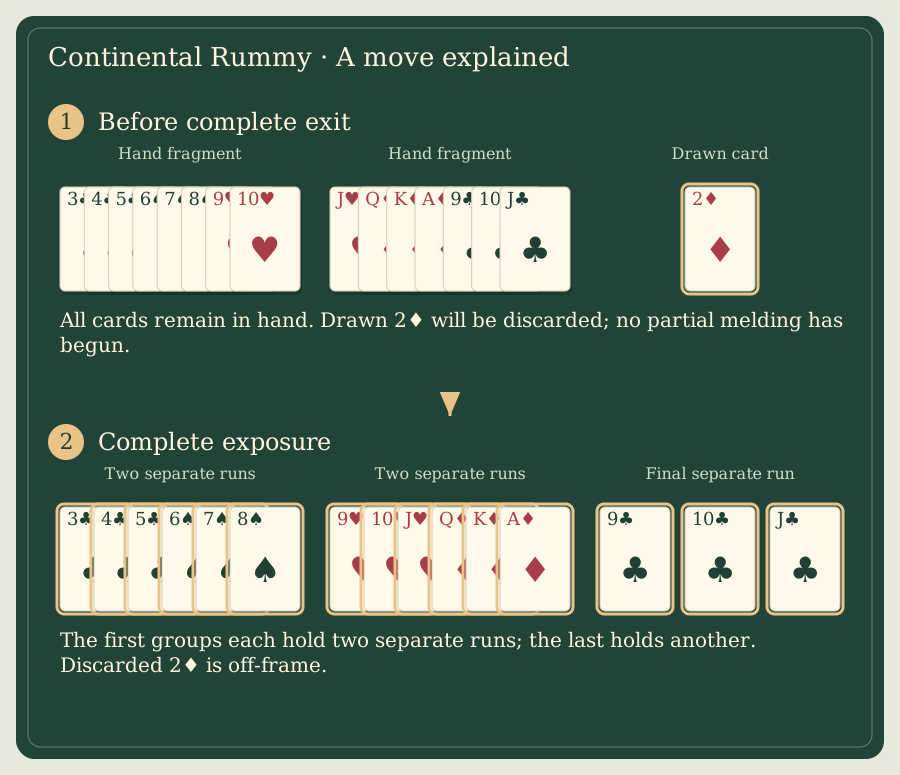
After the first turn, your hand contains 3♣–4♣–5♣, 6♠–7♠–8♠, 9♥–10♥–J♥, Q♦–K♦–A♦ and 9♣–10♣–J♣. Draw 2♦, discard it and expose all 15 as five separate triples. There is no deuce or joker in the layout: each opponent transfers 1+10=11. With 4 participants the winner gains 33 overall and each other loses 11. The diamond run validly uses ace high.
← On a small screen, scroll the diagram horizontally. →
Common questions
May I expose a ready run alone?+
No: all 15 are exposed together when going out.
Are equal-rank sets valid?+
No: this profile allows runs only.
Do leftovers score penalties?+
No: opponents pay from the winner’s layout, not their own leftovers.