← On a small screen, scroll the diagram horizontally. →
01 /
Aim and equipment
Two players use 40 cards: remove 8, 9, 10 from a standard 52-card pack. Order is A 2 3 4 5 6 7 J Q K, ace low only; 7 is adjacent to J. There are no jokers or trumps. Meld exactly 11 cards into your own combinations to win. This is the Anglo-American 10-card profile without an initial exchange between players.
02 /
Setup and deal
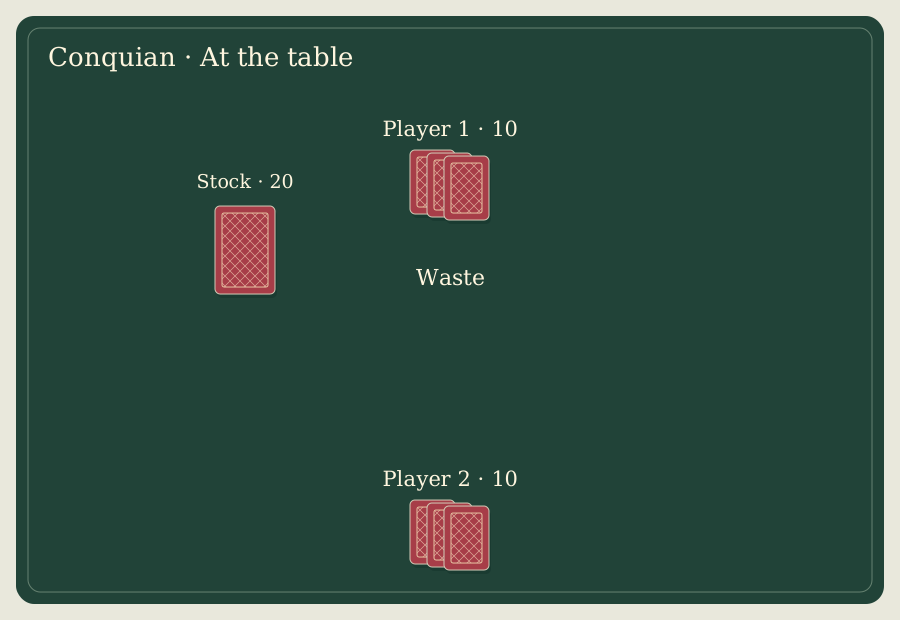
Choose the first dealer randomly and alternate thereafter. Shuffle, cut and deal 10 concealed cards each singly. The remaining 20 form a concealed stock; there is no initial discard. Nondealer reveals its top card. They may use it immediately in a meld or leave it for the opponent without melding or discarding.
03 /
Declarations
Valid melds are groups of 3 or 4 equal ranks and same-suit runs of 3 to 8 cards. A–2–3 and 6–7–J are valid; Q–K–A is not. A card belongs to one meld only. You may rearrange your own exposed melds provided every resulting combination is legal. Never add to your opponent’s melds or return exposed cards to your concealed hand.
04 /
Legal actions
Turns then alternate. Only the card left by the opponent is initially available. Either incorporate it into your melds, adding hand cards as needed, or reject it face down into waste and reveal the next stock card. Use that card or leave it for the opponent. A taken card is always melded immediately, never saved in hand. After using it discard a hand card unless you have won. Other hand cards may be melded only together with using the face-up centre card.
05 /
Bidding and contracts
If the face-up centre card fits your existing melds without extra cards from your hand, your opponent may force you to take it. This applies both to the left card and a newly revealed stock card; legal rearrangement of your melds is allowed. A forced meld normally requires a discard afterward. A card requiring additional concealed cards cannot be forced: your hand remains private.
06 /
Scoring
Our non-cash session agreement awards 1 point for a win and 0 each for a draw; unused cards have no point values. Play to 3 wins. This is an explicit record-keeping choice instead of a traditional fixed stake; draws do not double anything. A winner must have exactly 11 exposed cards in valid melds.
07 /
Ending the game
The final accepted card brings your melds to 11 and ends the deal without a discard. Melding 10 and discarding your last hand card is not enough: keep seeking an addition. When stock is empty the opponent’s left card remains available. If it is not used and no new card can be revealed, the deal is drawn. Never recycle waste. Shuffle the entire pack for the next deal.
08 /
Context and variants
Conquian belongs to Mexican card tradition and the development of Western rummy. Pagat identifies a known Mexico City reference from 1857, without establishing a sole inventor. This Anglo-American version differs from the modern Mexican profile with smaller hands and an initial exchange; their procedures are not mixed here.
09 /
Worked example
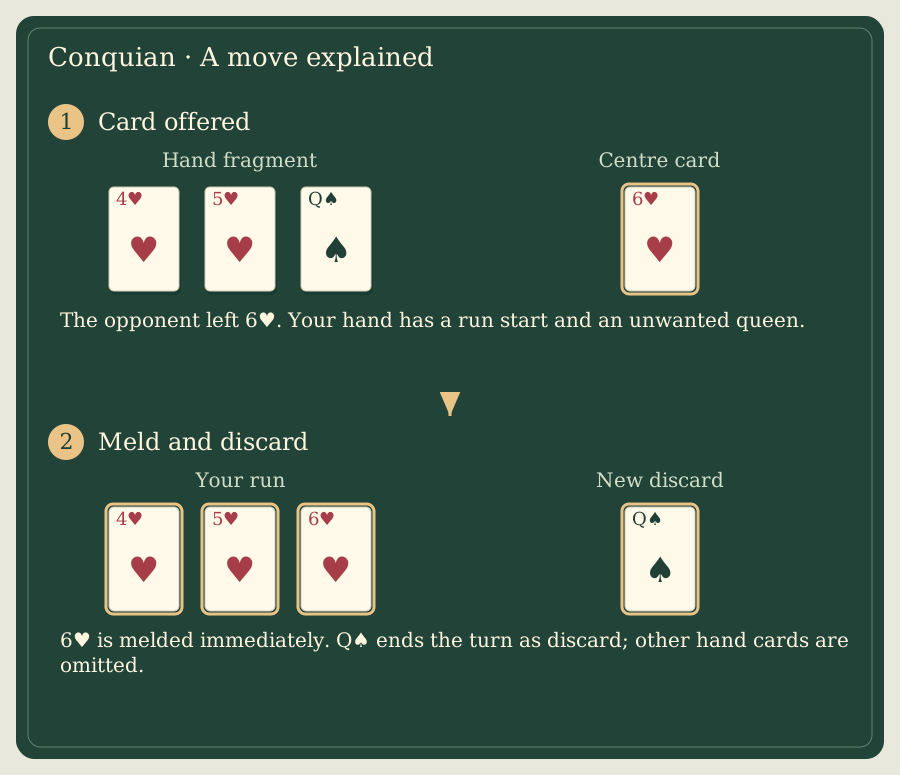
Your hand includes 4♥, 5♥ and an unwanted Q♠; the opponent left 6♥. Accept 6♥, immediately expose 4♥–5♥–6♥, then discard Q♠. If the centre offered 7♥ instead, you could not keep it in hand waiting for a six. Without using the centre card, the same 4♥–5♥ cannot be melded independently.
← On a small screen, scroll the diagram horizontally. →
Common questions
May I save a taken card?+
No: incorporate it into your melds immediately.
May I add to the opponent?+
No: the players’ melds are separate.
Does an empty hand win?+
Only with 11 melded cards; 10 is not enough.