← On a small screen, scroll the diagram horizontally. →
01 /
Players and cards
Two players use an ordinary 52-card pack without jokers. A is worth 1, and numeral cards 2–10 have their face value. J, Q and K have no numerical value. Players capture cards from an open table and keep their captures face down. This selects Anglo-American Cassino with strict building rules and a 1-point sweep bonus. It is not a similarly named house-banked gambling game.
02 /
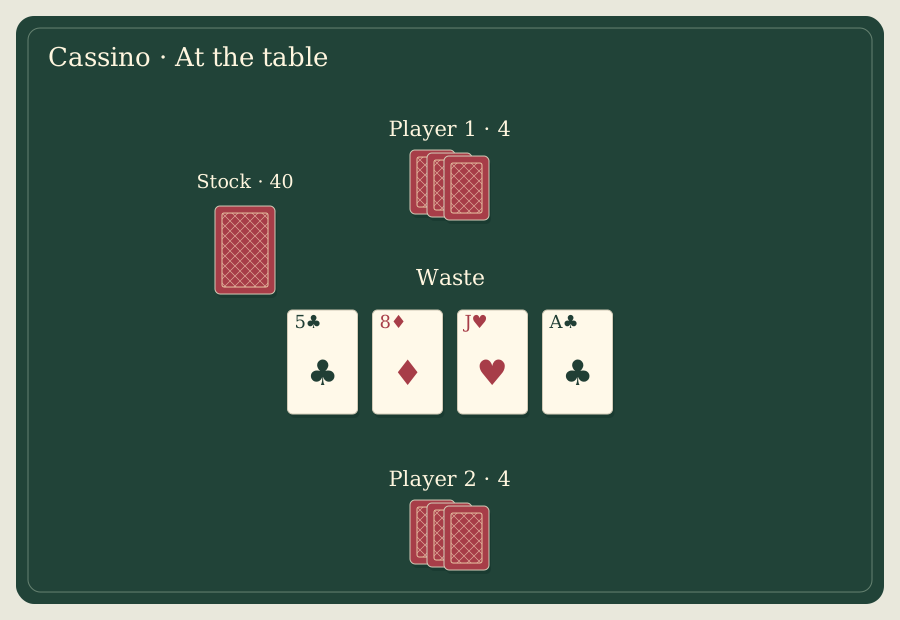
Deal and opening
Choose the first dealer by lot, then alternate after each complete round. Deal 4 cards to each player and 4 separate face-up cards to the table; stock is 40. The nondealer starts, then alternate turns. When both hands are empty, deal another 4 to each from stock, with no further table cards. There are 6 batches of hands. Announce “last” before the final batch. Play exactly 1 card each turn; capturing never grants an extra turn.
03 /
Playing a turn
A face card captures only 1 loose face card of its own rank, even when several match. A numeral captures any loose equal-value cards and any disjoint groups whose sums equal its value. It may take several such groups together; each card belongs to only one group. Taking every available card is optional. The played card joins the captured cards in the capture pile. Without a capture or build, it stays loose on the table. Such trailing is allowed even when a capture is possible, except under your building obligations.
04 /
Creating a build
Create a build by combining a numeral played from hand with table cards and announcing its capture value. Keep another card in hand able to capture it. A single build contains at least 2 cards whose total is the announced value. A multiple build contains several groups each worth that value; an individual equal card can be a group. Never build entirely from cards already on the table. Once created, the component groups are indivisible: do not break or rearrange them into a different partition.
05 /
Raising or extending a build
Raise a single build by adding a numeral from hand while retaining a card of the new value. Loose table cards cannot contribute to increasing the sum. At the same time you may incorporate additional groups already equal to the new value, making the build multiple.
Extend any build without changing its value by adding a hand card that, alone or with loose table cards, makes another group of the announced value. Retain a capturing card. A multiple build’s value can never change. Ordinary numerical values stop at 10, so a build above that value is impossible.
06 /
Capturing and building obligations
Either player may capture a build, but only with a card exactly matching its announced value. The same play may also take loose equal cards and groups of that value. You cannot add a loose card to a build in order to capture it with another rank.
While a build remains that you created or last added to, and the opponent has not added to it since, you cannot merely trail on your next turn. Make any legal capture, create a build or add to one. You need not capture your own build immediately, but may not leave it while spending your last matching capture card. If the opponent changes the build, your former obligation no longer binds you.
07 /
Scoring
After the final card is played, the last player to make a capture receives the table residue, not necessarily the last player to act. There are normally 11 base points: most cards 3; most spades 1; each A 1; 10♦ 2; 2♠ 1. If a majority is tied, neither player scores that award.
Add 1 for each actual sweep clearing the whole table by capture. Mark it by placing the played card face up in your capture pile. The final card can earn this bonus if it actually captures the entire table. Automatic collection of residue after the last turn is not a sweep.
08 /
Ending the game
Add scores only after the complete round. When a total reaches 21 or more, the higher cumulative score wins. If both reach the target and tie, play another full round. There are no early victory claims or ordered category scoring here. In the exceptional event that nobody captured at all, the declared home agreement voids the round and replays it without points; normally the last capture determines who receives residue.
09 /
History and selected variant
The historical research by Franco Pratesi cited by Pagat places Casino in late eighteenth-century London literature and shortly afterwards in Germany. Direct evidence for the often-supposed Italian origin is lacking. The spelling Cassino with two s became a later tradition. This is a fishing game, without an unsupported claim to be the original form of other games.
10 /
Worked example
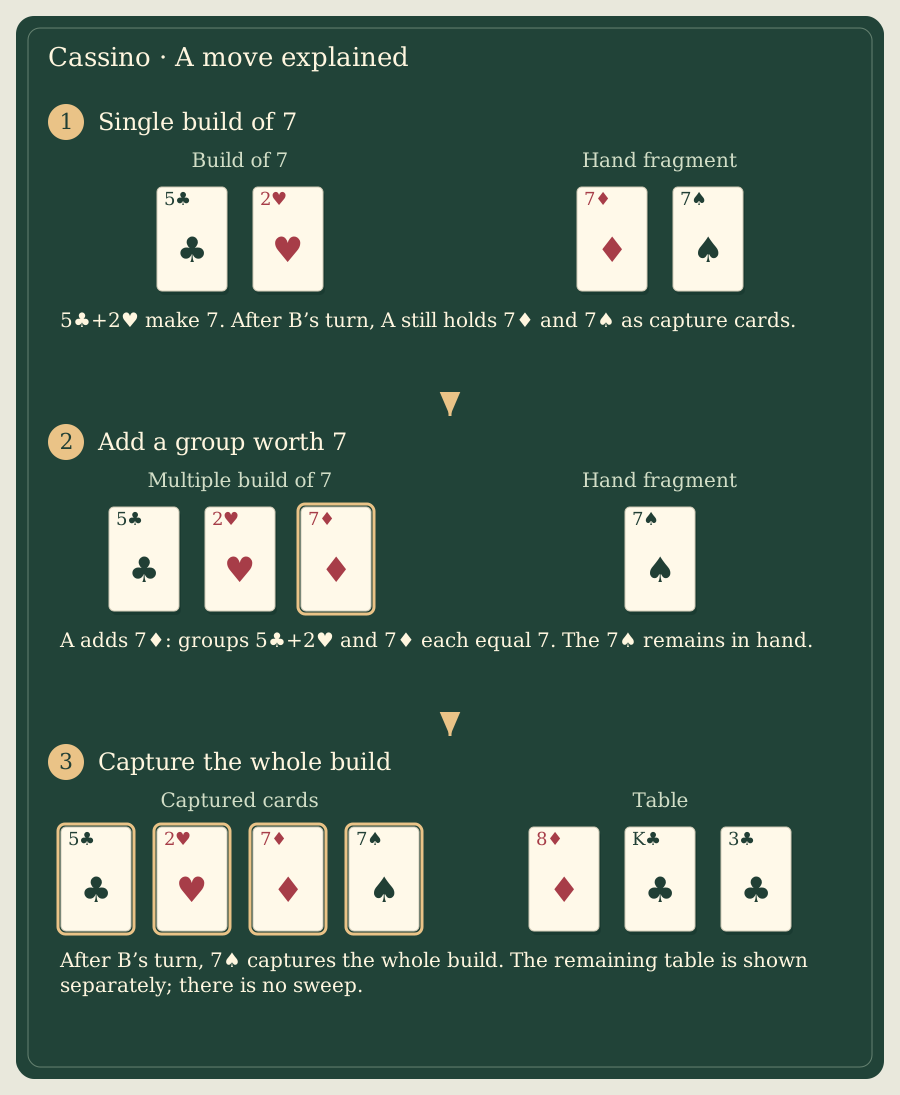
The table has 5♣ and 8♦. A plays 2♥ on 5♣, announcing build 7, and retains 7♦ and 7♠. B trails K♣. A adds 7♦ as another group worth 7: the build is now multiple, (5♣+2♥)+(7♦), still captured only by a seven. B trails 3♣. A plays 7♠ and captures all 4 cards including the played card. The table retains 8♦, K♣, 3♣, so there is no sweep bonus. Declaring a sum of 14 and changing the multiple build’s value was not allowed.
← On a small screen, scroll the diagram horizontally. →
Common questions
May I steal an opponent’s build?+
Yes, with a card of its announced value; creating a build does not protect it from capture.
Can a queen capture two queens?+
No, a face card captures only one matching face card per turn.
Does the final residue count as a sweep?+
No. Only an actual capture leaving the table empty earns the bonus.