← On a small screen, scroll the diagram horizontally. →
01 /
Players and cards
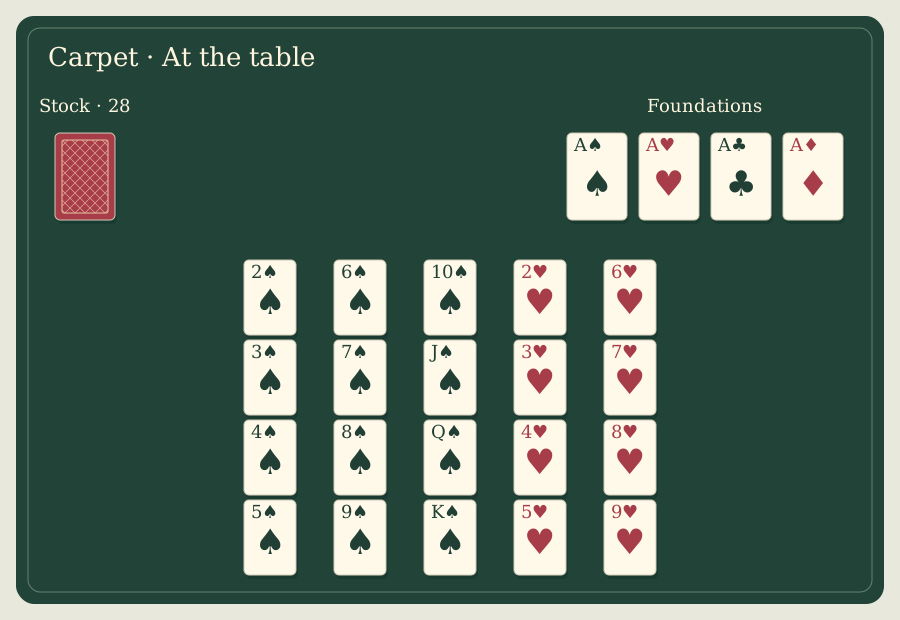
For 1 player use 52 ordinary cards without jokers. Choose pre-placed aces and 20 open spaces. Suits matter only on foundations; colours need not alternate. There are no moves between carpet cards and no sequence transfers.
02 /
Deal and opening
Remove 4 aces as foundations. Shuffle the other 48: expose 20 in a grid of 5 columns of 4. Every grid card is simultaneously available, with none covering another. The remaining 28 form stock; waste begins empty.
03 /
Playing a turn
Move one carpet card to a suitable foundation: same-suit A needs 2, then 3 through K. No gaps and no K–A wrap. Foundation cards never return. Choose between available transfers, or delay a transfer until the waste top is useful.
04 /
Spaces and the stock pass
Turn stock cards 1 at a time to one waste pile. Only its top may move to a foundation or any empty carpet space. Never take from the middle of waste. Fill a space with one waste card, not another carpet card. Filling may wait; to use a stock card, first expose it normally to waste.
There is only one pass: do not turn or shuffle waste back when stock empties. Continue available moves from carpet and waste top.
05 /
Scoring
The layout determines a win, not points. A personal log may count foundation cards out of 52, including starting aces. This is an optional progress convention. Do not promise a fixed win rate: card order and decisions affect the outcome.
06 /
Ending the game
Win by moving all 52 cards into 4 complete suit foundations. Exhausted stock alone is not defeat: continue while carpet cards and waste top are useful. If no legal move can advance play, the attempt is blocked. Never stack onto an occupied cell or redeal part of the carpet. A new layout is a new attempt, not a draw.
07 /
History and selected variant
Carpet, also Le Tapis, belongs to open-reserve patience without working-column building. Solitaire Forever compares several printed manuals, including Basil Dalton’s form where aces emerge during play rather than starting out. We choose 4 pre-placed aces; no precise inventor or creation date is established.
08 /
Worked example
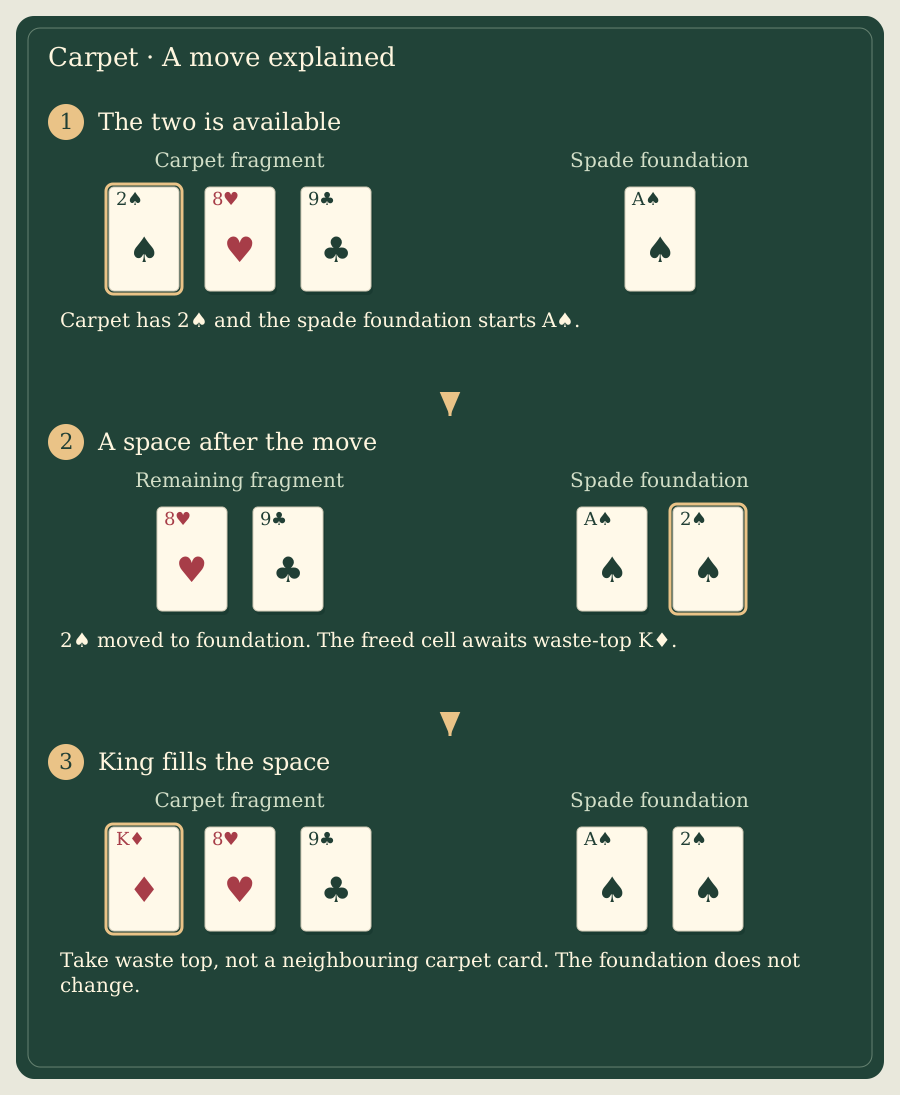
Spade foundation holds A♠ and carpet exposes 2♠. Move the two: foundation becomes A♠–2♠ and a space appears. With K♦ atop waste, place it into that empty cell, exposing the next waste card. Never put K♦ directly on the spade two: neither suit nor next rank matches.
← On a small screen, scroll the diagram horizontally. →
Common questions
Are only column tops playable?+
No; all 20 independent cells are available.
May stock be redealt?+
No; there is only one pass.
What fills a space?+
Only waste top, not another carpet card.