← On a small screen, scroll the diagram horizontally. →
01 /
Aim and equipment
For 2–5 players this is an explicit adaptation of published Standard Rules Cabo to 52 ordinary cards without jokers: A=1, numerals 2–10 at face value, J=11, Q=12, black K=13, red K=0. There are two zeros and two thirteens, not red kings worth −1. Suits otherwise have no effect. Seek the lowest card total and then lowest cumulative penalty. Bézier second-edition rules are not mixed in.
02 /
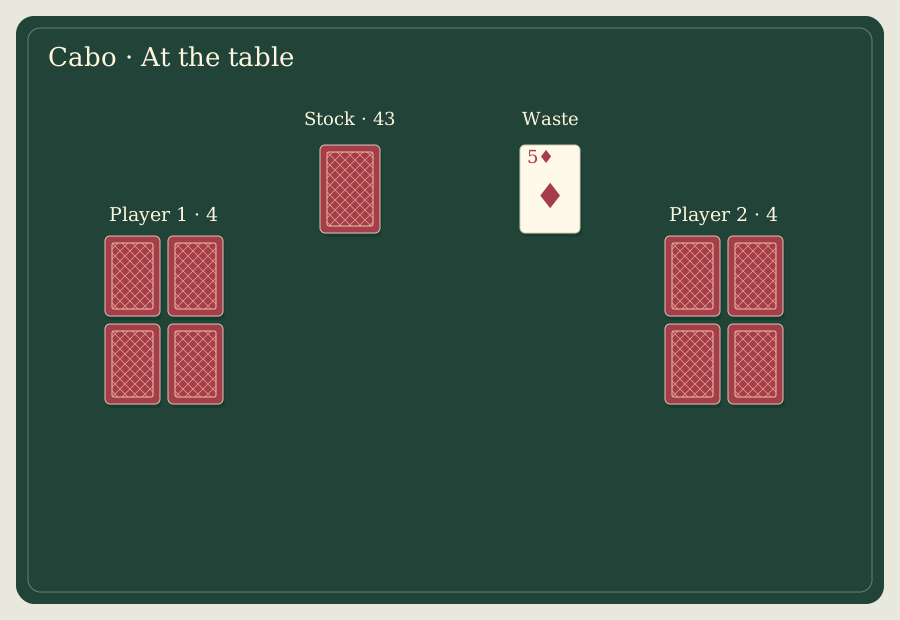
Setup and deal
Choose first dealer randomly; dealer’s left starts. Shuffle and deal 4 downcards each in fixed positions. A row or 2×2 grid is fine, but never rearrange cards as a memory aid. Inspect any 2 of your own, memorise and conceal them. Remaining cards form stock; expose its top as discard. Never inspect another card without an effect. Next round its lowest round scorer starts and highest deals; ties use the first clockwise from the previous starter or dealer respectively.
03 /
Legal actions
Clockwise choose exactly one: draw stock top, take discard top or call Cabo. Inspect a stock draw privately: exchange it for your own card or discard it without exchange, optionally using its ability. In an exchange discard the old card openly and put the new card face down in its place. A discard draw must replace your own card, also face down, with no ability. You cannot merely take and return the discard. Never inspect the outgoing card beforehand. An outgoing old ability card does not activate.
04 /
Declarations
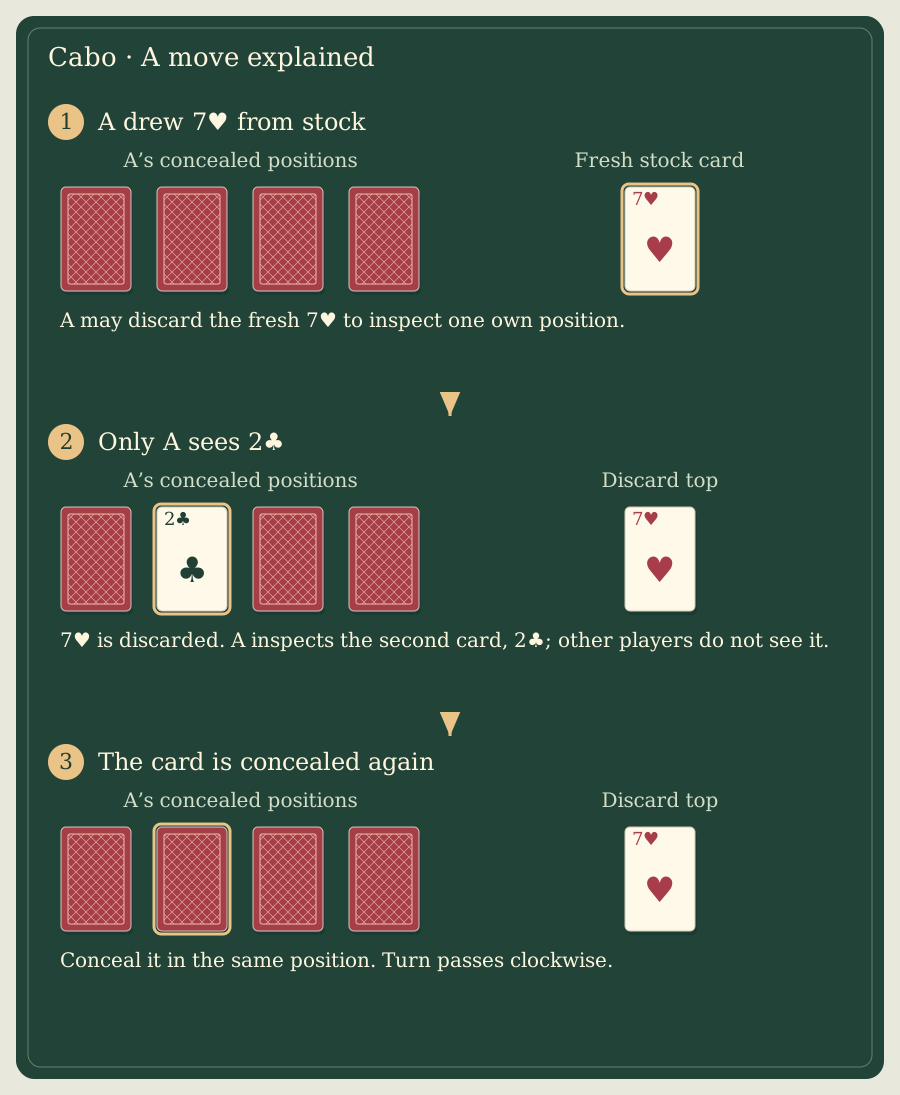
Only a fresh stock card immediately discarded without exchange grants an ability: 7–8 peek at 1 own downcard; 9–10 spy on 1 opponent downcard; J–Q blindly exchange 1 own card with 1 opponent card, inspecting neither. Reconceal a peeked card in place. Ability use is optional.
Instead of a single exchange replace 2, 3 or 4 equal-valued own cards with one drawn card. Choose positions before revealing and show the claimed matches. If correct discard all selected and place the new card face down in one freed position, leaving gaps elsewhere. If values differ show the mistake, return old cards to their positions concealed and discard the draw: the turn is lost. No extra penalty card. This is original Standard Rules, not another edition’s multiple-exchange penalties.
05 /
Scoring
Sum remaining card values. A unique lowest player scores 0, others their sums. A Cabo caller without a lowest sum adds 5. If caller shares lowest, only caller among that tie scores 0; the other tied players score their sums. If lowest players did not call, each scores 0 and the nonlowest caller scores sum plus 5.
Shooting the Moon: exactly two Q=12 and both black K=13 with no other cards gives holder 0 and everyone else 50 regardless of caller. Check it before ordinary scoring; awards do not stack. Add round score to cumulative total. Exactly 100 resets to 50 the first time per match; mark it used. A later exact 100 does not reset, but does not by itself end the match.
06 /
Ending the game
Call Cabo only instead of your draw, ending your turn. Every other player gets 1 final ordinary turn, not another call, then reveal. If stock empties earlier keep discard top and shuffle the rest into stock; this does not end the round. After scoring and permitted 100→50 reset, end if anyone exceeds 100. Lowest cumulative total wins; exact equality shares victory by our agreement. Last-round score alone cannot decide the winner.
07 /
Context and variants
Cabo is a modern designed game in the memory-and-exchange Golf family. Commercial editions change penalties, visibility of replacements and multiple-card mistakes. Published Standard Rules are adapted here to ordinary indices, so red K means zero, not its own ability. This substitute pack is not presented as the publisher’s official component set: it is an explicitly agreed home-table mapping.
08 /
Worked example
A draws 7♥ from stock, discards it and peeks at own second card, 2♣. It stays in place and is reconcealed; opponents do not see it. Taking 7♥ from discard cannot repeat the peek. In a separate count caller A has sum 6, B also 6, C 9: round scores 0,6,9. If B instead has 4, A scores 11, B 0, C 9. Cumulative 89+11=100 becomes 50 on its first occurrence.
← On a small screen, scroll the diagram horizontally. →
Common questions
Is a red king worth minus one?+
Not in this adaptation: red K=0, black K=13.
Does a discard draw activate a peek?+
No, only a fresh stock card immediately discarded may activate.
Does exactly a hundred always reset?+
No, 100→50 is available only once per match.