← On a small screen, scroll the diagram horizontally. →
01 /
Selected historical system
Bouillotte spread in France around the Revolution and through the nineteenth century, developing from Brelan. We choose the four-player historical system synthesised by Pagat. Unlike the CardRulesPlus summary, it has no separate brelan favori, suit points use all exposed cards, and 9 and 8 retain their face values. Session rules and rare unresolved cases below are labelled teaching agreements.
02 /
Cards, chips and deal
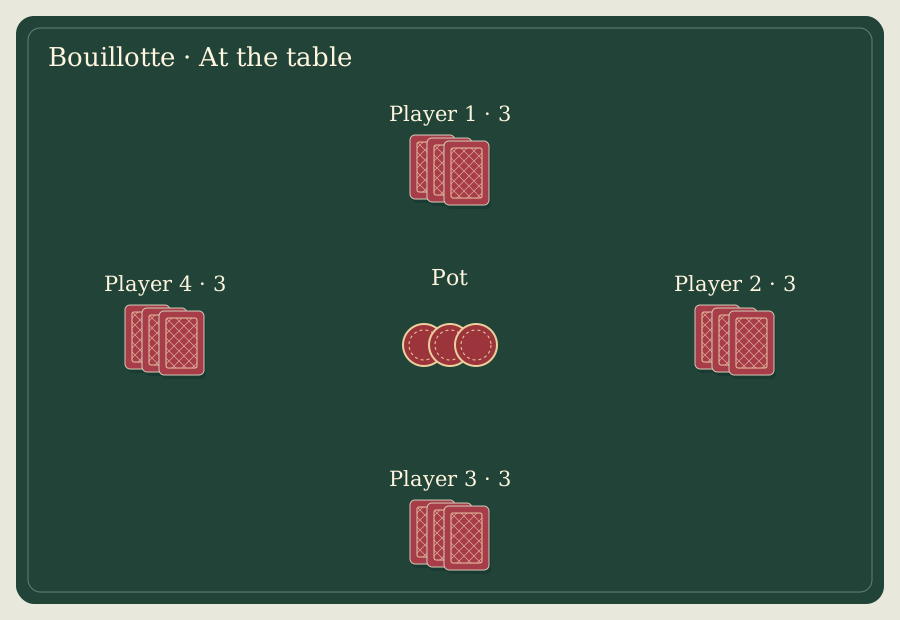
Use 4 players and 20 cards: A,K,Q,9,8 in each suit, in that descending order. Each starts with a cave of 100 notional chips; betting cannot exceed the remaining cave. Choose first dealer by lot. Only dealer antes 1. Before seeing cards, dealer’s right may add the whole pot’s amount, the next player right may double the new pot, and so on for at most one circuit; the first refusal ends these blind carre bets. Dealer shuffles, left cuts, then deals singly anticlockwise, 3 each, exposing the next as retourné. The remaining 7 cards are unused. Deal passes right.
03 /
Betting and closing action
Without carre, dealer’s right acts first; otherwise the player right of the last straddler starts. Before anyone opens, passing retains the right to enter later. An opener brings their total contribution up to the largest already made; our agreement requires adding at least 1 even when already equal. Once opened, call, raise or fold, forfeiting the contribution.
One survivor takes the pot unseen. With two survivors, the next call closes betting. With 3 or 4, after all calls everyone except the last raiser gets one further chance to raise or say “no more”. If nobody raises, show down; a raise restarts the cycle. All-pass without carre carries the pot and next dealer adds 1; after carre, all-pass awards it to the last straddler.
04 /
Brelans and the collective point
Best is brelan carré: 3 same-rank cards in hand plus the fourth as retourné. Next is ordinary brelan: 3 matching cards in hand, ranked A,K,Q,9,8. Two personal cards plus retourné do not make a brelan.
If eligible contenders have no brelan, expose even folded hands. Total each suit over all 13 exposed cards, including retourné: A=11, K/Q=10, 9=9, 8=8. The richest suit wins; its highest personal card held by an unfolded player owns the pot. For tied suit totals, the owner of a tied suit earliest anticlockwise from dealer wins. The upcard belongs to nobody. Explicit agreement for an undocumented edge: skip a suit held by no eligible contender; for a side pot use the next eligible suit if its contenders do not hold the main winning suit.
05 /
All-ins and bonuses
A player short of chips may call all-in with the remainder, but cannot open or raise. They contest only the pot up to their contribution level; other excess contributions form side pots. Return uncalled excess. Each pot is contested only by eligible unfolded players; the main pot’s point establishes the suit for side pots too, with the stated no-owner agreement.
At showdown, every carré holder receives 2 from each opponent, ordinary brelan 1, including folded players; claims apply independently of the pot and offset one another. Without showdown these bonuses are not claimed. To avoid physical chip shortages, our teaching table records bonuses on a separate signed ledger, without enlarging the betting cave.
06 /
Session and final result
Our explicit session agreement is 12 deals. If a cave reaches zero, a new cave of 100 is allowed before the next deal; record every rebuy. A partly depleted cave cannot be topped up. After the final deal, split any carried pot equally among 4, retaining exact fractions. Final result is remaining cave plus bonus ledger and pot share, minus initial 100 and all rebuys. Highest net result wins; equal results share position. This is notional-chip accounting, not a universal historical tournament code.
07 /
Carré and another brelan
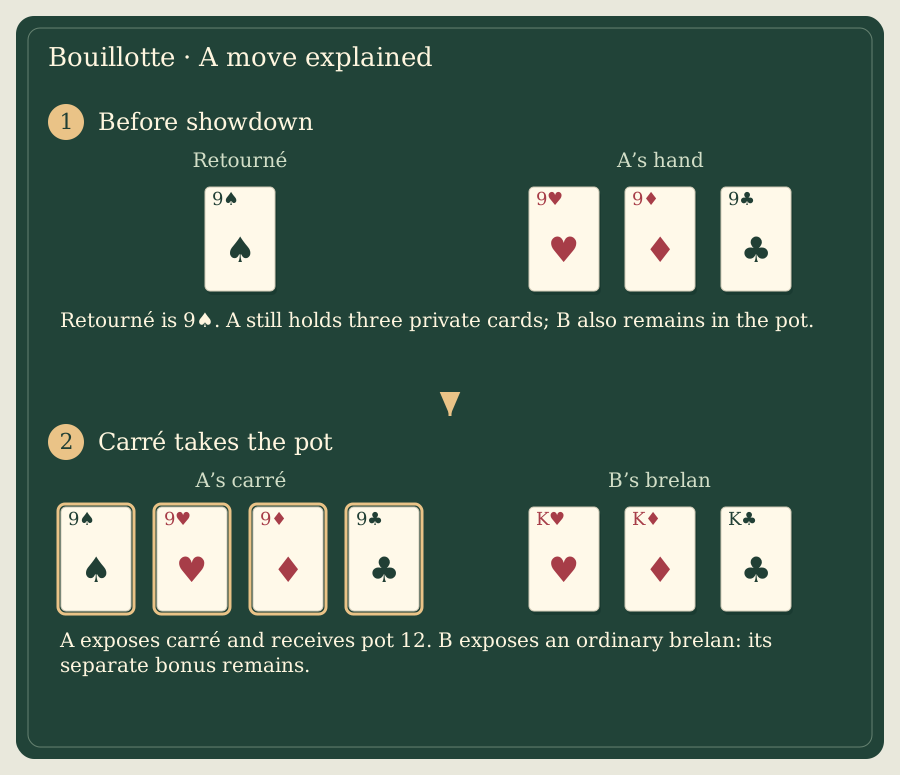
Retourné is 9♠. A shows 9♥,9♦,9♣; B shows K♥,K♦,K♣. Both stayed in, and the pot is 12. A’s carré wins 12. A claims 2 from B,C,D, totalling 6; B claims 1 from A,C,D, totalling 3. After offsets the bonus changes are A=+5, B=+1, C=−3, D=−3. Their sum is 0; the pot award is separate from these bonuses.
← On a small screen, scroll the diagram horizontally. →
Common questions
Can retourné complete an ordinary brelan?+
Not in this system: three matching cards must be in your own hand.
Do folded cards affect the point?+
Yes. Their suit values count, but a folded player cannot win the pot.
Are bonuses only for the pot winner?+
No. At showdown every brelan earns its independent payments.