← On a small screen, scroll the diagram horizontally. →
01 /
Which Boston?
Boston is a historical whist-family game, not a modern bridge variant. Foster’s Complete Hoyle treats Boston and Boston de Fontainebleau separately; we choose the former with its American decimal settlement. It uses preferred suits, bidding for solo play against three, and a shared pool. There are no honours or overtrick payments. The little/grand misère and spread terms below retain the original distinctions.
02 /
Packs, preferences and pool
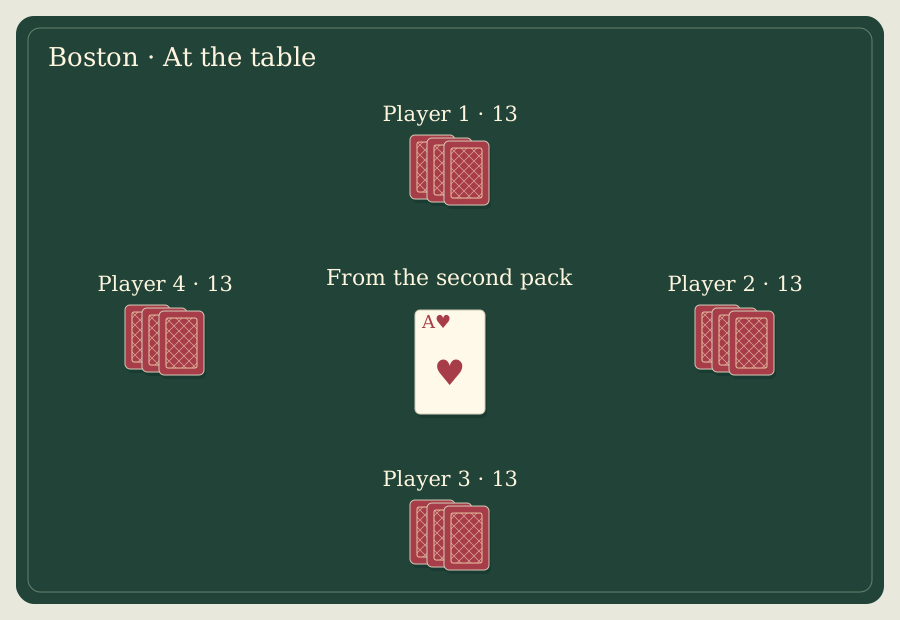
There are 4 players and 2 separate complete 52-card packs without jokers. One is dealt; the still pack establishes preferences. Ranks descend A,K,Q,J,10,9,8,7,6,5,4,3,2. Shuffle both initially, then only cut them for the rest of the session. Choose first dealer by lot; deal clockwise in batches of 4, then 4, then 5, giving 13 each. Deal passes left and packs alternate. In the selected chapter account, dealer’s opposite cuts the still pack and the right neighbour exposes its top card. Its suit is first preference; the other of that colour is second, and the remaining suits are equal plain suits. This does not force trumps.
Each starts with a notional balance of 1000 white units and contributes 10 to the pool: initially 40. Source red counters equal 10 white; we calculate everything in white units and allow negative teaching balances.
03 /
Complete contract ladder
Ascending ladder: Boston=5 tricks; 6; 7; little misère; 8; 9; grand misère; 10; 11; little spread; 12; grand spread; Grand Slam=13. A numeric contract requires at least the bid with the caller’s chosen trump suit; Slam requires every trick. In little misère everyone discards 1 card face down and plays 12 tricks without trumps: caller must take none. Grand misère has the same aim over all 13 without discarding. Little spread and grand spread correspond to those two misères, but caller exposes the remaining hand before the opening lead. Defenders neither expose their hands nor control the exposed hand.
04 /
Auction and all-pass
Dealer’s left acts first, then clockwise, overcalling or passing. An initial numeric call need not name a suit. The same number can be overcalled by “I keep” in second preference, then “I keep over” in first preference. Thus a bare number yields to second preference, which yields to first; first preference requires a higher number or higher-ranking misère to beat it. Winner names trumps consistently with any preference commitment. After passing, numeric re-entry is barred, but a still-valid higher misère or spread may re-enter. Bidding ends when the others make no higher call.
All-pass produces misère partout: 13 no-trump tricks, everyone individually avoiding tricks. Pool is untouched. If one player has maximum h, that player pays each other 10×(h−their tricks). If m tie for maximum, each pays each non-leader 10×(h−their tricks)/m. Tied leaders do not pay one another.
05 /
Playing a trick
Dealer’s left always leads first. Follow the led suit when able. When void, any card is legal: neither trumping nor overtaking is compulsory. Highest trump wins, otherwise highest of the led suit. Winner takes the trick and leads next. Under American settlement a positive contract can end when the promised tricks are secured; extras earn nothing. A misère fails with caller’s first trick, Slam with the first lost trick. Expose cards on such an ending to verify following suit. Correct a misdeal by the same dealer redealing and adding 10 to the pool. Tournament revoke and exposed-card penalties require a separate full code; here we describe legal play and explicitly agree to cancel a disputed deal for teaching.
06 /
Complete American payments
Every payment is to or from each of 3 opponents, not a combined amount. Successful contracts 5,6,7,8,9,10,11,12,13 pay respectively 10,15,20,25,35,45,65,105,170 to caller. On failure caller pays the table below: row number is the contract; entries left to right mean shortfalls of 1,2,3 and so on. Little misère pays 20, grand misère 40, little spread 80, grand spread 160: to caller on success, from caller on failure. There are no separate honours, doubles or overtrick payments.
5: 10, 20, 30, 40, 50
6: 15, 25, 35, 45, 55, 65
7: 20, 30, 40, 50, 60, 70, 80
8: 25, 35, 45, 55, 70, 85, 100, 115
9: 35, 45, 55, 65, 80, 95, 110, 125, 140
10: 45, 55, 70, 80, 95, 110, 125, 140, 155, 170
11: 70, 80, 95, 110, 125, 140, 155, 170, 185, 200, 220
12: 120, 130, 145, 160, 180, 200, 220, 240, 260, 280, 300, 320
13: 180, 200, 220, 240, 260, 280, 300, 320, 340, 360, 390, 420, 450
07 /
Shared pool and session end
A successful bid of 7 tricks or any higher-ranked contract also wins the pool. At 5 or 6, defenders may unanimously say “I pay” before playing to the second trick: they pay the ordinary success amount but save the pool. Without that agreement, a successful caller also receives the pool. On higher calls concession does not save it.
Any failure doubles the active pool: caller adds its existing amount, besides paying opponents. A single pool is capped at 250: set full pools aside and use the remainder for another. With a full pool present, winner takes one full pool; otherwise the current partial one. Failure doubles the first full pool if any exists. When no pools remain, everyone contributes 10 again. After 12 deals divide all remaining pools equally among 4; highest final balance wins, with ties retained.
08 /
Eight fails: a Boston settlement
Active pool is 40. Caller bids 8 but takes 6: shortfall 2. The second entry in row 8 is 35, so caller pays each of 3 opponents 35, totalling 105, and adds 40 to the pool. Caller loses 145; pool grows to 80.
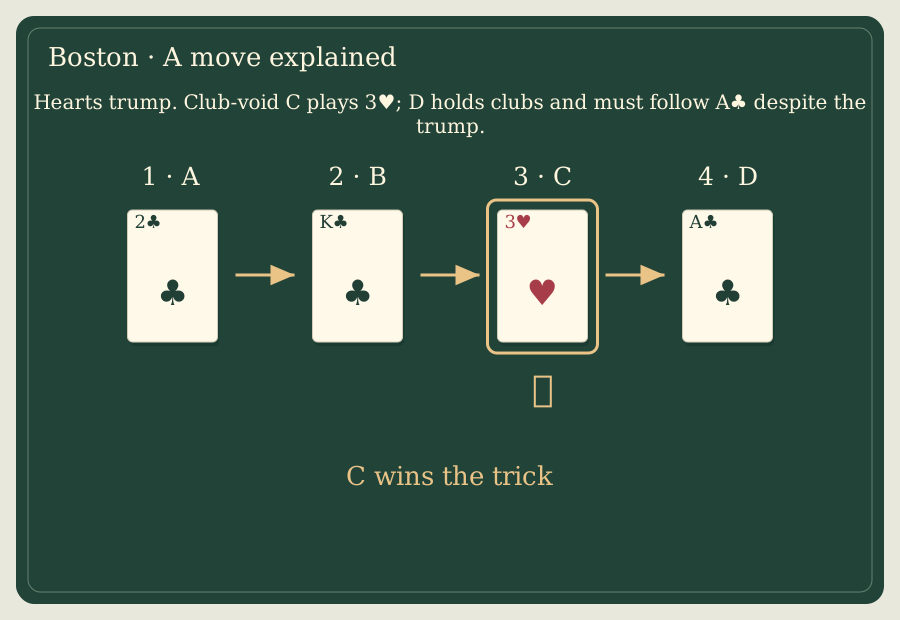
A separate legal trick with hearts trump: A leads 2♣, B follows K♣, club-void C plays 3♥, and D must follow with held A♣. C wins by trumping despite A♣. These cards have no separate point values.
← On a small screen, scroll the diagram horizontally. →
Common questions
Is the exposed suit necessarily trump?+
No. It sets bidding preference; caller chooses trumps within the commitment.
Are overtricks paid?+
Not in this selected American system.
Can a passed player re-enter?+
Only with a valid higher misère or spread, not a numeric contract.