← On a small screen, scroll the diagram horizontally. →
01 /
Players and cards
This patience for 1 player uses a standard 52-card pack without jokers. Suits and colours do not restrict moves. Ranks form the cycle A–2–3–4–5–6–7–8–9–10–J–Q–K–A: an ace neighbours both two and king.
02 /
Deal and opening
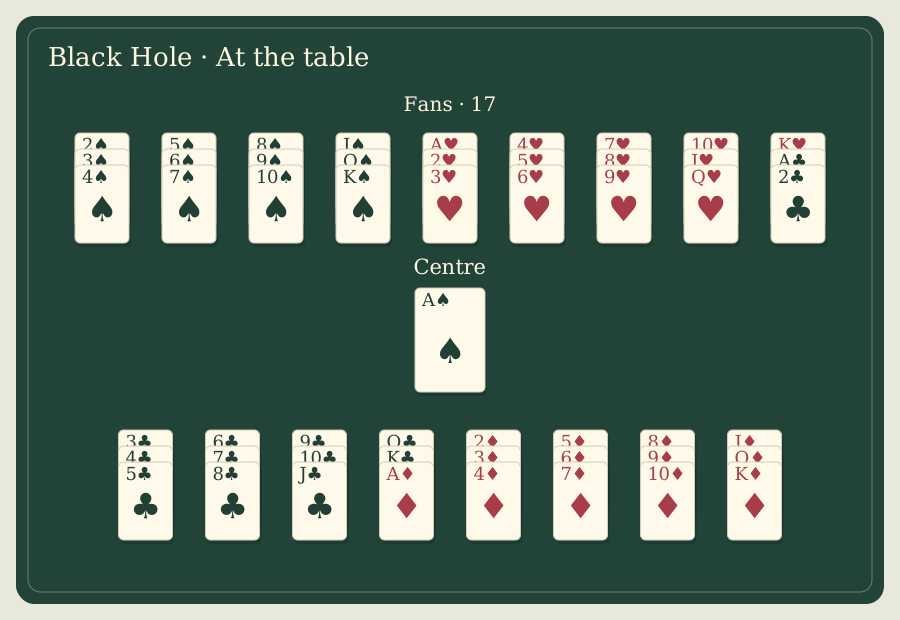
Put A♠ face up in the centre. Shuffle the other 51 cards and deal 17 fans of 3, all face up. Preserve the overlapping order within each fan: only its uncovered end card is available. There is no drawing stock.
03 /
Playing a turn
Move one available card onto the centre if its rank is exactly 1 higher or lower than the top. It becomes the new top and exposes the next card in its fan. You may reverse direction after any move. Equal ranks do not fit.
04 /
Fixed fans and legal access
Do not move cards between fans or refill an empty fan. A convenient middle card is still blocked. Cards never leave the centre pile. Undo may be agreed separately as a practice aid for exploring a solution, not as an additional move type.
05 /
Scoring
No point score is needed to solve a deal. A personal log may record cards moved out of 51 and distinguish a win from a blocked position. This measures progress rather than a tournament score; track time or undos only by prior agreement.
06 /
Ending the game
Win when all 52 cards occupy the centre and every fan is empty. If cards remain but no available card neighbours the top, the attempt is blocked. Do not turn a stock or redeal a fan: no stock exists. A newly shuffled layout is a new attempt; a draw is not a result here.
07 /
History and selected variant
David Parlett publishes Black Hole among his original patience games and relates its mechanism to Golf and One Foundation. The consulted author page does not establish an exact creation date. This guide uses his open layout; solvability percentages do not promise a win on a particular attempt.
08 /
Worked example
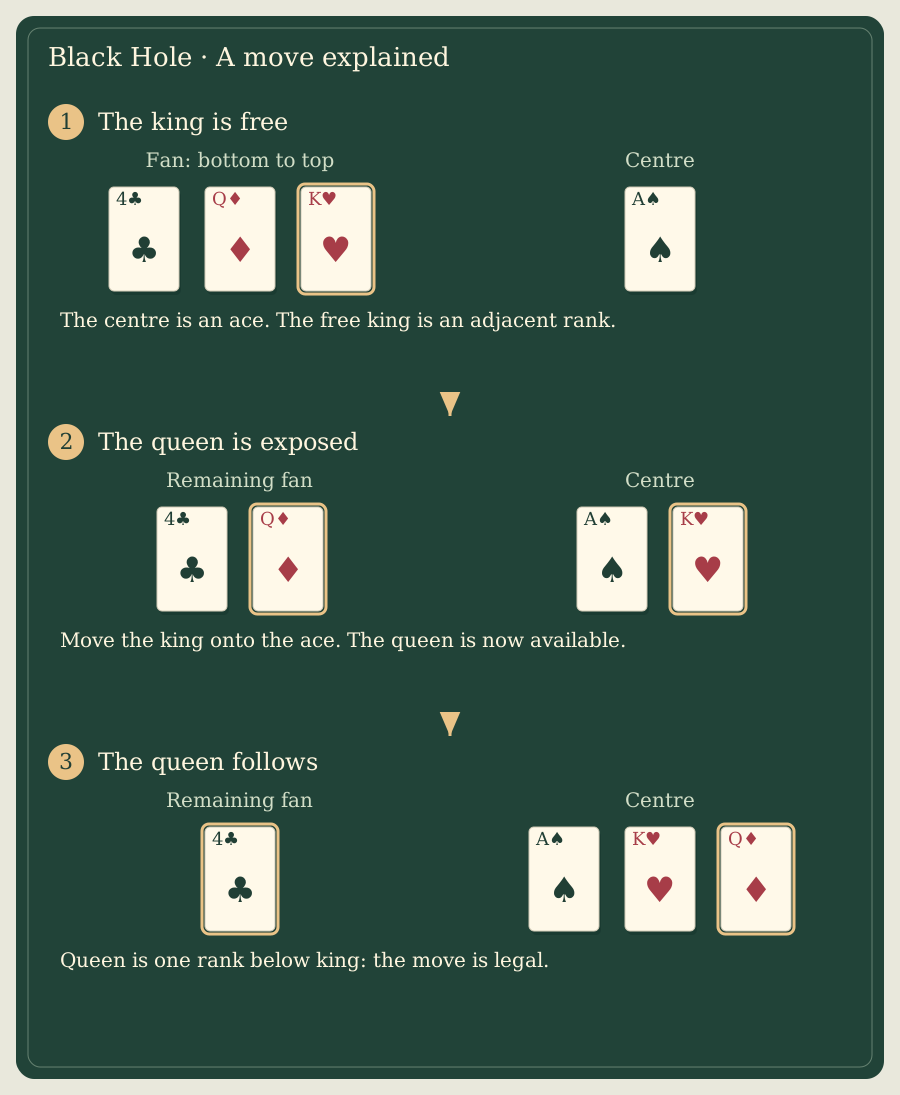
The centre is A♠. One fan, from blocked end to free end, is 4♣–Q♦–K♥. Move K♥ onto the ace, exposing Q♦. Move the queen onto the king; an exposed J♣ from another fan then fits the queen. The 4♣ is initially blocked and unavailable.
← On a small screen, scroll the diagram horizontally. →
Common questions
Does an ace neighbour a king?+
Yes: K–A–2 is allowed.
May I take a middle card?+
No; remove the cards covering it first.
Must colours alternate?+
No: only adjacent rank and availability matter.